Showing posts with label Summer. Show all posts

2026/10/02

September 2026 Review

It's time for our big look back at September 2026, which was another pretty quiet month.

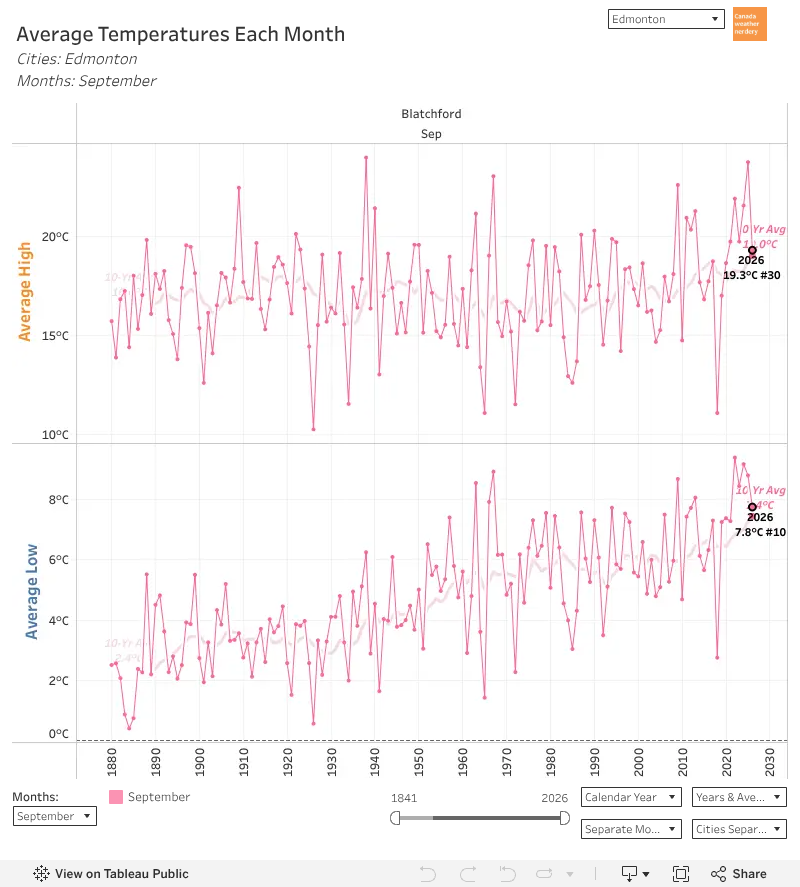
September 2026 was our coldest September since 2020. But historically that still puts it well above average. 

The average High of 19.3°C was the 30th warmest. 

The average Low of 12°C was 10th warmest. (compared to 100 years ago September's average Lows have increased by 5°C)


High Temperatures
September's Highs basically bounced around the average all month, with a few extra warm days around the 21st. The coldest High was 11.1°C on the 26th, and the warmest was 28°C on the 21st. 

Overall 16 Highs were above-average, and 14 were below.

September averages 12 20°C Highs, and 2026 got 12. 

4 of those might get to 25°C, while 2026 got 6 of them.

2022 & 2024 both had several 30°C Highs, but 2026's warmest was 28°C. 

And September averages 2 Highs below 10°C, but 2026 had none.


Warm Days So Far
We might still see some warm days in October. 

But right now 2026 has had 103 Highs reach 20°C, which is typical nowadays, but the historic average was closer to 90. 

And 38 of those got to 25°C, which is just a bit above average.


Low Temperatures
September 2026's Lows were mostly above average: 19 were above, with 11 below. 

The warmest was 14.6°C on the 2nd. The coldest was 1.4°C on the 15th. So it was another frost-free September for Blatchford.

Blatchford hasn't had a September frost since 2019. Although they used to happen every few years.


First-Frost
Blatchford's average first frost is September 30th, and Stony Plain's is September 25th. But so far they're both frost-free.

The airport & Campsie got their first frosts on the 15th & 13th, which is a little later than their averages of the 10th & 6th.


Warm & Cold Months
September 2026 gets medium orange/warms dots. 

The average High of 19.3°C was 2.4°C warmer than the 20th century average. The average Low of 7.8°C was 3.1°C warmer than the 20th century average.


The Horserace
With 3 months left in the year (and the promise of a super El Niño on the way) 2026's temperatures currently sit as Edmonton's 23rd warmest on record, at 1.48°C warmer than the 20th Century average. 

Recently 2025 & 2024 ended the year as 7th & 10th, while 2023 was 1st.


Across Canada
Across Canada September was cool in the east, and above-average everywhere else. Saskatoon's Highs were 2.8°C warmer than their 20th century average, while Moncton's were 0.8°C below theirs.


Precipitation
In September Edmonton averages 32mm of Precipitation. After the ridiculously rainy summer, September was below average. 

In 2026 Blatchford got 14.4mm, the airport got 21mm, and Stony Plain got 21.7mm.


2026 So Far
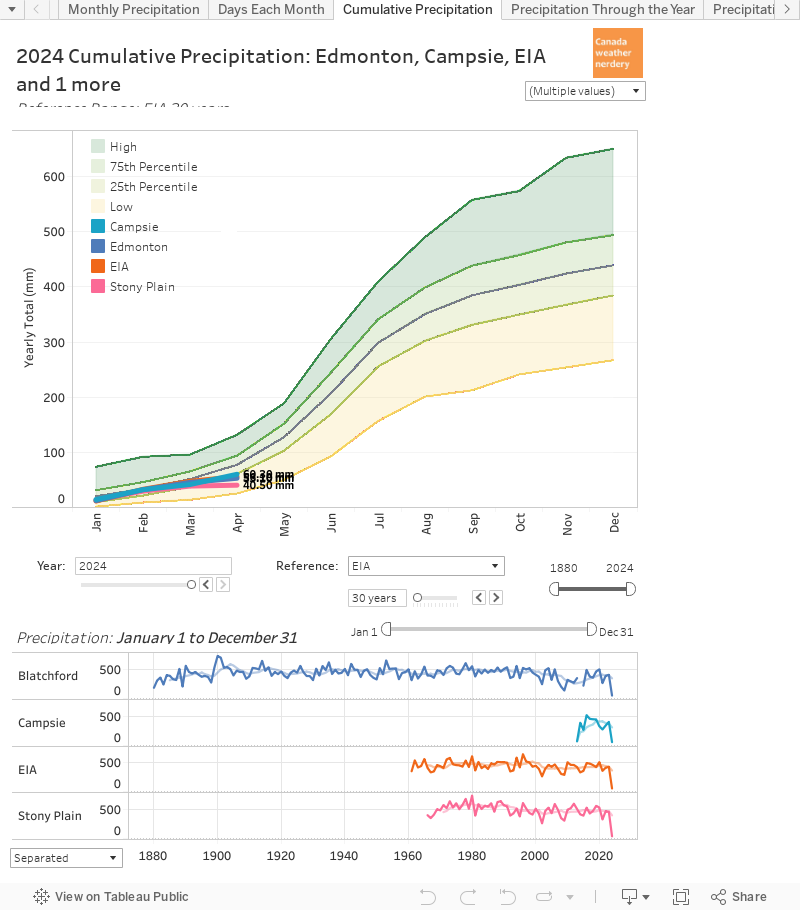
By the end of September we average around 382mm of precipitation for the year, but in 2026 the local stations are still well above average. Blatchford is up at 716.8mm, Stony Plain has 571mm, and the airport has 496mm.

716.8mm is Blatchford's 2nd rainiest year on record. It's just 8mm behind 1900's record of 724.8mm. In October we average 18mm, and before the end of the year we average 54mm.


Precipitation Across Canada
Edmonton's 717mm has it well ahead of the other prairie cities, which are all between 350-400mm. But central & eastern Canada are mostly from 800-1000mm, with Halifax close to 1100mm.

For big September storms Halifax led the way with 72.6mm on the 4th. That first week saw 40mm+ storms in Toronto, Halifax, Charlottetown (x2), St. John's, Regina & Saskatoon. Compared to that the rest of the month was pretty quiet.


October
For October, we average about 1~2 Highs of 20°C, but half of the time there are none. 

October also averages 2 Highs below 0°C, and 14 freezing Lows. 

And...we average 7cm of snow in October. Although 2021, 2022, 2024 & 2025 had none.

2026/08/31

August 2026 Review

So it's the end of August, and we finished off the summer with a pretty quiet month. Let's take our big look back at Edmonton weather for the past month.

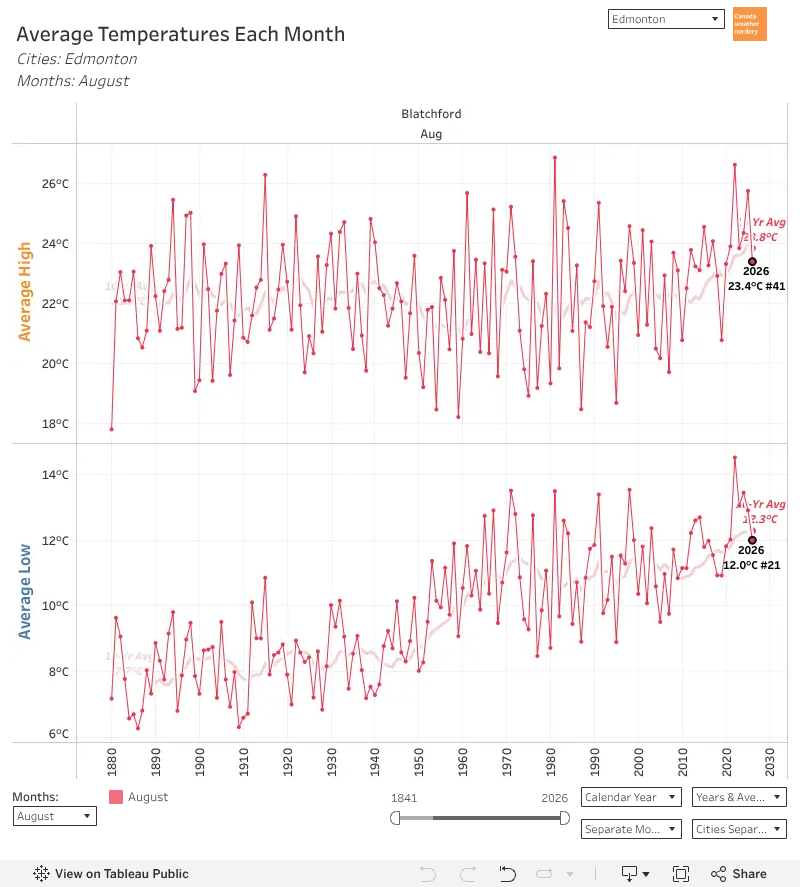
August 2026 was our coldest August since 2020, but historically that still puts it well above average. 

The average High of 23.4°C was the 41st warmest. The average Low of 12°C was 21st warmest. 

(compared to 100 years ago August's average Lows have increased by 5°C)


High Temperatures
August's Highs were a little below average early in the month, and a little above late in the month. 

The coldest High was 17.7°C on the 13th, and the warmest was 29.7°C on the 26th & 27th. Overall 16 Highs were above-average, and 15 were below.

August gets to 30°C about half of the time. 2026 got close with three 29°C days, but didn't quite make it. 

August averages 10 25°C days, and 2026 only got 7. And it averages 23 20°C days, and got 27.


Warm Days So Far
The summer of 2026 was not a scorcher.

At the end of August we've had 89 Highs reach 20°C. 32 of those got to 25°C, and 4 reached 30°C. 

Those numbers are all pretty normal for us They're down from the string of exceptionally hot summers that we had from 2021-2025.

Our 30°C season can stretch into the first week of September, with the occasional stragglers later in the month.

And our 25°C season can extend through September, with a bit of spillover into October.


Low Temperatures
For the Lows 12 were below average, mostly early in the month, and then the other 19 were above average. That included a new record for August 22nd of 16.1°C.

August Lows usually don't have much of a spread.

It averages 19 Lows between 10-15°C, and this year we got 20. 

On the warm side we had 4 above 15°C, and the cool side had 7 below 10°C. Both of those were pretty average.


Warm & Cold Months
August gets orange/warms dots smaller than anything since 2020. The average High of 23.4°C was 1.3°C warmer than the 20th century average. The average Low of 12°C was 2.4°C warmer than the 20th century average.


Across Canada
August was a little above-average across all of Canada.

Kelowna was at the top with an average High of 29.9°C, which was 3.2°C above their 20th century average. At the other end Saskatoon's 24.2°C was -0.2°C below theirs.


Summer 2026
Across the county the summer of 2026 (May-August) was top 20~30 for a lot of the country, including Edmonton.

At the top Kelowna's had its 3rd warmest, and Moncton's was 8th. At the other end Winnipeg, Ottawa & St. John's were around their top-50.


Precipitation
And now: Precipitation.

After a frankly ridiculous June & July, August was mostly back to normal. August averages 50mm.

In 2026 Blatchford got 42.7mm, the airport got 53.6mm, and Stony Plain got 63.8mm.


2026 So Far
At the end of August Blatchford has had a total of 702.4mm. By this point of the year our average is half of that at around 350mm. 

Stony Plain & the airport are well below Blatchford, but still well above average with 549.3mm & 475mm.

702.4mm is Blatchford's 2nd rainiest year on record, passing 1901's 699m, but behind 1900's 724.8mm. 

Between now and the end of the year we average another 85mm, so catching the record should be pretty likely.

Edmonton's monsoon season typically lasts from mid-May to mid-August. This year things got a little excessive in the middle of that. But by this point we should be pretty much done with our summer storms.


Precipitation Across Canada
Across the country Blatchford's 702mm is enough to put us in the middle of a bunch of cities like Toronto, Ottawa, Montréal and Charlottetown. That's a weird spot for Edmonton to be. At the top Halifax is around 900mm, while Kelowna is below 100mm.

For big August storms Ottawa, Winnipeg & Montréal each got a 30mm+ day. And there were lots more from 20-30mm. Edmonton's biggest was 20.5mm on August 2nd.


The River
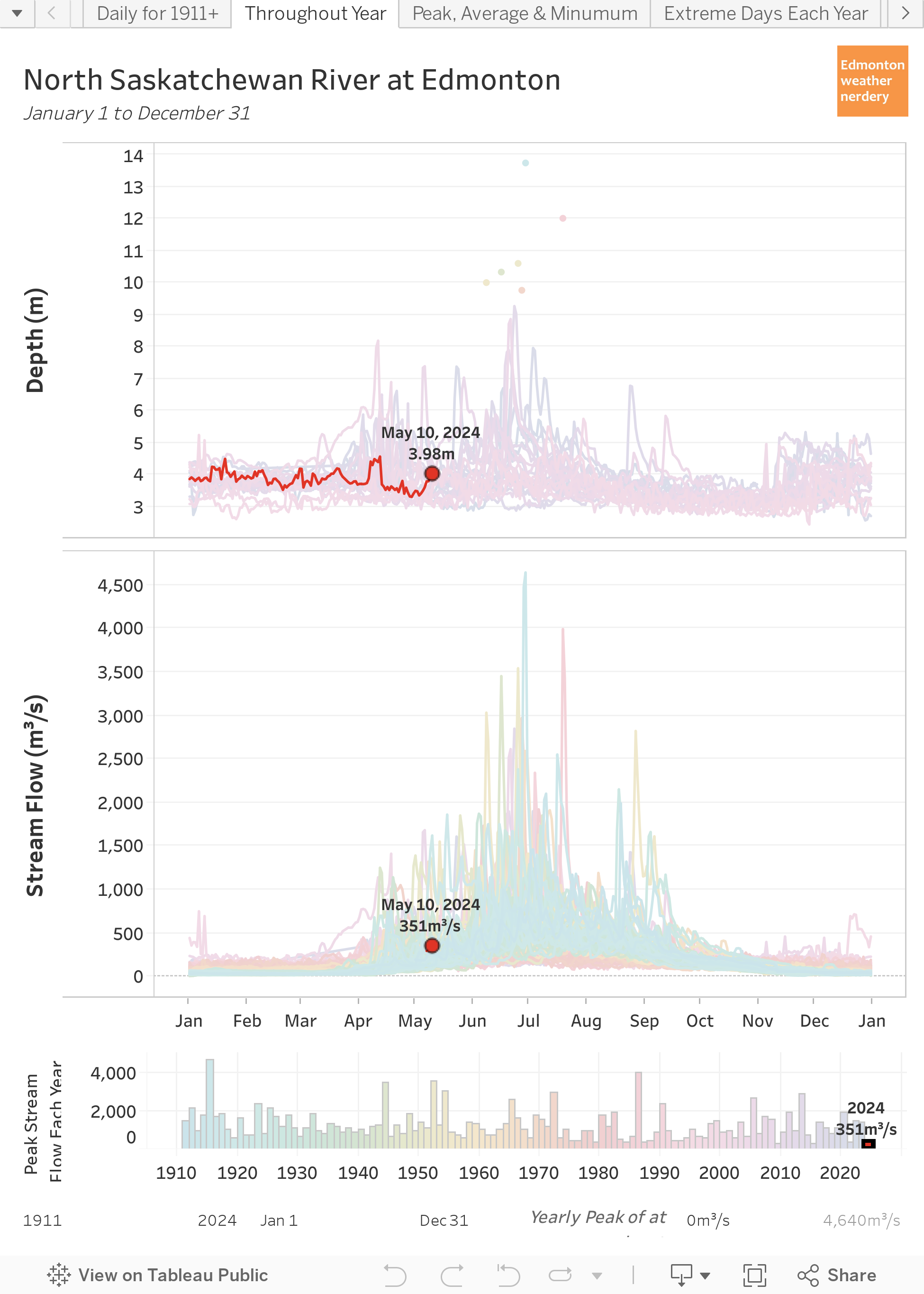
After spending most of July above 500m3/s, in August the river settled down to the more typical range of 200-300m3/s,


September
For September we average 11 days at 20°C, including 3 at 25°C. Although 2025, 2024 & 2022 all started with heatwaves.

September frost and snow can both happen. But our last September frost was 2019, and last snow was 2018.

2026/08/01

July 2026 Review

"Unprecedented" gets thrown around a lot, but let's talk about our latest unprecedented summer as we take a big look back at July 2026 Weather for Edmonton.

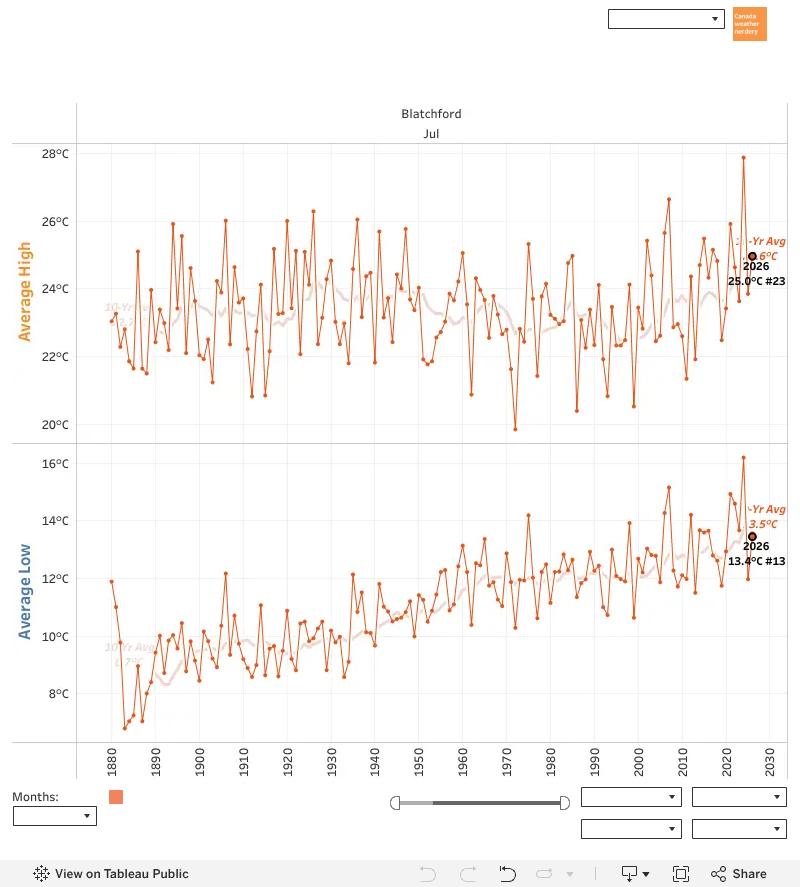
July 2026 was very rainy, but still managed to be pretty warm. 

The average High of 25°C was the 23rd warmest. That's below #1st place 2024, but above 2025, 2023 & 2022. 

The average Low of 13.4°C was 13th warmest. That's above 2025 but below 2021-2024.


High Temperatures
July's Highs were mostly right around our average of 24°C, with a few warm stretches later in the month. 

Overall 18 Highs were above-average, and 13 were below. And nothing was very extreme. The warmest was 30.7°C on the 17th, and the coldest was 20.4°C on the 5th.

On average July has 13 Highs reach 25°C, and 2026 had 14. 

July averages 2 30°C Highs, and 2026 had 2 on the 17th & 18th. 

July also averages 5 Highs below 20°C, and 2026 had 0 of those cooler days. That's only happened 3 times before, in 1936,1920 & 1881.


June & July
Comparing June & July, they were both ridiculously rainy. But July ended up being pretty warm, while June was fairly cool.


Warm Days So Far
At the end of July we've had 4 Highs get to 30°C. That doesn't compare with 2024 (11) or 2021 (13), but it's more than a lot of years. 

And we've had 25 Highs get to 25°C, which is pretty typical. Some big years were 2023 (41), 2021 (36) & 2018 (42).


Low Temperatures
For Low temperatures July 2026 had 21 above-average and 10 below. 

They ranged from 8.1°C on the 6th to 17.8°C on the 17th. A few of those could have been higher, but got knocked down by evening storms.

July Lows usually don't have much of a spread. 

We average 3 below 10°C, and 2026 had 2. 

And we average 7 above 15°C, and 2026 had 7.


Warm & Cold Months
July gets orange/warms dots. It's not as warm as 2024, but was warmer than a lot of years. 

The average High of 25°C was 1.7°C warmer than the 20th century average.

The average Low of 13.4°C was 2.4°C warmer than the 20th century average.


Across Canada
July was above-average across most of Canada, with just the west coast and Dawson City on the cool side. 

Kelowna was at the top with an average High of 31.7°C that was 4.1°C above their 20th century average. 

At the other end Dawson City's 21.3°C was -1.3°C below theirs.


Precipitation
And now the unprecedented part: Precipitation!

July is usually our rainiest month, averaging 90mm.

In 2026 Blatchford almost tripled that, with 267.4mm.

 Meanwhile, the neighbouring stations were way below, with Stony Plain at 110.9mm, and the airport at 107.2mm.

Why the huge difference between stations? 

In June things were close, but in July multiple storms hit Blatchford straight-on, and glanced off the outlying stations. 

Blatchford had 7 20mm+ days. Villeneuve & Elk Island had 2, and the aiport & Stony Plain only had 1.

The stations are usually close over a whole year, although sometimes there are gaps. 

In 2017 the airport was 115mm above Blatchford. 

In 1980 Stony Plain was 179mm above Blatchford. 

For 2026 Blatchford is 174mm over Stony Plain, and 238mm over the airport.

So July's 267.4mm ends up as Blatchford's 3rd rainiest month on record. 

The only months with more were:
  • last month's 269.1mm (1.7mm more)
  • July 1901's 282.7mm (15.3mm more)

July 1901's monthly record remains unbroken. But June+July 2026 dropped 536.5mm, which is...unprecedented. 

The previous record was 1901's 359mm (178mm less). And the average is 160mm, so 2026 was 3.3x that.

We've only ever had 3 months get to 250mm: July 1901, and June & July 2026. 

And only 4 more have reached 200mm: July 2012 (Stony Plain), July 1982 (airport), July 1937 & June 1914.

So it's a lot of rain, and we got two of them in a row.


2026 So Far
At the end of July we've had a total of 659.7mm. That is the 3rd highest year on record, with 5 months to go.

The only years with more were 1901's 699mm, and 1900's 724mm. 

In August we average another 50mm, which would move us very close to the record.


Storms
This year Blatchford has had 12 days with 20mm or more. The previous record was 7. 

8 of those got to 30mm, when the previous record was 6 (and 3 is a lot). 

And 4 of those got to 40mm, when the previous record was 2. 

So the flooding is not a surprise.

Our monsoon season usually stretches from mid-May to mid-August, so we've still got a few weeks left.

June & July both average around 15 days with rain. In 2026 Blatchford got 19 & 17 respectively. Things start to taper off in August, with it averaging 12 days.


Precipitation Across Canada
Blatchford's 659.7mm is enough to take 4th place among these Canadian cities. That last time that happened was never.

Charlottetown is a bit ahead with 673mm, while Halifax & St. John's are near 800mm.

Calgary is down at 241mm, after getting only 17mm in July.

For big July storms it's Edmonton, and then everyone else. 

We got 5 30mm+ days, while Ottawa got 2, and a few other cities had 1. Edmonton's 268mm was 105mm more than 2nd place Ottawa's 163mm. 

And for June+July Edmonton's 537mm was 250mm more than Ottawa's 287mm.

So who else gets 250mm+ months? 

They're fairly common in Vancouver & St. John's. Victoria, Halifax and Moncton have gotten quite a few as well. And Winnipeg got one in 1901 (like Edmonton), while Ottawa & Montreal got one in 1899.

One notable difference with Vancouver's 250mm months is that they're all in the winter - usually November through January.

But even in Vancouver it's unusual to get 2 in-a-row. The last time that happened was November & December 1988.

350mm+ months are pretty rare:
  • Halifax (3, most recently August 1971)
  • St. John's (December 1909)
  • Vancouver (8, most recently November 2006)
  • Victoria (November 1990)
Vancouver's 525mm in January 1935 is the big winner.


The River
Even with all of July's rain, the river is now back around 320m3/s, which is pretty typical. 

It started July at 1,300m3/s, which is a lot, but not as high as 2020's 1900m3/s. And then it spent a few weeks in the 500-600m3/s range.


August
For August on average we have 25 Highs which reach 20°C, including ~10 above 25°C. 

About half of the time August hits 30°C. 

Most Lows are 10~15°C, but half of the time August will have a night below 5°C. 

And August is our 3rd rainiest month averaging 52mm.