
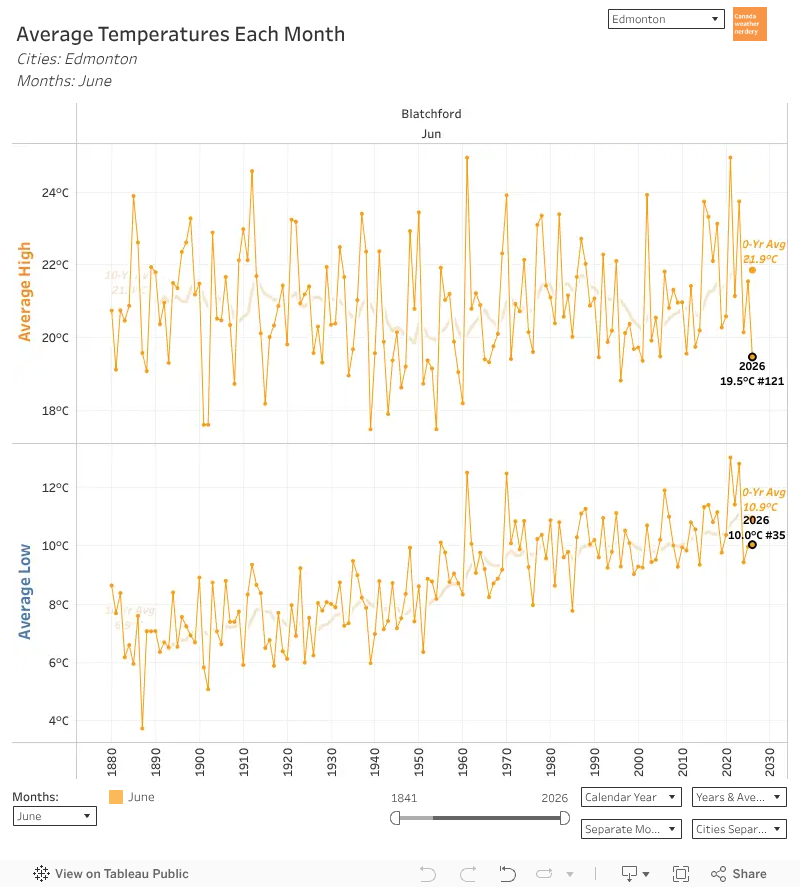
The average High of 19.5°C was the 122nd warmest out of 147. That's around the same as 2013 & 2011.
On the other hand, the average Low of 10°C was actually 35th warmest.
High Temperatures June's Highs ranged from 10°C on the 1st to 25.9°C on the 14th.
12 Highs were above average. and 18 were below average. The 1st & 2nd were the coldest in 30+ years.
June's Highs ranged from 10°C on the 1st to 25.9°C on the 14th.
12 Highs were above average. and 18 were below average. The 1st & 2nd were the coldest in 30+ years.
 June averages 18 Highs above 20°C, and 2026 only had 15.
High Temperatures
And on average 5 of those get to 25°C, and 2026 got 5.
It's a little weird that the Highs made this a bottom-25 year, because it was honestly pretty unremarkable.
Low Temperatures For Low temperatures June 2026 had 10 above the 30-year average (which is still much higher than the long-term average), and 20 below.
They ranged from 6.6°C on the 23rd to 15.1°C on the 25th.
For Low temperatures June 2026 had 10 above the 30-year average (which is still much higher than the long-term average), and 20 below.
They ranged from 6.6°C on the 23rd to 15.1°C on the 25th.
 June Lows usually don't have much of a spread.
We average 2 above 15°C, and 2026 had 3 (2023 had 12).
And about half of the time we will get a Low below 5°C, but 2026 had none (2024 had 4).
June Lows usually don't have much of a spread.
We average 2 above 15°C, and 2026 had 3 (2023 had 12).
And about half of the time we will get a Low below 5°C, but 2026 had none (2024 had 4).
Warm & Cold Months June's Highs get a blue dot. The average of 19.5°C was -1.3°C cooler than the 20th century average, and close to 2013 & 2011.
Low Temperatures
Warm & Cold Months
The Lows are a pretty typical orange. 10°C is 1.4°C warmer than the 20th century average.
The Horserace Halfway through 2026 and our average temperature is the 29th warmest on record, and 0.92°C above the 20th century average.
The Horserace
Almost all of that was due to our January & February heatwaves. Since then we've mostly been pretty average.
Across Canada Across the country June was a little cool on the prairies, and a little warm everywhere else.
Across Canada
The Highs ranged from 2°C above the 20th century average in Victoria, to -1.3°C below in Edmonton & Calgary.
 For the year so far Kelowna Highs have been its 3rd warmest, Victoria is 9th, and Vancouver is 14th.
For everyone else the first half of 2026 has ranged from top-25 to top-70.
Precipitation And now...precipitation!
Precipitation
June is usually our 2nd rainiest month, averaging 78mm.
But wow, June 2026 really showed off.
Blatchford ended up with 269.1mm, Stony Plain got 256.3mm, and the airport got 222.5mm.
 Our record for June had been 216.5mm, from 1914.
But 2026 blew that away.
Our record for June had been 216.5mm, from 1914.
But 2026 blew that away.
And our rainiest month ever recorded was 282.5mm, in July 1901.
In the end 2026 missed that record by just 13.6mm.
But it sits comfortably as our 2nd rainiest month on record.
 June and July average around 15 days with rain.
June 2026 got 20 rainy days at Stony Plain, 19 at Blatchford, and 18 at the airport.
June and July average around 15 days with rain.
June 2026 got 20 rainy days at Stony Plain, 19 at Blatchford, and 18 at the airport.
 By the end of June we average around 208mm of precipitation for the year.
The rainy June pushed Blatchford to 392mm, Stony Plain to 375mm, and the airport to 314mm.
In a full year we get around 430mm of precipitation, and June 2026 just delivered 2/3 of that.
 This is our peak storm season, and we got several 30mm+ days.
The largest were June 21st with 73.3mm at Stony Plain and 63.8mm at Blatchford.
The airport had an underachieving 45.9mm.
This is our peak storm season, and we got several 30mm+ days.
The largest were June 21st with 73.3mm at Stony Plain and 63.8mm at Blatchford.
The airport had an underachieving 45.9mm.
 Blatchford's 63.8mm was its 11th rainiest day on record.
For Stony Plain's 73.3mm day, it had only ever had 7 days that big, the airport has had 1 (in 1990), and Blatchford has had 5 (most recently in 1990).
 Blatchford got 105.7mm over the 3 days from June 20-22. That's only the 6th time that has happened at Blatchford.
And Stony Plain's 2-day total for June 20-21 was 123.2mm. That's only happened twice before, in 1953 & 1937 at Blatchford.
 Edmonton's 380mm of total precipitation might feel impressive, but at the end of June Halifax & St. John's are both over 700mm.
And while we had a record-breaking June, in Calgary their 104mm was just a bit above average.
Edmonton's 380mm of total precipitation might feel impressive, but at the end of June Halifax & St. John's are both over 700mm.
And while we had a record-breaking June, in Calgary their 104mm was just a bit above average.
 For big storms it's not often that we see Edmonton leading the pack, but here we are.
Our 63.8mm was ahead of Regina's 57.5mm.
And our monthly total was more than 100mm ahead of anyone else.
The River With all the rain the river saw 2 nice little bumps up to around 6.5m & 1,300m3/s.
The River
That's a fairly typical summer peak, similar to 2024 & 2023.
2020 got to 8m & 1,900m3/s, and 2013 (Calgary's flood year) got to 9.2m & 2,850m3/s.
July For July, the average High is about 23.5°C. Around 25 days reach 20°C, including about 10 at 25°C.
Most Julys will get at least one 30°C day, but recently 2020, 2019 and 2016 didn't.
July is also usually (usually) our rainiest month, with an average of 90mm.
For July, the average High is about 23.5°C. Around 25 days reach 20°C, including about 10 at 25°C.
Most Julys will get at least one 30°C day, but recently 2020, 2019 and 2016 didn't.
July is also usually (usually) our rainiest month, with an average of 90mm.
July
