Here's a quick look at the recent history of weather in Edmonton for the Labour Day long weekend.
The average High for the Labour Day long weekend is around 19°C and the Low is 8°C.
The 2021 long weekend was pretty warm, with Friday as the coldest day with a High of 22.1°C. Saturday and Sunday both reached 25°C, with Highs of 25.1°C and 25.2°C respectively. And then the holiday Monday reached 22.5°C. The Lows ranged from a chilly 4.6°C on the Friday to a very warm 12.6°C on the Monday.
In 2020 we had a warm Friday (24.1°C) and Saturday (23°C), followed by a cool Sunday (14.6°C) and Monday (13.3°C).
Some recent hot Labour Day weekends which reached 25°C were 2017, 2013, 2011, 2006, 1996, 1995 & 1991. And years with Highs below 10°C were 2015, 2000 & 1992.
For Lows, the only frost shown here was September 7th, 1992.
Usually there will be some precipitation on at least one of the days. Since 1990 the years with no green bars were 2014, 2008, 2006, 1999, 1998, 1995, 1993 and 1991. The years which had precipitation can range from a 1mm day in 2020, to a 25mm day in 2015.
Labour Day Weekends Overall
This chart is a little busier, but it has the average temperatures and total precipitation for each Labour Day weekend, going back to 1880 (Labour Day didn't officially become a holiday in Canada until 1894. I'm not sure when it was recognized in Alberta).
2021's average High for the weekend was 23.7°C was pretty warm, although in recent years 2013 (24.4°C), 2006 (26.4°C) and 1995 (24.3°C) were all warmer. And the average Low of 8.6°C was really close to average.
The warmest Labour Day weekend on record was 1988 with a 4-day average High of 29.3°C.
The coldest Labour Day weekend for Highs was 1896, with a 4-day average of 6.9°C. The coldest for Lows was one year earlier in 1895 with an average Low of -5°C.
The average temperatures for the August long weekend in Edmonton are a High of 23.9°C, and a Low of 13.9°C.
In 2021 the Friday, Saturday & Sunday were all really warm at 29.4°, 31.3°C & 29.3°C. And then on the Monday the smoke really rolled-in, and the High only reached 21°C. The average High for all 4 days was 27.8°C, which still made it one of the warmest recent August long weekends, along with 2020 & 2003.
The Lows were all between 16.9°C and 18°C, which is warm, but not as warm as 2020's which ranged from 17.9°C to 18.9°C.
And there was no rain recorded at the Blatchford station, which is the story of this summer so far.
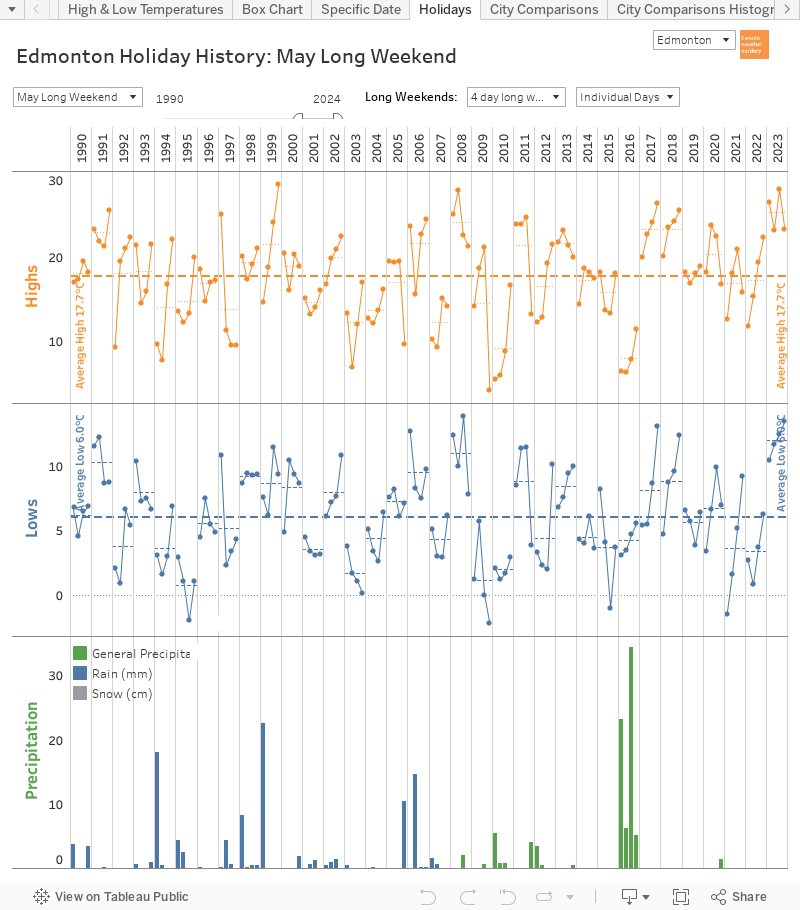
We have a brand-new holiday-centric dashboard to play with, so let's take a look at Victoria Day weather for 2021.
The Victoria Day long weekend is infamous for having unpredictable and often crummy weather. On the right side of the chart we have 2021, and it had a bit of that, with a cool Friday and Monday, but a fairly warm Saturday and Sunday.
Highs:
Our average High for the May long weekend is around 17°C. This year Saturday hit 18.1°C and Sunday made it all the way to 20.9°C, while Friday was down at 12.6°C and Monday was 15.8°C.
In recent years the Victoria Day long weekends in 2017, 2018 & 2020 were all pretty summer-y with some days up around 24°C or 26°C. And 2019 wasn't cold; it just wasn't hot with Highs between 17°C and 19°C.
And so the last really cold Victoria Day long weekend that we had was 2016 with the Friday-Sunday all having Highs below 8°C, and the holiday Monday reaching a scorching 11.4°C.
Lows:
The average Low for Victoria Day is around 6°C, and this year Friday-Sunday were all below that, while Monday's Low reached up to 10.3°C. The Low of -1.5°C on Friday joins 2015 and 2009 as the only recent Victoria Day long weekends to have a frost.
Precipitation:
Looking at the green bars for Precipitation the 2016 long weekend really stands out with a total of 68mm. May's average Precipitation is 52mm, so that was more than a month's worth over 4 days.
In comparison 2021 was pretty (or really) dry. Blatchford recorded 0mm of Precipitation, even though Monday was actually a little bit rainy. On Monday the International recorded 5mm and Stony Plain had 1mm.
Calgary
Just for comparison, the 2021 Victoria Day long weekend in Calgary was a pretty rainy and chilly one. Saturday was the warmest day with a High of 13.8°C, and Sunday and Monday had a total Precipitation of 16.7mm.
Winnipeg and Regina were also cool and rainy this weekend, while Toronto, Ottawa and Montreal all started off with Highs above 30°C on the Friday.
How did the weather for the 2019 Thanksgiving Long Weekend compare to recent years?
Temperatures
Thanksgiving 2019 was a late Thanksgiving, and it wasn't really cold, but it wasn't warm either.
Saturday's High of 11.9°C was above the Thanksgiving average of 11°C, and Friday also broke 10°C at 10.3°C. Things cooled off from Saturday & Sunday at 7.2°C & 4.4°C respectively.
In recent years:
Thanksgiving Monday in 2018 was below freezing at -1.8°C
2017 had two days above 15°C
2016's Highs were all below 3°C
2015 was a "hot" thanksgiving with one High at 26°C and another at 21°C
Precipitation
It was a fairly rainy Thanksgiving weekend, with the International getting 2.7mm on the Sunday and 3.6mm on the Monday. And Blatchford (not shown) was double that with 6.4mm of precipitation on the Sunday and 6.9mm on the Monday.
This year the International also recorded "trace" amounts of snow, but not enough to count as a measurement. Thanksgivings 2016-2018 were all snowier than that, with 2016 & 2018 getting a lot, and 2017 a little.
For 2015-2019 we've now had 5 Thanksgivings in-a-row with precipitation. And just before that from 2010-2014 we had 5 in-a-row without any.
Do we really want to talk about Labour Day Long Weekend weather? I guess that we might as well...
Temperatures
The average High temperature for the Labour Day weekend is actually only 19.4°C, so I guess that we shouldn't be too shocked to have sub-20°C days?
In 2018 the smokey August was just ending, and the Friday reached 20.4°C, but the Highs for the rest of the weekend were between 15-18°C.
2017 was a warm Labour Day weekend, with the Saturday at 25.5°C, and the Friday and Monday both above 20°C.
And for the three years from 2014-2016 there wasn't a single High above 20°C, although 2014 came close. 2015 & 2016 both reached scorching Highs of 16.4°C
The warmest recent Labour Day weekend was 2013 with two days hitting 25°C, and the coldest was 2000 with no Highs hitting 15°C.
Precipitation (the title of this chart is wrong)
And precipitation is fairly typical.
2018 had rain on the Friday, Saturday & Monday.
2017 had rain on the Saturday & Sunday.
2016 had rain on the Friday, and the International even recorded a bit of snow on the Saturday.
2015 had rain on all four days for a total of 34mm.
Going back to 1995 the only Labour Day weekends with no precipitation were 1995, 1998, 1999, 2006 and 2010.
Updated for 2019:
And so Labour Day 2019 ended up with one day above 20°C, with the holiday Monday hitting 21°C. The Friday High was down at 13.7°C, which is cool, but 2015 & 2016 had much cooler days. And the Saturday and Sunday were just above 15°C. So across the weekend the temperatures were pretty close 2018, well below 2017, but above 2015& 2016.
For temperatures the International recorded rain on all 4 days, with Saturday having the most at 6.1mm. For Blatchford (which isn't shown here) the Friday had the most precipitation with 5.3mm.
Here's a quick look at the history of Canada Day weather in Edmonton.
Temperatures
Canada Day for 2013-2017 were all quite warm, with Highs between 25°C and 29°C. Last year 2018 was a little cooler though, with a High of only 19.8°C.
The warmest Canada Day was 1924 with a High of 35.6°C. The coldest High was 1912 at only 11.7°C, and the coldest Low was 1919 at 2.8°C.
Over the last century the average High for July 1st has stayed fairly consistent at around 22°C, but the average Low has increased from 9°C to 12°C.
Precipitation
We get at least some rain on Canada about half of the time.
Recently 2012 was a pretty big year with 14mm at Blatchford and 7mm at the International. And 2015-2018 all had a little rain at both stations, ranging from 0.2mm to 2.2mm.
Blatchford's rainiest Canada Day was 1998 with 30.2mm, and the International's was 1973 with 25.4mm.
We will be back with an update once the 2019 numbers are in the books.
Updated for 2019
And so Canada Day 2019 comes in just a bit cooler than 2018, with a High of only 18.6°C, which makes it Edmonton's 16th coldest Canada Day since 1880.
And that actually overstates things, because the temperatures peaked at around 8AM, and then started stopping:
By 11PM it was down to about 8°C, which did probably make this one of Edmonton's coldest Canada Day fireworks shows.
It was a fairly rainy and gloomy day, and Blatchford and the Airport received 6.4mm and 5.2mm of rain respectively. That's a reasonably amount of rain, but it doesn't compare to some of the giant thunderstorms from previous years.
The Victoria Day Long Weekend (or May Long Weekend) has a pretty bad reputation for weather, but is that justified? Let's take a look:
Temperatures
The last two Victoria Day weekends - 2017 & 2018 - were both very warm, with Highs above 20°C, and each with a day above 25°C.
The 2016 weekend was not warm, with Highs down around 5-10°C. That was the coldest Victoria Day weekend since 1995, and the warmest was 2008.
Generally though, the average High is 16.6°C, and the average Low is 5.7°C. And Lows below freezing are fairly rare, with 1995, 2009 & 2015 each having one.
Precipitation
One of the reasons the Victoria Day 2016 wasn't warm was because it was very rainy, with a total of 80.6mm of rain at the International. We talked about that in 2016 May Long Weekend Post-Mortem. And since 1995 both 2009 and 2010 recorded a bit of snow.
We've done these write-ups for Victoria Day a few times now, and
It's rarely above 25°C (5 times since 1995, including 2017 & 2018)
It's rarely below 0°C (3 times since 1995, most recently in 2015)
It's above 20°C less than half of the time
75% of the time there's at least one genuinely rainy day, and 85% of the time there's at least a little rain.
We'll be back in a few days with an update once the weekend is over.
Update with 2019 Numbers:
The May long weekend 2019 had 4 days with Highs between 16-19°C, and Lows between 3-7°C. And that put the temperatures right on the average.
And it was another May long weekend with no precipitation at the Edmonton International (or at Blatchford).
Today we are going to take a look back at the weather history for recent Easter long weekends in Edmonton.
Aujourd'hui nous allons parler de la météo recent pour le long week-end de Pâques à Edmonton.
Hoy vamos a hablar sobre el clima reciente para el fin de semana largo de Pascua en Edmonton.
Temperatures
Here are the High and Low temperatures for each Easter long weekend, going back to 1995.
Easter is a little strange, because it moves around a lot. Since 1995 the earliest that Easter fell was March 21-24 in 2008, and the latest was April 22-25 in 2011. For Edmonton weather, the difference between late-March and late-April can be the difference between full-on winter and genuine spring. Because Easter moves around so much it's tough to talk about a "typical" Easter, but since 1995 the average High has been 9°C and the average Low has been -2°C.
The coldest recent Easter was last year in 2018. Its Lows were way down at -15.2°C, -20°C, -18°C & -17.7°C across the four days, and its Highs were also well below average ranging from -10°C up to -2°C. Since 1995 only 4 Easters had any Highs below freezing: 2002 had 3 days, 2006 had a single -0.5°C, 2017 had a single -0.2°C, and then 2018 had all 4 days. Both 2002 & 2018 were early Easters, falling right at the end of March.
The warmest recent Easter was 2000 with 2 days above 20°C. 2003 was also warm with the Sunday reaching 19.4°C and the Monday at 22.8°C. Both of those Easters were pretty late, falling on April 21-24 & April 18-21, which is about the same time as Easter 2019.
As for the Easter of 2019, it ended up being quite warm, with all 4 Highs above 10°C which recently happened in 1996, 2000, 2004 & 2010. And Easter Sunday hit 15.8°C, while Easter Monday was all the way up at 21.5°C.
Voici les temperatures maximales et minimales pour les week-ends de Pâques depuis 1995. Il est difficile de parler d'un week-end de Pâques typique parce que la date de Pâques peut se situer entre la fin mars et la fin avril. À Edmonton le temps change vraiment pendant cette période, donc dans une année Pâques peut ressembler à l'hiver alors que la suivante est presque l’été. Cela dit, depuis 1995 à Pâques la température maximale moyenne est de 9°C et la température minimale moyenne est de -2°C. Récemment le week-end de Pâques le plus froid a été l'an dernier en 2018. Les températures minimales étaient entre -20°C et -15°C pendant les quatre jours, et les températures maximales étaient entre -10°C et -2°C. Depuis 1995 il n'y a eu que 4 week-ends de Pâques avec des températures maximales inférieurs à 0°C: en 2002 il y'en a eu 3, 2006 & 2017 en ont eu chacun un, et 2018 en a eu 4. En 2002 et 2018 les week-ends de Pâques étaient à la fin mars, ce qui est un peu tôt. Ces dernières années le week-end de Pâques le plus chaud a été en 2000 qui avait 2 températures maximales au-dessus de 20°C, et en 2003 il y'en a eu un, et aussi un deuxième à 19,4°C. Les deux étaient après la mi-avril, ce qui est semblable à cette année. Et pour Pâques 2019 il faisait assez chaud, avec tous les 4 jours au-dessus de 10°C, ce qui est également passé en 1996, 2000, 2004 et 2010. Cela a inclus le dimanche qui a atteint 15°C et le lundi à 21.5°C.
Aquí están las temperaturas maximales y minimales para los fines de semanas de Pascua desde 1995. La fecha de la Pascua cambia, y puede ser a finales de marzo o a finales de abril. Durante ese mes las temperaturas en Edmonton pueden cambiar mucho, así que una Pascua puede parecer invierno mientras que la siguiente es casi verano. Por eso es difícil hablar de una Pascua típico. Dicho esto, la temperatura máxima promedio es de 9°C y la mínima promedio es de -2°C. Desde 1995 la Pascua la más fría fue el año pasado en 2018. Hacía mucho frío, con temperaturas mínimas entre -20°C y -15°C durante los cuatro días, y temperaturas maximas entre -10°C et -2°C. Recientemente sólo hubo 4 fines de semana de Pascua con temperaturas inferiores a 0°C: 2002 tuvo 3 días, 2006 y 2017 cada uno tuvieron uno, y luego 2018 tuvo los 4 días. La Pascua reciente la más cálida fue en 2000, con dos días por encima de 20°C. 2003 también fue bastante cálido, con el domingo a 19.4°C y el lunes a 22.8°C. Durante la Pascua de 2019 hacía bastante calor, con cada 4 días por encima de los 10°C, que recientemente ocurrieron en 1996, 2000, 2004 y 2010. El domingo alcanzó los 15,8°C y el lunes los 21,5°C.
It is good to remember that Highs of 20°C are not impossible in April. In the last 20 years 75% of Aprils have had at least one day which reached 20°C.
On doit se souvenir que des températures maximales de 20°C ne sont pas impossibles en avril. En fait, ils sont presque attendus car 75% du temps d’avril en aura au moins un.
Las temperaturas cálidas en abril no son imposibles. De hecho, el 75% de las veces haya al menos una temperatura máxima de 20°C en abril.
Precipitation
Here we have the recent history of Easter Rain or Snow at the International Airport. And 2017 really stands out, with a total of 21cm on the Friday & Saturday. 2014 was also fairly snowy with 6cm, and 2002 had 6.8cm over 3 days. Last year 2018's very cold Easter had one day with 1.4cm of snow.
For rain 2009 was notable with a total of 6.3mm across all 4 days, plus 1cm of snow. 2003 also had one day with 4mm of rain an 2cm of snow; and 2006 had a day with 2.4mm of rain and 0.4cm of snow.
Voici les précipitation (neige ou pluie) à l'aéroport depuis 1995 durant le week-end de Pâques. En 2017 il y avait beaucoup de neige, avec un total de 21cm le vendredi et le samedi. 2014 & 2002 ont eu chacun plus de 6cm. Et le week-end de Pâques tres froid de 2018 a eu un jour de neige avec 1.4cm.
2009 a été le week-end de Pâques le plus pluvieux de ces derniers années avec un total de 6.3mm sur les 4 jours, et 1cm de neige aussi. Et 2003 a eu une journée avec 4mm de pluie et 2006 a eu une journée avec 2.4mm.
Aquí tenemos la historia reciente de las precipitaciones (lluvia o nieve) de Pascua. En 2017 hubo mucho, con 21cm de nieve el viernes y el sábado. 2014 también fue bastante nevado con 6cm, y 2002 tuvo 6,8cm en 3 días. La muy fría Pascua del año pasado tuvo un día con 1,4cm de nieve.
En cuanto a la lluvia, 2009 fue notable con un total de 6,3mm en los 4 días, y también 1,4cm de nieve. 2003 también tuvo un día con 4mm de lluvia y 2cm de nieve, y 2006 tuvo un día con 2,4mm de lluvia y 0.4mm de nieve.
Easter 2019: warm, and dry.
Enfin, Pâques de 2019: presque chaud, et sec.
Por último, la Pascua de 2019: casi cálida, y seca.
Today we are looking at the history of weather for the Family Day long weekend.
Temperatures
Family Day was introduced in Alberta in 1990, and a holiday in mid-February in Alberta maybe doesn't seem like such a great idea? But generally the temperatures have been fairly warm, with an average High of -2.2°C and an average Low of -11.3°C.
2018 was fairly cold, with Highs around -10°C and the Lows closer to -20°C. And 2019 will probably be a bit colder than that. But the 5 Family Days from 2012-2017 all had Highs around or above freezing.
2016 was the warmest-overall Family Day weekend with all three days between 5-7°C. The coldest-overall was back in 1994, and it is the only Family Day weekend that was a complete deepfreeze, with all three Highs down around the -20°C mark. For the very first Family Day in 1990 the temperature swung from a low of -31.2°C on the Saturday up to a balmy high of 2.6°C for the holiday Monday.
Precipitation
For precipitation it is no surprise that snow happens a lot more often on the Family Day long weekend than rain does. But the day here with the most precipitation was February 14, 2015 (the Saturday of that long weekend) with 7.4mm of rain.
In 2018 there was no precipitation, and 2017 had a mix of rain and snow.
Snow on the Ground
And finally, this chart shows how the snowdepth at the International Airport changes from February 14-21, which is the week in which Family Day moves around.
The average is about 20cm, and this year we are high at 33cm. Last year was also a bit high at 25cm. And during the really warm week in 2017 the snowdepth fell from about 12cm down to 2cm.
Updated for 2019:
Family Day Weekend 2019: the coldest since 2011, and much colder than 2012-2017.
Today we are taking a break from all of the talk of deepfreezes to take a quick look at the history of Valentine's Day weather in Edmonton.
Temperatures
In recent years our average high on February 14th has been -3°C, and the average low -11°C.
Last year's Low was pretty chilly at -18.1°C, but the High was up at 2.8°C. And 2017 was almost record-breaking, with a High of 10.3°C and a Low of -1.4°C.
Right now the record temperatures for Valentine's Day were all set a long time ago. The warmest High was 10.6°C back in 1907, and the warmest Low was 2.8°C in 1913. The coldest High was -40.6°C in 1904, and the coldest High was -30°C in 1936.
This Valentine's Day will probably not be warm. We haven't had a super-cold Valentine's Day in a long time though - 2007 was chilly with a low of -22.4°C, but a reasonably nice high of -7.4°C. For a true deepfreeze you have to go all the way back to 1979 with a high of -24.1°C and a low of -35.1°C.
Precipitation
In recent years the most notable Valentine's Day precipitation was 2015 with 7.4mm of Rain.
Typically though, Valentine's Day precipitation comes in the form of snow. Blatchford's snowiest Valentine's Day was 1921 with 19.1cm of snow, but in recent decades the snowiest days have been around 2cm.
Snow on the Ground
The average snowdepth at the Airport for this time of year is about 20cm. Last year it was a little high at 25cm, and in 2017 & 2018 it was a little low at around 12cm. This year we are on the high side again at 33cm.
Updated for 2019
If you had guessed that this was going to be a cold Valentine's Day, you were right! It was the coldest one since 1979. And in 2019 there wasn't any precipitation.
In previous years we have split Christmas and New Year's into two separate posts, but this year we're going to combine them, since they are only a week apart and it's interesting to compare the similarities and the differences.
Christmas Day Temperatures
Here we have the High & Low temperatures for Christmas Day, recorded at Blatchford.
2017 was very cold, with a High of -19.3°C and a Low of -26.7°C. That's still much warmer than the coldest recorded Christmases, with the coldest High in 1917 at -28.9°C and the coldest Low way back in 1880 at -39.4°C.
Recently things have been some warm years like 2005 & 2011 with Highs above 6°C; and from 2001 through 2007 all 7 of those Christmas Days had a High above freezing. But there have also been some cold Christmases, like 2008, 2012, & 2017 with Lows down around -25°C; and 2015 & 2016 were also both cool~ish with Highs of -12.9°C and -14.4°C, and Lows of -20.1°C and -22.9°C respectively.
Looking at the lines for the 30-Year averages, right now the average High for Christmas Day is about -4°C and the average Low is -13°C. For 1880-1910 the average High was -7°C with an average Low of -16°C, and the averages were actually lowest around 1940 (covering the period from 1910-1940) with Highs of -11°C and Lows of -18°C.
New Year's Eve Temperatures
New Year's Eve 2017 was also very cold, with a High of -22.6°C and a Low of -28.2°C. That was part of the weeklong cold snap which started on Christmas Eve.
New Year's is only a week after Christmas, but the average temperatures are quite a bit lower: an average High of -4°C for Christmas compared to -8°C for New Year's; and an average Low of -13°C for Christmas compared to -16°C for New Year's.
New Year's Eves for 2014, 2015, & 2016 were all fairly warm though, with Highs of 3°C, 2.5°C, & -1.5°C respectively, and Lows of -3.6°C, -14.4°C, & -9.7°C.
One of the important things about New Year's Eve is always hoping not to freeze at -20°C or -25°C while waiting for the fireworks in Churchill (or at any other outdoor activity). The City cancelled the outdoor activities in 2017 because it was so cold, and in the last decade other cool New Year's Eves were 2008, 2009, 2010, & 2013 all with Lows below -22°C.
New Year's Day Temperatures
Average temperatures for New Year's Day are pretty close to New Year's Eve, with the Highs at -8°C and the Lows at -16°C.
New Year's Day 2017 was the end of the weeklong deepfreeze, with a Low way down at -27.6°C, but then a High of -7.8°C. And then January 2nd hit 3.2°C.
Christmas Eve & Christmas Day Precipitation
For a holiday like Christmas I think it makes sense to combine the snowfall on Christmas Eve and Christmas Day, so here we have the Snowfall (or Rainfall) for December 24 & 25, for Blatchford and the International.
Blatchford's snowiest Christmas was 1938 with 27.4cm of snow, and the International's was 1961 with 9.9cm. Recently 2016 was the International's 2nd snowiest Christmas with 7.5cm.
Blatchford has recorded rain on 3 Christmases, with 1989 as the rainiest at 2.4mm. And 1989 was the only Christmas when the International recorded rain, also with 2.4mm.
New Year's Eve & New Year's Day Precipitation
And here we have the combined precipitation for December 31st and January 1st.
Blatchford's snowiest New Year's had 15.2cm of snow in both 1893 and 1934. The International's was in 1997 with 11.8cm.
The International has never recorded rain on New Year's, but Blatchford recorded a little bit in both 1958 and 2000.
Jewelry stores used to do a promotion where if it snowed X amount (I can't remember how much) on New Year's Eve or Day (also can't remember which) then anyone who'd bought something during the holiday season would get it for free. Across the two days the most snow we've gotten recently (ie. since the 1930s) was 11.8cm at the International for the 1997-1998 New Year's.
Snowdepth
Snowdepth at this time of the year isn't too exciting, with an average of about 10cm-15cm. But there are big winters like 2013-2014 up at 35cm, and low winters like 2005-2006 down at 0cm.
There's no risk of having a brown Christmas this year, but it almost happened last year, and we did a whole big post about it. The last time that we had a brown Christmas (or low-snow Christmas) was 13 years ago in 2005. But in 61 years of recordings at Blatchford there have been 11 low-snow Christmases (18% of the time), and in 55 years at the International there were 7 (13% of the time). The peak era for low-snow Christmases was 1997-2005, with 4-out-of-9 years recording 1cm-or-less of snow at both stations.
2018 Update:
And so for Christmas Day 2018 the High of -5.3°C was right around the average, while the Low of -10°C was a little bit above average. So a mild day (especially compared to 2017) but pretty typical.
And for Christmas Eve & Day Precipitation the International recorded 2.2cm of snow while Blatchford had 1.6mm of Total Precipitation (environment canada doesn't separate rain & snow at Blatchford anymore, but we'll assume that was snow).
Today we'll be looking at the weather for Thanksgiving 2018.
The short version: pretty cold but not really cold; pretty snowy but not really snowy.
Temperatures
This chart shows the temperatures for the Thanksgiving weekends (Friday-Monday) going back to 1995.
Thanksgiving 2018 was on October 5-8, which as early as it can possibly be. Other early Thanksgivings here were 2001 and 2012. But even a late Thanksgiving can only be as late as October 11-14, and recently we had those in 1996, 2002 and 2013.
The warmest recent Thanksgiving was 2010 with the Friday, Saturday and Sunday all above 25°C. And the hottest single Thanksgiving weekend day here was the Saturday of 2015's Thanksgiving weekend, at 26°C.
The coldest recent Thanksgiving was 2009, with all 4 Highs below freezing. 2016 was also pretty cool, with all for Highs below 5°C.
How does 2018 compare?
The average High around Thanksgiving is 11.5°C, and on Friday and Saturday we were just below that at 10.2°C and 11.2°C respectively. Then Sunday was cool at 7.4°C. As I'm writing this it looks like Monday's High will be about -1.8°C, and that's very cold. Since 1995 the only other Thanksgiving with any Highs below freezing was 2009.
The average Low for Thanksgiving is 1°C, and this year all of the Lows were a few degrees cooler down around -2°C and -3°C. 2016, 2009, 2008, 2000, & 1997 all had Lows which dropped below -5°C.
So Thanksgiving 2018 was pretty cold but not really cold.
Rain & Snow
This chart shows the Rain and Snow recorded at the International Airport since 1995.
This year Sunday had 2.2cm of snow & 0.4mm of rain, and Monday had 2.0cm more of snow.
For some recent comparisons:
2017 had 0.2mm of rain on the Saturday, and 0.4cm of snow on the Sunday.
2016 was a big snow year, with snow on all 4 days for a total of 12.5cm.
2015 had a total of 1.4mm or rain on the Sunday and Monday.
Before that we need to go back to 2009 to find a Thanksgiving with some Precipitation, and it had 1cm of snow across 3 days.
The really notable Thanksgiving here was 1998, with 2.6mm of rain and 16.2cm of snow.
So Thanksgiving 2018 was pretty snowy but not really snowy.
Our Cold, Cold, Cold September Continues...
Last week we talked about the historically cold September of 2018, and while temperatures have moderated a bit since then, we've still been below average - in some cases (like Thanksgiving Monday) a lot below average.
Winter 2018-2019 Snow Totals So Far...
This chart shows our cumulative snow totals for the winter of 2018-2019, so far. And thanks to the historically snowy September 2018 we're well above any recent years, with a total of 43.2cm. The average doesn't hit 43.2cm until later December.
Lasting Snow
This chart shows the depth of snow-on-the-ground at the International Airport. 2018-2019 isn't included yet because so far in October there hasn't been much going on.
At Edmonton Weather Nerdery we don't make predictions. But typically we don't get lasting snow until the last week of October at the earliest.
Here's a quick look at the history of temperatures records in Edmonton for Canada Day:
The 2018 High of 19.8°C was a bit below the average of 22°C, and made this the 29th coldest Canada Day since 1881 (so 29th out of 137). That was still warmer than 2010 or 2011, though. And the Low of 11°C was just a bit below average.
And so we reach the end of a really lovely Victoria Day weekend.
This actually makes 2 very warm Victoria Days in a row, because 2017 was very similar to this year. The last time that we had 3 fairly-warm Victoria Days in a row was back in 1998, 1999 and 2000.
Depending on where the official numbers for Monday come in our average temperature for the weekend will be just about the same as 2017, and a bit below 2008 which was the warmest recent Victoria Day.
All four days this weekend hit 20°C, and that technically didn't happen last year because the Friday was only 19.9°C. The only other years here that did have all four days at 20°C were 2013 and 2008.
When we had first looked at Victoria Day in 2016 I'd said:
It's almost never above 25°C (4 times since 1995, including 2017)
It's almost never below 0°C
It's above 20°C less than half of the time
75% of the time there's at least one genuinely rainy day, and 90% of the time there's at least a little rain.
In 2018 we might have one day which breaks 25°C (it depends on the official numbers for Monday), we've now had 2 years that were basically all above 20°C, and also two years with no notable rain.So fingers-crossed for 2019.
We're near the end of Thanksgiving weekend, so it's time to see how 2017 compared to other years.
Temperatures
As I'm writing this, the final High for Thanksgiving Monday hasn't been recorded yet. But so far Friday was warm at 16°C, Saturday was cooler at 10°C, and Sunday reached 7°C. The average High is 12°C, and the average Low is 1°C, so this year we're right around where we would expect to be,
2016 was a cold Thanksgiving, with all 4 days down around freezing. And 2015 was a warm one, with all four days above 15°C, and the Saturday all the way up at 26°C. 2014 was quite warm too, with all four days above 15°C.
Taking the average temperatures across the entire weekend, the warmest recent Thanksgiving was 2010, which had 3 days above 20°C. The coldest was 2009, with the Highs for all four days below freezing.
Precipitation
In this chart we have we have Thanksgiving precipitation at the Airport, and it isn't very common.
The standout is obviously 1998, with 2.6mm of rain and 15.6cm on the Friday. And then last year in 2016 we had a total of 12.5cm of snow spread across the 4 days.
In 2017 we had 0.2mm of rain on Saturday, and then 0.4cm of snow on Sunday.
The Labour Day weekend this year was a pretty nice one, with 3 days above 20°C, including Saturday which hit 25.5°C. Sunday was down at 18.6°C, but that was still warmer than any of the days from the 2015 or 2016 long weekends.
Looking at many of the other years here, 2017 is pretty typical. But because 2014-2016 were all on the cool side of things, this year was the warmest Labour Day weekend that we'd had since 2013.
Precipitation
And in terms of precipitation, both Blatchford and the International recorded 0.6mm of rain on the Saturday, which is barely worth mentioning compared to some of the other recent years.