2026/02/16

The Great Mildwave of February 2026

All good things must come to an end. 

As winter returns after a length pause, let's talk about the great mildwave of February 2026. Just how unusual was it?
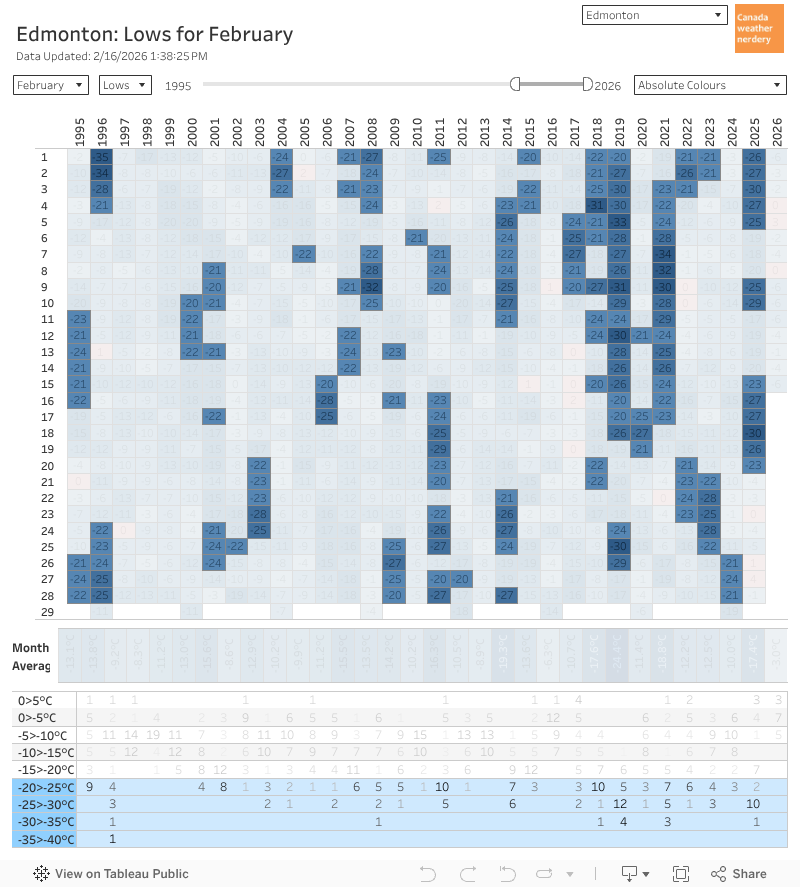
For some context, February does like to throw deepfreezes at us.

On average it gets around 5 Lows of -20°C.

The only recent years with none were 2016 & 2013. 

But recently 2025, 2021 & 2019 got to -20°C on 14, 15 & 19 days respectively. So February can definitely be cold.

But February also usually gets a fair number of mild days.

On average 12 Highs are above-freezing. Midway through the month 2026 is at 14. Recently 2016 & 2003 both got to 20 for the whole month.

We average 5 5°C Highs, and so far we're at 12. 2016 had 13 for the whole month.

February 2026 had 2 Highs reach 10°C. Those are unusual, but not super rare. 

2025 had 3, 2024 had 2, 2020 had 1, 2017 had 3, 2016, had 2, etc.

And for some reason, prior to 1940 we recorded a lot of them. 1889 has the record with 6, and a bunch of years had 3, 4 or 5.

So the warm temperatures at the start of February 2026 were not unusual by themselves.

We did get a new record High for the 4th, and record warmest-Lows for the 5th & 8th.

But the big thing is that we got a lot of warm days, all in-a-row.


Days In A Row
We had 9 Highs in-a-row get to 7°C, which ties 1896 for 2nd longest streak on record. 1916 got to 10. 

We had 12 6°C Highs in-a-row, which is new record, 2 ahead of 1916's 10. 

And we had 12 5°C Highs in-a-row, which ties the record with 1916 again.

We've also had 14 Highs in-a-row get to 0°C.

That sounds like a lot, but 1977 has the record, with all 28 days above freezing (and carrying on for another two weeks into March). 1986 went 26 days in-a-row, 1991 went 17, and 2001 went 16.

But was this our warmest start to February? 

For February 1-15 the average High of 6.4°C easily beat 2nd place 1977's 5.7°C. 1991, 1984 & 1934 round out the top-5. 

And the average Low of -3°C is ahead of 1991's -3.5°C. 1977, 1889 & 1984 are the top-5.

Our warm start to February follows a pretty warm January.

So a month and a half in to 2026 its temperatures are our 6th warmest on record. (that will change as winter returns). 

1889 was the warmest at this point of the year, and was our warmest year overall until 1976.

And the mildwave wasn't just us. Calgary, Saskatoon & Regina were all well above average. Even Winnipeg got a bit of it.

This is comparison of Edmonton's & Calgary's temperatures.

On the 4th & 5th when we were around 10°C they got up to 16.2°C and 18°C (their 8th warmest February day on record). From the 9th onwards the temperatures were pretty close.


Snow
February is generally our least snowy winter month, averaging 13cm, while the others are closer to 20cm.

And so far this February is at...0cm. 

That will change as winter returns. But the lack of snow and the warm temperatures have dropped the snowdepth at the local stations.

Seasons are complicated in Edmonton, and March & April can be wintery.

But this mildwave got us 2 weeks closer to the start of the end of winter. 3 weeks from now is when our average temperatures start the climb towards spring, and the big melt usually gets going.

2026/02/01

January 2026 Review

And somehow it's February. There's still plenty of winter left, but let's take a look back at Edmonton's weather for January 2026.

January 2026 was warm but not unusual.

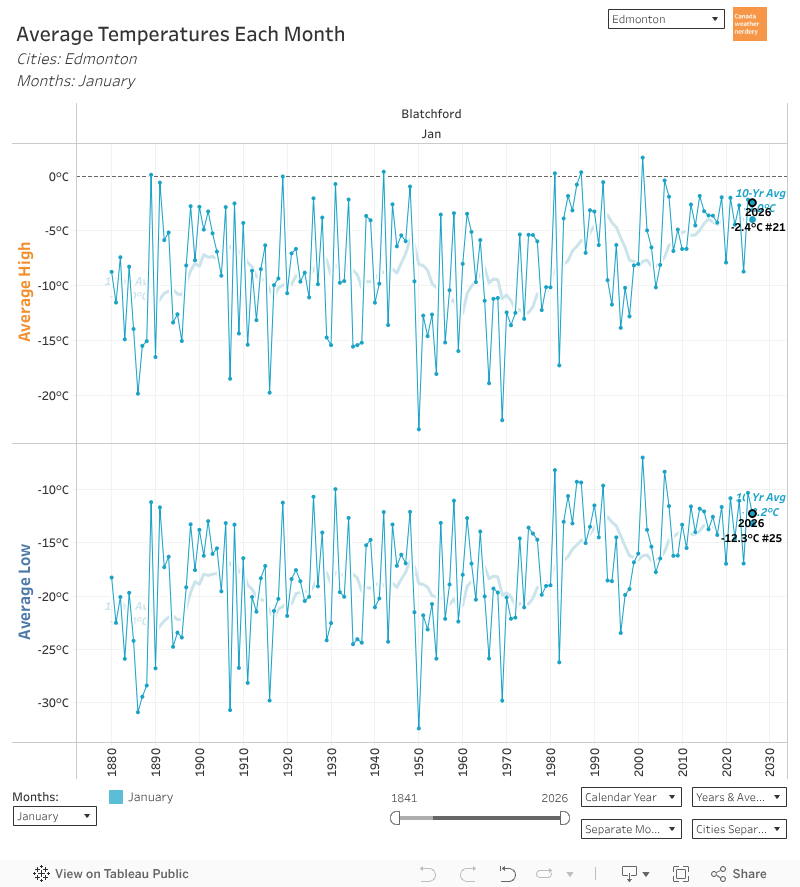
The average High of -2.4°C was the 21st warmest on record. The average Low of -12.3°C was 25th warmest.

That's in basically the same range as 2025, 2023, 2022, and 2014-2020. Recent cool Januarys were 2024 & 2021,

Our modern January temperatures have nothing in common with a century ago, or even with the 1970s. Average Highs are up by 8°C and Lows are up by 10°C. Even a "cold" modern January like 2024 is above the historic average. December & February haven't changed nearly as much.

Edmonton's outlying stations have shorter histories than downtown, but they've also seen big jumps in January temperatures since the 1970s.


High Temperatures
January's Highs were a little cool, then really warm, then a little cool, and finally a little warm. 

Overall 21 Highs were above freezing, with 2 records on the 12th and 14th. 10 Highs were below average.

January averages 12 above-freezing Highs, and 2026 got 12.

We had 8 Highs get to 5°C, when the average is around 4. 

And we had 2 Highs get to 10°C, which is pretty rare, but which also happened in 2024.

January averages 2 -20°C Highs, but 2026's coldest was -15.7°C.


January 2026 Heatwave
January's mid-month heatwave had 6 5°C Highs in-a-row. That tied 2015 for January's 2nd longest streak on record. 1942 & 1889 both got to 7 in-a-row.

January has only ever recorded 24 Highs of 10°C. 2026 got 2, along with 2024, and a bunch of other years. And 1906 actually got 4.

10.3°C on the 12th was our 15th warmest January High. 11.6°C on the 14th was the 6th warmest. Those both set new daily records.


Low Temperatures
For January's Lows, January 13th set a new record of 1.7°C. 18 Lows were above average, and 13 were below. The coldest was -27.5°C on the 23rd.

January averages around 7 -20°C Lows, and 2026 got 5.

2 of those got to -25°C, when we average around 3.

And no -30°C Lows. Even in January those are hit or miss: 2024, 2022, 2021, 2015...

And we had 1 above-freezing Low. Recently 2025 got 3, 2022 & 2023 got 1, 2020 got 2...


Cold Days So Far
By the end of January we average around 15 -20°C Lows, and so far this winter we're at 18, thanks mostly to December.

And we've had 8 -25°C Lows, which is right on average.

And no -30°C Lows so far (last winter's only -30°C waited until February 18th).

Historically our -30°C season stretched into March. Recently we got to -30°C in March 2011, 2009 & 2003. But more typically they're late-December through early-February.

But our -20°C season stretches well into mid-March, and in 2020 we even got one on April 2nd.


Warm & Cold Months
2026 gives us another orange/warm January.

The average High of -2.4°C was -6.3°C warmer than the 20th century average. The average Low of -12.3°C was 6°C warmer.

The last January with a High colder than the 20th century average was 2004. The last below-average Low was 1998.


Across Canada
January was well above-average in the west, and a little cool in central an eastern Canada.

Calgary was at the top with a High 6.6°C above their 20th century average, followed by Edmonton's 6.3°C.

Toronto was at the bottom with a High -2.2°C below their average.

Calgary also got the mid-month heatwave, along with 3 new records on the 13th, 14th & 17th.

January 14th's 17.4°C, which was their 2nd hottest January High on record.


Snow
In January we average 20cm of snowfall, and 10 days with snow.

2026 was a little low with 12.2cm over 7 days. That gave us a break after our extremely snowy December.

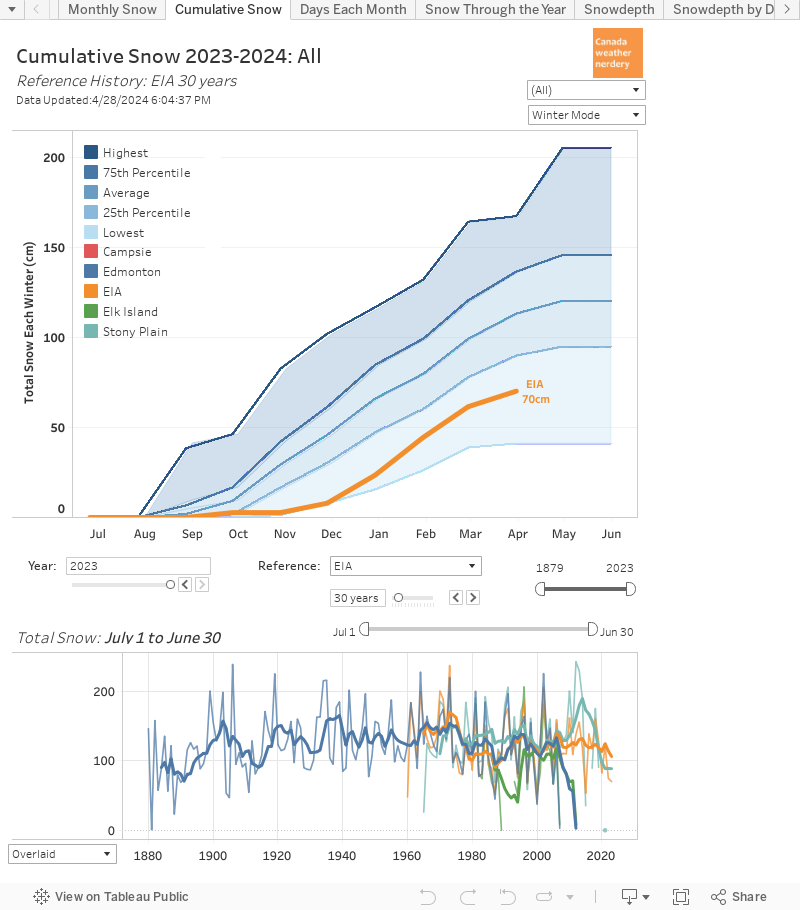
By this point of the winter we average 66cm of snowfall This winter we're up at 84.2cm, mostly due to the 59.9cm in December.


Snow Across Canada
This chart is pretty messy, but it is the snow totals so far across the country. St. John's is in the lead with over 211cm. Ottawa, Toronto & Montréal are all around 150cm. And then there's everybody else.

The big outliers so far this winter for snow are Toronto, with 151cm tying their record from 1951-1952. And Charlottetown's 74cm is well below their average of around 300cm for this time of year. Calgary's 46cm is also pretty low.

These were the big storms across the country for January.

Toronto was the winner with 46cm on the 25th, and 20cm on the 15th. Ottawa & St. John's also got 20cm+ days. Edmonton's biggest was 4cm on the 1st.

Toronto's 46.2cm was its 2nd snowiest day since 1880, behind 48.3cm on December 11th, 1944.

And 88.6cm was their 3rd snowiest January, and their 4th snowiest month. January 1999 got to 118.4cm.


Snowdepth
At the end of January we average around 20cm of snowdepth. This winter the snowy December pushed us way up, and the January heatwave brought us back down a bit. The airport is the lowest local station with only 21cm, while Blatchford & Elk Island are at 37cm.

Our big melt usually gets started around the first week of March, so we've still got plenty of snow season left. We usually don't get down to zero snow until late March. And some years like 2020 & 2018 drag into mid-April.

Back at the end of December Edmonton's snowdepth was well ahead of everyone else.

But January's storms gave a big bump to Winnipeg, Toronto, Ottawa, Quebec City & Halifax, pushing them up over 40cm.


February
Our February temperatures are often a lot like January, with 10~15 Highs above 0°C, and 5 Lows below -20°C.

But recently February 2025, 2021 & 2019 all had long deepfreezes.

On average February is the least snowy main winter month, with about 14cm.

It will still be another month and a bit before our temperatures really start climbing towards spring. And that's when snow usually really starts to drop, until we're snowfree around two months from now.