2026/01/17

Snow Removal?

Fine, let's talk about snow removal. 
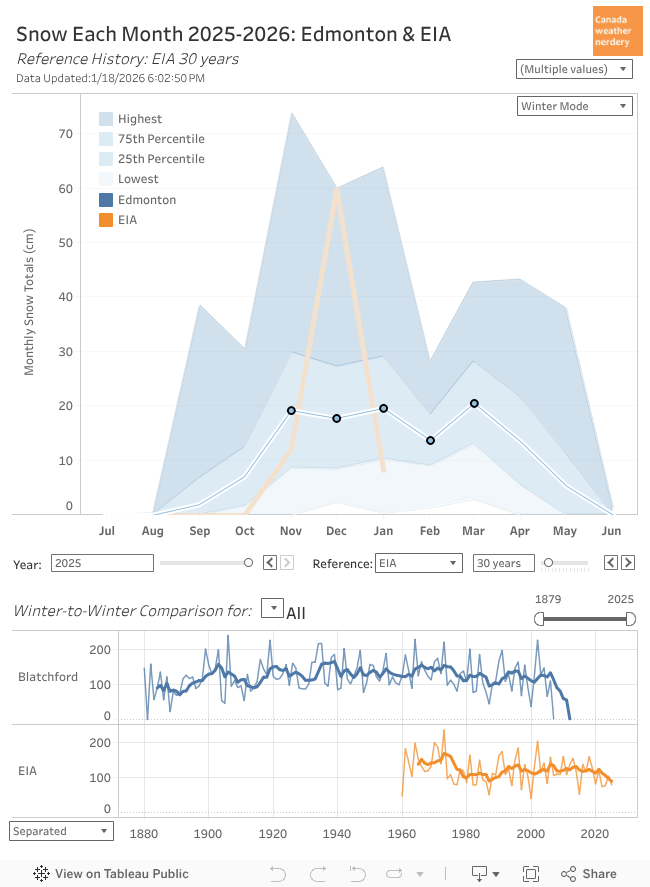
For the 5 big winter months of November-March we average around 20cm of snow. February is a bit of an under-achiever compared to its neighbours, around 14cm. The other months can get snow, but it's more hit-or-miss.

In December 2025 we got 59.9cm, so 3x the average.

That was the airport's snowiest December on record. Although Blatchford got to 73cm in 1933, and 81.5cm in 1893.

Ge got a few reasonable snowfalls in November and early December.

But from the 16th through the 26th we got the 44.3cm, which led to most of our problems.

That snow coincided with a long stretch of temperatures 10-15°C below average. Also, the holidays.

A 10cm storm is pretty big for us, and they tend to make a mess of things. In a typical winter we will get 1 or 2 of them. 3 would be a big year. 

But December 2025 gave us 3 of those in the span of a week and a half.

The bubbles here are snowfall totals for each month. (Blatchford used to record snow, but now it's just the airport) 

December 2025's 59.9cm was the biggest month since January 2011. Before that Blatchford had a snowy January 1999, and November 1996 was big for both.

Here we've just got the 60cm months (well, 59.9cm) going back to 1880. 

In that time the two stations have only had 19 of those.

They used to be a bit more common, but in "recent" history it's: 1960, 1974, 1982, 1994, 1996, 1999, 2011, 2025.

Here we've just got the 40cm months, or 2x average.

In recent memory the only time that we've gotten 2 of those in-a-row was Nov-Dec 2013. Before that you need to go back to 1965.

So when we do get a big month, afterwards things are usually closer to average.

And now, we get to the point of all of this.

In cities like Ottawa & Montréal the average snowfall in December-February is ~50cm per month.

So they get what we just got, but 3~ish months of it in-a-row, every winter.

Here are the monthly bubbles for Edmonton, Ottawa & Montréal.

Edmonton has more bubbles, because our snow season is longer. But our bubbles are generally a lot smaller.

Here we've got the 40cm & 60cm months. 

In Ottawa & Montréal basically every winter gets at least 2 40cm months in a row.

And basically every winter gets at least 1 60cm month. Ottawa had 3 in-a-row in 2022-2023.

For a bit more fun, these are 100cm months.

Since 2000 Montréal has had 2, and Ottawa has had 6.

Going back to the 1880s Edmonton has never had one, while before 1930 Ottawa often had more than 1 per year.

Earlier we saw that Edmonton might get 1-2 10cm storms across a whole winter. 

Ottawa & Montréal get a bunch more. They'll get 8 over a much shorter timeframe. 

And 20cm might happen every few years around here, but they will get a few each winter.

So you can't really compare Edmonton's snow to Montréal & Ottawa. 

We average 120cm (a bit less in recent years) mostly spread across Nov-Mar (5 months), with a bit in the shoulder-season. 

Ottawa & Montréal average 230cm & 200cm, mostly spread across Dec-Feb (3 months).

But don't they get more melting than us, so the snow disappears?

Well actually, in December-February we average more 0°C and 5°C Highs than Ottawa & Montréal, and a lot more than Quebec City.

I don't know where their snow goes, but they definitely don't get to rely on chinooks.

2026/01/02

2025 Year-In-Review: Part 3 - Snow

And finally we have reached the end of our 2025 Year-in-Review, as we dig into Snow. How was the snow for Edmonton and other Canadian cities last year?

(Blatchford no longer records snowfall, so most of the numbers will be from the International Airport)


Monthly Snow
Normally we talk about snow each winter, but today is the 2025 summary, so it's January-March and November-December.

March & December were well above average, while February was really low.

April & October were both snowfree. 

For April the only other time that has happened at the airport was 1998, although Blatchford had a number of snowfree Aprils.

And October is snowfree every few years, like 2022, 2021, 2015...

December's 59.9cm was the biggest story.

It was the airport's snowiest December on record, although Blatchford did get 81.5cm in 1893.

And it was our snowiest month since since January 2011's 63.7cm. Before that November 1996 got 73.7cm.


Total Snow
This chart has the cumulative snow for year (it looks a little strange because it includes the summer months).

We average about 120cm of snow each year, and in 2025 the airport recorded 136.1cm. That's not super exciting, but it is the snowiest year since 2018's 166cm.


Snow Across Canada
For these cities across Canada Charlottetown was at the top with 447.4cm, which is pretty average for them.

Calgary's 81.9cm is the biggest outlier, because they average around 140cm in a year.


Last & First Snowfalls
In 2025 our final spring snowfall was March 28th, which is very early. And the first fall snowfall was November 7th, which is a week or two late.

This is a comparison of the snow seasons. 

Edmonton & Calgary usually start in early October and last through May. Central & Eastern Canada start later in November, and usually end in April. (Regina, Saskatoon & Winnipeg don't do snow measurements anymore)


The Spring Melt
For the spring melt, our snow was basically gone in the last week of March. But then a big March storm bounced it back up until the first week of April.

This one is pretty busy, but it shows the spring 2025 snow depths for other cities. 

Many cities were down to 0cm by late March, but then got a final quick blip. Dawson City & Saskatoon held on the longest, and even they were done by the second week of April.


Fall Snow
For fall snowdepth the locals stations didn't get started until November 28th, which is really late. And then with all of the December snowfall things really took off around the middle of the month.

A busy chart again, but for fall snowdepth a lot of the cities here got started around December 1st. Edmonton's snowy December pushed us ahead of the pack.


Snowstorms
For snowstorms the biggest days were March 27 with 14.4cm, and December 17th with 13cm.

...but both of those were part of multi-day snowstorms. 

The March 27-28 storm dropped a total of 24cm, and December 16-17 dropped 18.6cm. Both of those are pretty big for us, with most winters not getting an 18cm+ strom.

Across the country the biggest single-day snowfalls were: 
  • Charlottetown with 46cm, and 6 other 30cm & 20cm days. 
  • Montréal with 36.8cm & 34cm 
  • Ottawa with 33.4cm & 26.8cm 
  • St. John's with 21.8cm


Winter Rain
It always feels weird when it happens, but winter rain is not too unusual for Edmonton.

We might average around 3 rainy days in January, February & December, but 2025 actually had 8. That's the most since 2015's 9.

And that finally brings us to the end of our long look back at the weather for 2025.

2025 Year-In-Review: Part 2 - Precipitation

Are you ready for our 2025 Year-in-Review: Part 2 - Precipitation! We will take a look at Edmonton, and some other cities across Canada.

Edmonton averages 435mm of combined precipitation (rain + snow) each year.

For 2025 the airport ended up right on average with 429mm, while Blatchford and Stony Plain were down at 335mm.

February, April & September were very low. And July was low at Blatchford & Stony Plain, but average at the airport.

On the other hand, March & December were both well above average.


Big Storms
The summer storms missed Blatchford, which is a big part of why its 2025 total was so much lower than the airport's.

Blatchford's biggest day was 18.1mm on March 27th, while on July 19th Stony Plain got 29.4mm and the airport got 32.9mm.


Precipitation Across Canada
For cities across Canada the total precipitation ranged from Saskatoon at 262mm, up to St. John's with 1,294mm

The outlier cities for 2025 are: 
  • Halifax averages 1,500mm, but only got 1,052mm 
  • Moncton averages 1,200mm, but only got 830mm 

Everywhere else was pretty close to average.


Big Storms Across Canada
These festive-looking charts show the biggest storms of the year. 

Montréal is at the top with 81.6mm (although in 2024 they had a record-breaking 154mm). 

Victoria, Ottawa & Charlottetown all had 50mm+ days. And Calgary, Regina, Toronto & Halifax all got close.

That's the end of Part 2 of our 2025 Year-in-Review. In Part 3 we will take a look at snow.

2026/01/01

2025 Year-In-Review: Part 1 - Temperatures

And now, what you've all been waiting for! It's time for our big look back at 2025 with our Year-in-Review Part 1 - Temperatures.


Warmest & Coldest Years
The big news: 2025 is Edmonton's 7 warmest year on record at 2.2°C above the 20th century average. 

That's a bit above 10th place 2024, but below 1st place 2023.

Warm months were Jan (#13), May (#6), Aug (#5) & Sep (warmest on record). Feb & Dec were below average.

At the end of November 2025 was 5th warmest, but the cold December pushed it down to 7.

The average High was also our 7th warmest, while the average Low was 14th warmest. But together that makes 2025 #7.

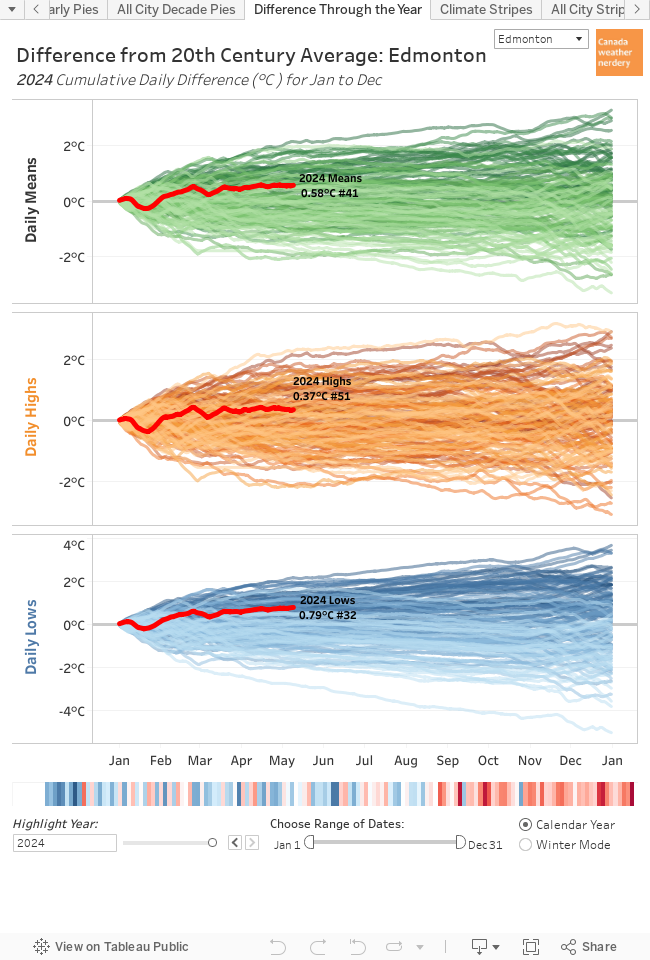
You can see where the red line dips for February & December.

I only get to use this chart once a year, and here each month of the year gets a pie piece.

In 2025 February & December were colder than the 20th century average, so they get the blue trivial pursuit pieces. The other months get various shades of orange.

For the climate stripes scarf chart 2025's 2.2°C is another red one, although obviously not as red as the record-breaking 2023.

The last time that we had a blue stripe was back in 1996, at -1.7°C colder than the 20th century average.

For the local outlying stations 2025's temperatures ranked #8 for the airport, #13 for Stony Plain, and Campsie was just #26.


Temperatures Across Canada
Across the country 2025 was Kelowna's #1 warmest on record.

Dawson City, Edmonton, Calgary & St. John's were top-10.

The other cities mostly fell in the range of top 15-35. But Quebec City was lowest with 2025 as its 56th warmest year.

Here are the climate stripes for the country's big cities. 

Back in 2022 we had a few whites and one blue (Winnipeg), but 2023, 2024 & 2025 have been all pink or red. Quebec City is the least pink of the bunch.

Kelowna's previous hottest year had been 1958, at 2.3°C warmer than their 20th century average. 2024's 2.2°C came close to catching it. But 2025 succeeded, at 2.6°C warmer.

Aug & Sep were their warmest on record, and 6 other months were top-10.


Warm & Cold Months
Across the country February & December were below-average for most of the country.

All of the other month were pretty unanimously above average, with a few little blips of blue, like July in Saskatchewan, and November in Ontario.


High Temperatures
For 2025 Edmonton had 230 days with Highs above our 30-year average. That included 8 warmest-records in February, May, 4 in August, and 2 in September.

2025 had 115 Highs reach 20°C. That's the 6th most on record. Recently 2022 had 119 and 2023 had 121. 1897 & 1898 share the record with 122.

2025 had 56 Highs reach 25°C, which is the 5th most on record, and the most since 1961. 1898 has the record with 64.

2025 had 14 Highs reach 30°C. That ties 1961 for 3rd most on record. The only years with more are 2024's 16 and 2021's 17.

We got a late heatwave at the end of August, which wasn't as exciting as some of the big peak-of-summer heatwaves that we've seen recently. But for as late in the year as it was, it set a bunch of new records. We talked about it more here: https://edmontonweathernerdery.blogspot.com/2025/02/the-great-deepfreezeish-of-february-2025.html


The August heatwave had: 6 30°C Highs in-a-row, which doubled the record for that late in the year, and missed the overall record by 1. 

4 32°C Highs in-a-row which tied the overall record. Set 4 new daily record Highs in-a-row.

For 30°C days across the country Edmonton & Kelowna, Montréal & Moncton were top-10.

And even though Edmonton got a lot, Calgary & Saskatoon were both well below average.


Low Temperatures
For 2025 there were 214 days with above-average Lows, including 6 new warmest-records in January, Feburary & August. 

The 151 below-average Lows were spread around, but included lengthy February & December deepfreezes, and a few cool weeks in July.

2025 ended up with 31 Lows of -20°C, when our average is around 25. Most of those came from February (13) and December (13).

19 of those got to -25°C, which tied 2019. Our average is around a dozen.

2025 only had 1 Low reach -30°C, when we average around 4. The only -30°C was -30.3°C on February 18th. For as cold as December felt, it "only" got down to -29.5°C.

2025 had two deepfreezes, in February & December. They were both long, but they weren't as long, or as cold as some of the more epic deepfreezes we got from 2018~2024.

We looked at them in more detail here:


For -20°C Lows across the country 2025 was pretty typical for the big winter cities.


Warm Winter Days
In the deep-winter months of January, February & December we average around 35 above-freezing Highs (about 40% of the winter). 

2025 had long coldsnaps in February & December, and ended up with 34 of them.

That included 16 5°C Highs, which is right on average.


Yearly Extremes
With a warmest High of 33.3°C and a coldest Low of -30.3°C Edmonton's temperature range in 2025 was 63.6°C. That's pretty typical for modern years. 

2024, 2021 & 2020 were all around 70°C because they got hotter heatwaves and colder deepfreezes.


Records
2025 set 8 new record Highs. That's down from 2024's 11, but it ties 1934 for the 4th most record Highs.

And it set 6 new record warmest-Lows. That's pretty average, and down from 2021-2024 which all set 10 or more.


Frost-Free Days
2025's final spring frost was pretty late on May 5th, while the first fall frost was just a bit late on October 4th.

So 2025 ends up with 140 frost-free days, which is a bit below the average of 146.

2024 had 174, 2023 was up at 182, and 1980 has the record at 184.

This chart is very cramped, but it gives a sense of how the growing season varies across the country.

In 2025 most cities were pretty average, but the prairie cities (except Edmonton) were all around 2 weeks longer than average.


Edmonton versus Calgary
And finally, a quick comparison of Edmonton & Calgary. The temperatures usually track fairly closely, although Calgary is warmer.

But something happened in December. It was a really cold month in Edmonton and across the prairies, but Calgary lucked out with just a bit below average.

That's the end of Part 1 of our 2025 Year-in-Review. Part 2 will look at precipitation, and part 3 will be all about snow.