It's time for our look back at Edmonton's weather for February 2026, which was a month that was all over the place.
Overall February 2026 was fairly warm.
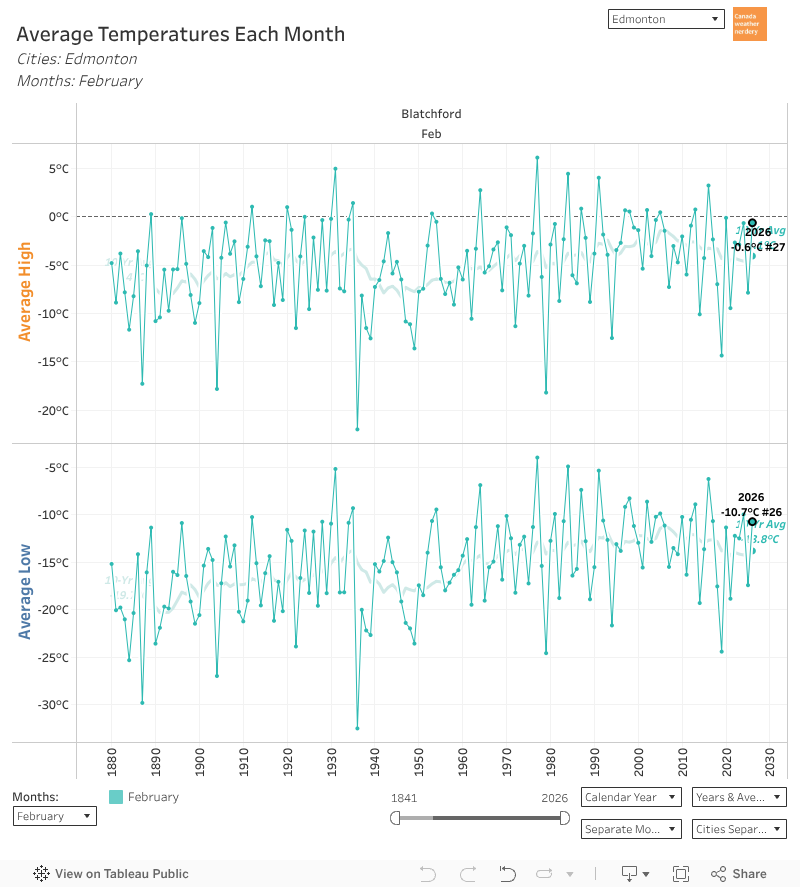
The average High of -0.6°C was the 27 warmest on record.
The average Low of -10.7°C was 26th.
Those averages are close to 2024, 2020 & 2017, but average only tell part of the story...
High Temperatures
February started really warm, and it stayed there for 2 weeks. Then we got a pretty cold week, then warm, and then cold.
Overall 18 Highs were above average, including a record of 10.2°C on the 4th. And 10 Highs were below average.
We talked more about The Great Mildwave of February 2026
here.
- We had the 1 record on the 4th.
- 12 Highs in-a-row got to 6°C (a new February record).
- 14 in-a-row were above freezing (which is a lot, but 1977 spent all of February above freezing)
February averages 12 above-freezing Highs, and 2026 got 16.
14 of those got to 5°C, when the average is around 5.
And 2 got to 10°C, which is pretty rare, but 2025 had 3 and 2024 had 2.
We also got our first -20°C High of the winter, with -23.4°C on the 18th.
Warm Winter Days
For December-February we average 35 above-freezing Highs. And this winter got 35 (38% of the winter).
We average 13 5°C Highs, and got 24 (The 2nd highest, behind 3 winters that got to 25)
And we got 4 10°C Highs, which is unusual. But 1884-1885 & 1888-1889 both got 7?
Low Temperatures
February's Lows were mild for the first half of the month, with new records on the 5th & 8th.
But then the second half was mostly quite cold, with a short warmup on the 25th.
15 Lows were above average, and 13 were below.
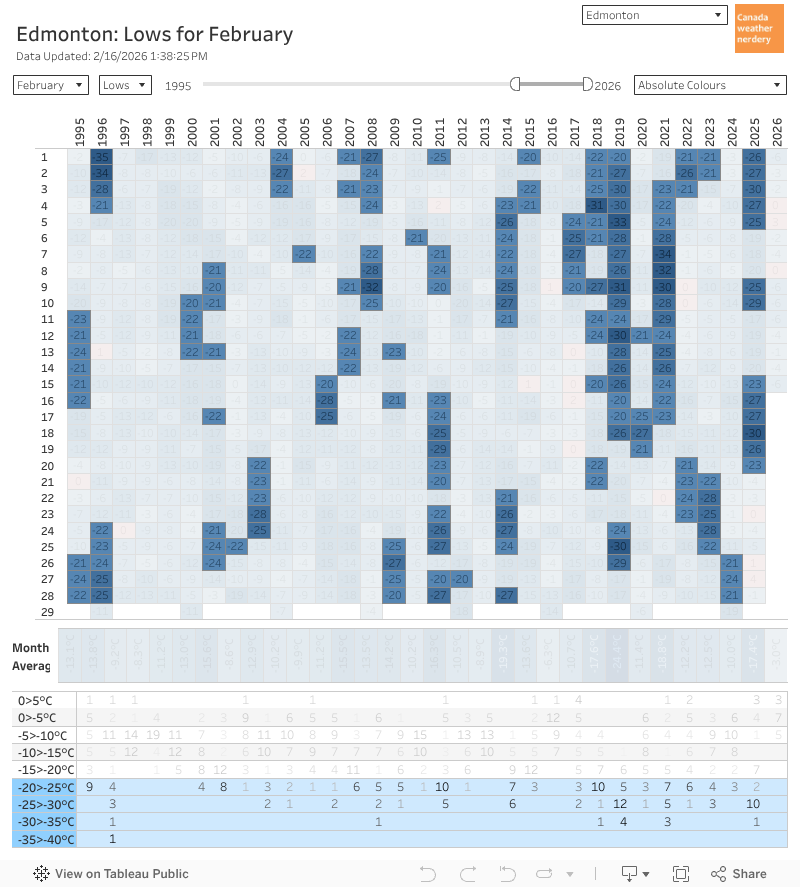
The February mildwave gave us 3 above-freezing Lows. 2025 also had 3, and 2017 had 4.
February averages around 6 -20°C Lows, and 2026 got 7.
3 of those got to -25°C, when we average around 2.
And no -30°C Lows. Recently we got to -30°C in February 2025, 2021, 2019 & 2018.
Cold Days So Far
At the end of February we've had 25 -20°C Lows. That's average, although the only recent winter with more was 2021-2022's 32.
We've gotten to -25°C 11 times, which is right on average.
And no -30°C Lows for the first time since 2016-2017 (although we did get close).
Historically our -30°C season stretched into March.
Recently we got to -30°C in March 2011, 2009 & 2003. But more typically they're late-December through early-March.
And our -20°C season stretches well into mid-March, and in 2020 we even got one on April 2nd.
Warm & Cold Months
February 2026 was a bumpy ride, but it gets a warm/orange bubble.
The average High of -0.6°C was 4.2°C warmer than the 20th century average.
The average Low of -10.7°C was 4.5°C warmer.
February 2025, 2021 & 2019 all had really long deepfreezes, and got blue bubbles.
Across Canada
As with January, February was well above-average in the west, and cooler in central and eastern Canada.
Regina was at the top with a High 6.2°C above their 20th century average.
Halifax was at the bottom with a High -0.2°C below their average.
The great mildwave of early February wasn't just Edmonton.
It also stretched to Calgary, Saskatoon, Regina & Winnipeg (along with a similar drop in the backhalf of the month).
Warm Winter Days Across Canada
One of my favourite pieces of trivia is the number of warm winter days that Edmonton gets, compared to other winter cities.
We can't compete with Calgary's chinooks.
But for 5°C & 10°C days in December-February we are well above the others (which is not a new thing).
Snow
In February we average 14cm of snowfall, and 8 days with snowfall.
2026 was a just a little High with 15.3cm, and 6 days.
And everything is dwarfed by our extremely snowy December.
The big February storm was the 16th & 17th, which together dropped 11.7cm.
In a winter we will average around 3 10cm+ storms.
This was our 4th one of 2025-2026, after December threw 3 at us in the span of 10 days.
By the end of February we average 79.8cm of total snowfall.
This winter we're up at 99.5cm, which is still mostly thanks to the 59.9cm in December.
(no one will want to hear this, but we average another 40cm of snow in March, April & May)
Snow Across Canada
This chart is pretty messy, but it is the snow totals so far across the country.
St. John's is way out in the lead near 400cm. And then a bunch of cities are all clustered between 175-225cm.
Some snow outliers:
- Toronto's 179cm is 2nd most for this point of the winter
- Charlottetown's 213cm is well below their average of ~400cm
- Calgary's 63cm is their average of ~100cm (although they get lots of spring snow)
- Vancouver has recorded 0cm for the first time since 2002-2003
February's big storms were all on the east coast.
- St. John's had a 44cm day, and then 2 more around 28cm
- Charlottetown got 2 around 35cm
- Halifax got 1 at 33cm
Snowdepth
At the end of February we average around 21cm of snowdepth.
December pushed the stations way up, the heatwaves dropped it, and February's snow raised it.
The airport is the lowest local station with 26cm, while Blatchford is at 42cm.
Our big melt usually gets started around the first week of March, and it's often done around the end of March.
So we're getting close.
Although some years like 2020 & 2018 drag into mid-April.
Across the country everyone is still deep into their their snow seasons.
St. John's has the most with 69cm on the ground, followed by Dawson City's 57cm.
Calgary is predictably melty, and Regina is low.
March
In March we average 20 days with Highs above freezing.
It's often when we start to hit 10°C, although we've already had 4 of those.
Although it also averages 3 -20°C Lows, and 20cm of snowfall.
But we have made it to the point where things start changing, and temperatures finally leave their long winter slump and begin climbing towards spring.
(but also, expect another ~40cm of snow before things finally end in May)

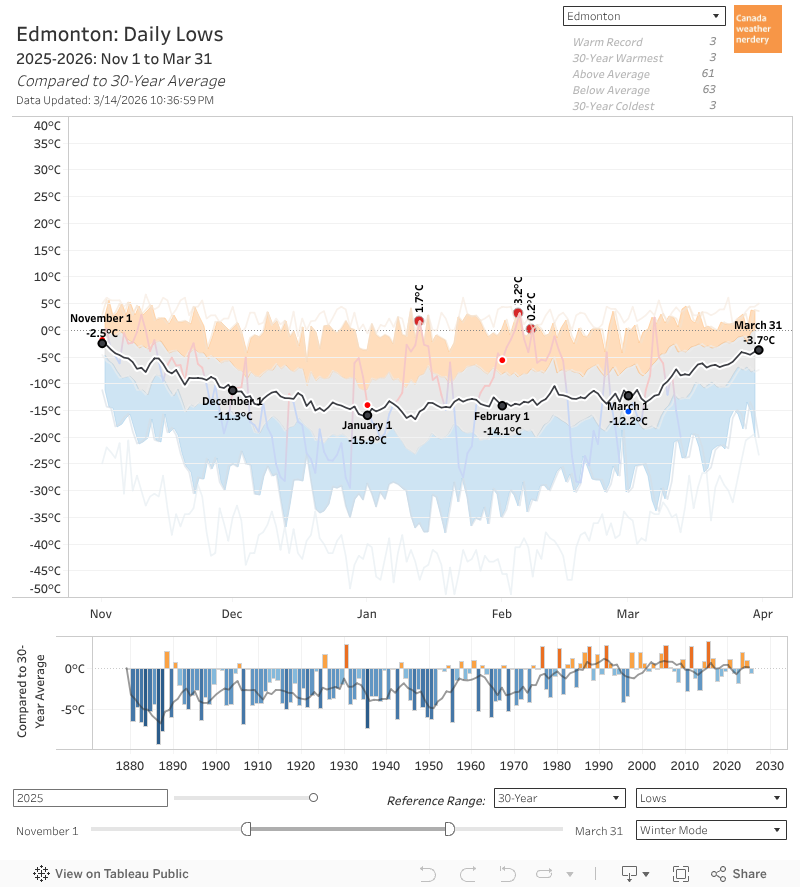


 If we want to extend things out a bit to include November-March, 2015-2016 was warm for all 5 months (it was a super El Niño),
  We will probably finish this winter with 25 Lows of -20°C, which is right on average (we narrowly missed a few more, but close doesn't count).
  And this winter we didn't get to -30°C (although we did get to -29.5°C on December 28th).
 Around the neighbourhood the number of -20°C & -25°C Lows this winter was right on average for Stony Plain, the Airport & Campsie.
 For -30°C Lows Stony Plain did get one, when it averages around 4.
 For warm days Blatchford had 35 Highs reach 0°C for Dec-Feb, which is right on average.
  And we always think of the outlying stations as being cold.
  Things should start warming up soon, but the snow isn't done with us.
On average we get another 28cm of snow after March 15th.
Things should start warming up soon, but the snow isn't done with us.
On average we get another 28cm of snow after March 15th.
 The average date of our final snow is right around the start of May. That average has been consistent for a long time, although from year to year there's a lot of variability.
 May averages around 5cm of snow, although lots of years get none, while some years gets lots.
  In terms of snow on the ground, we're often snowfree by the end of March or beginning of April.