Showing posts with label Record Watch. Show all posts

2026/10/10

The Record for Wettest Year: October 10, 2026

 As of 11AM on October 10th Blatchford will have recorded 725.4mm of precipitation in 2026.

That's a new record! It beats 724.5mm from 1900.

(for the completists out there, Stony Plain got to 731.9mm in 1980, so we've still got that to aim for, possibly this weekend.)

https://public.tableau.com/shared/YGK9JDZT2?:display_count=n&:origin=viz_share_link


I use data from Environment Canada, but if you look at their total it's only around 708mm. Why the difference? Well, they declare a day "missing" if any of its hourly data is missing. So they count a day like August 4 (and several others) as 0mm, even though their actual station actually recorded 5.6mm. I think that's weird, and it reduces their total by around 15mm.


So how did we break the record?

It was basically all June & July.

They are normally our rainy months, but in 2026 they were the 2nd & 3rd rainiest months ever recorded. In an entire year we average ~430mm, and they dropped 536.5mm in 2 months.


https://public.tableau.com/shared/8HKKDZM3Z?:display_count=n&:origin=viz_share_link


The Other Big Years

- 1901's 699mm had a big July (the biggest) & September.


- 1900's 724.8mm didn't have any huge months, but was above average from January through October.


- 1980's 731.9mm in Stony Plain had a big June-August, and December


https://public.tableau.com/shared/B6K9CJSYJ?:display_count=n&:origin=viz_share_link


Around Town

2026 was a somewhat strange year, with historically huge gaps between stations.

Everybody is above average, but Blatchford has 150mm more than Stony Plain, and 225mm more than the airport.

The stations won't always match, but they're never that far apart.


For the rest of the year we average around another 50mm. And yes, snow will count towards the total precipitation.

https://public.tableau.com/shared/6S8NWCYFD?:display_count=n&:origin=viz_share_link

2026/07/01

June 2026 Review

And so we've reached the end of a fairly historic June. Let's take a big look back at Edmonton weather.

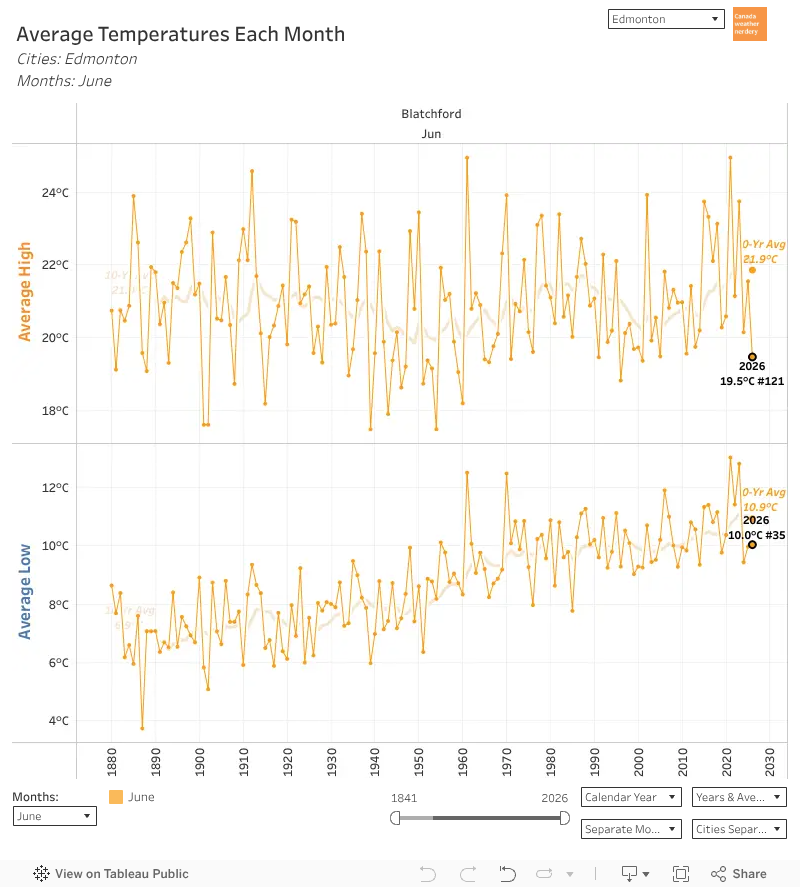
It's perhaps unsurprising given all the rain, but June 2026 was quite cool.

The average High of 19.5°C was the 122nd warmest out of 147. That's around the same as 2013 & 2011.

On the other hand, the average Low of 10°C was actually 35th warmest.


High Temperatures
June's Highs ranged from 10°C on the 1st to 25.9°C on the 14th. 12 Highs were above average. and 18 were below average. The 1st & 2nd were the coldest in 30+ years.

June averages 18 Highs above 20°C, and 2026 only had 15. 

And on average 5 of those get to 25°C, and 2026 got 5. 

It's a little weird that the Highs made this a bottom-25 year, because it was honestly pretty unremarkable.


Low Temperatures
For Low temperatures June 2026 had 10 above the 30-year average (which is still much higher than the long-term average), and 20 below. They ranged from 6.6°C on the 23rd to 15.1°C on the 25th.

June Lows usually don't have much of a spread. We average 2 above 15°C, and 2026 had 3 (2023 had 12). And about half of the time we will get a Low below 5°C, but 2026 had none (2024 had 4).


Warm & Cold Months
June's Highs get a blue dot. The average of 19.5°C was -1.3°C cooler than the 20th century average, and close to 2013 & 2011. 

The Lows are a pretty typical orange. 10°C is 1.4°C warmer than the 20th century average.


The Horserace
Halfway through 2026 and our average temperature is the 29th warmest on record, and 0.92°C above the 20th century average.

Almost all of that was due to our January & February heatwaves. Since then we've mostly been pretty average.


Across Canada
Across the country June was a little cool on the prairies, and a little warm everywhere else.

The Highs ranged from 2°C above the 20th century average in Victoria, to -1.3°C below in Edmonton & Calgary.

For the year so far Kelowna Highs have been its 3rd warmest, Victoria is 9th, and Vancouver is 14th.

For everyone else the first half of 2026 has ranged from top-25 to top-70.


Precipitation
And now...precipitation!

June is usually our 2nd rainiest month, averaging 78mm. But wow, June 2026 really showed off. 

Blatchford ended up with 269.1mm, Stony Plain got 256.3mm, and the airport got 222.5mm.

Our record for June had been 216.5mm, from 1914. But 2026 blew that away. 

And our rainiest month ever recorded was 282.5mm, in July 1901. In the end 2026 missed that record by just 13.6mm. But it sits comfortably as our 2nd rainiest month on record.

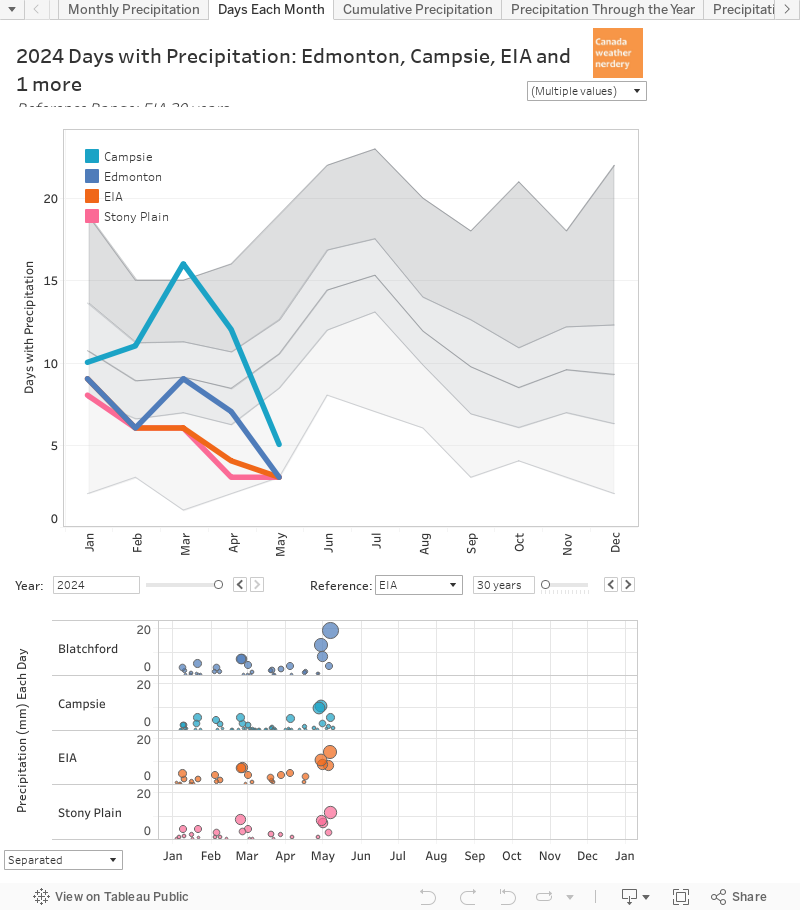
June and July average around 15 days with rain. June 2026 got 20 rainy days at Stony Plain, 19 at Blatchford, and 18 at the airport.

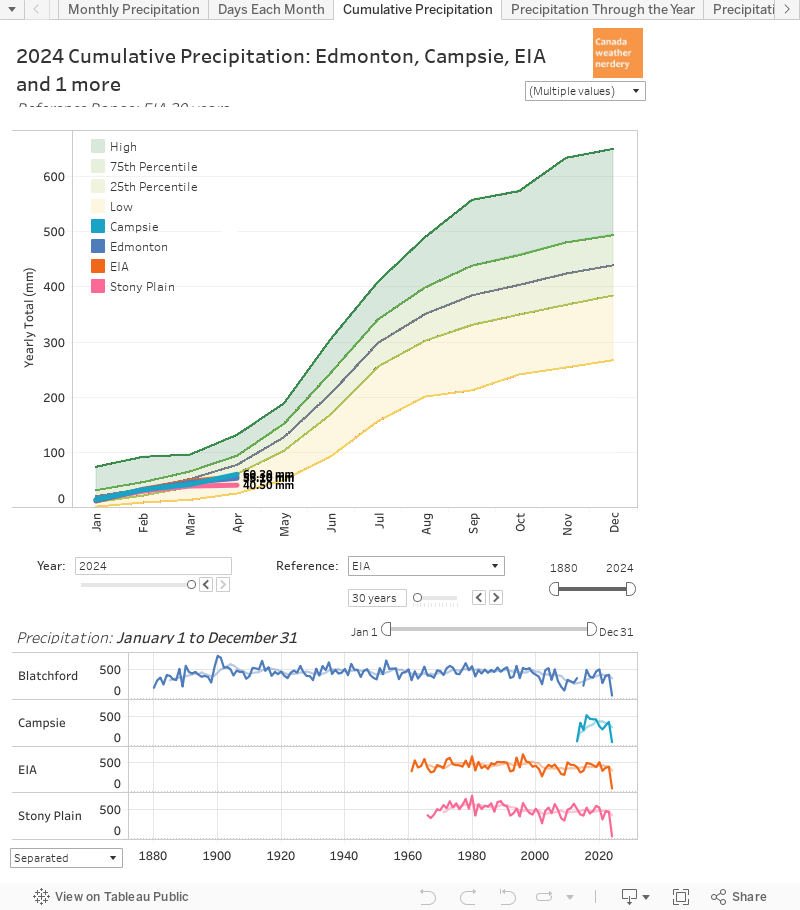
By the end of June we average around 208mm of precipitation for the year. 

The rainy June pushed Blatchford to 392mm, Stony Plain to 375mm, and the airport to 314mm.

In a full year we get around 430mm of precipitation, and June 2026 just delivered 2/3 of that.

This is our peak storm season, and we got several 30mm+ days. The largest were June 21st with 73.3mm at Stony Plain and 63.8mm at Blatchford. The airport had an underachieving 45.9mm.

Blatchford's 63.8mm was its 11th rainiest day on record.

For Stony Plain's 73.3mm day, it had only ever had 7 days that big, the airport has had 1 (in 1990), and Blatchford has had 5 (most recently in 1990).

Blatchford got 105.7mm over the 3 days from June 20-22. That's only the 6th time that has happened at Blatchford.

And Stony Plain's 2-day total for June 20-21 was 123.2mm. That's only happened twice before, in 1953 & 1937 at Blatchford.

Edmonton's 380mm of total precipitation might feel impressive, but at the end of June Halifax & St. John's are both over 700mm. And while we had a record-breaking June, in Calgary their 104mm was just a bit above average.

For big storms it's not often that we see Edmonton leading the pack, but here we are.

Our 63.8mm was ahead of Regina's 57.5mm. And our monthly total was more than 100mm ahead of anyone else.


The River
With all the rain the river saw 2 nice little bumps up to around 6.5m & 1,300m3/s. 

That's a fairly typical summer peak, similar to 2024 & 2023. 2020 got to 8m & 1,900m3/s, and 2013 (Calgary's flood year) got to 9.2m & 2,850m3/s.


July
For July, the average High is about 23.5°C. Around 25 days reach 20°C, including about 10 at 25°C. Most Julys will get at least one 30°C day, but recently 2020, 2019 and 2016 didn't. July is also usually (usually) our rainiest month, with an average of 90mm.

2025/06/01

May 2025 Review

May 2025 ended on a hot note, so let's take a look back at Edmonton weather for the month.

May 2025 was pretty warm, but not as extreme as 2023 (#1) or 2018 (#2). 

The average High of 20.5°C was the 9th warmest on record, and average Low of 7.6°C was 5th warmest.


High Temperatures
May 2025 had 23 above-average Highs, and 8 below-average. It started and ended really warm, with a bit of a cool down in the middle. 

May 29th's 32.7°C set a daily record, and was the 3rd hottest May High on record. 

The coldest High was 11.1°C on the 21st.

May averages 10 20°C Highs, and in 2025 we got 16. 

We average 3 25°C days, and got 7. 

And we got 3 30°C days, which is the most since 1986's 4. 

May also averages 3 Highs below 10°C, and 2025 had none.


Hot Days
By the end of May we average 15 20°C Highs. 2025 is a bit above that with 18, but well below 2023's 25 & 2018's 27. 

Our 3 30°C Highs are the 4th most on record, behind 1986, 1936 & 1928 which all got to 4. Recently 2023 & 1995 had 2 by this point.


Records
May 29th's High of 32.7°C was our second daily record of 2025, following February 22nd's 12.5°C. 

A typical year might set around 3 new records Highs. But recently 2021 & 2022 had 5, 2023 had 6, and 2024 had 11.

May 29th's 32.7°C was our 3rd hottest May temperature on record. It was our earliest 32°C day since 1986. Between 1986 & 2025 the earliest that we'd gotten to 32°C was almost a month later, on June 26th in 2002 & 2021.


Low Temperatures
May 2025 had 25 above-average Lows, and only 6 which were below average. 

But one of those snuck in as a relatively late frost at -0.8°C on May 16th.

In May we average around 2 below-freezing Lows, although a lot of years don't have any (2022-2024, 2020, 2017-2018, 2011-2013, etc). The final frost on May 16 was fairly late. But 2025 also had a Low above 15°C, with 18°C on May 29th.


Final Spring Frost
Blatchford's average date for final spring frost is May 5th. It seemed like 2025 would be early like 2020 (April 19th), 2023 (April 22nd) & 2024 (April 20). 

But then May 16th gave us another one. So 2025 is a pretty late year like 2021 (May 21st) & 2015 (May 17th).

Stony Plain missed the May 16th frost, so their final frost was April 28th. At the airport and Campsie their last frost was May 16th, so they might be done for the year, but June frosts aren't impossible there.


Warm & Cold Months
May 2025 gets a medium sized orange bubble. 

The average High of 20.5°C was 3°C warmer than the 20th century average. The average Low of 7.6°C was 2.9°C warmer.

The last time that we had a warm March-April-May like this was maybe 2016, or maybe even 2001.


Across Canada
Across the country March-April-May have been mostly above-average. 

For May the 2 exceptions were Dawson City & Quebec City with Highs -0.5°C cooler than their 20th century average. 

Winnipeg was the most above-average, at 4.8°C above their 20th century average.

Somewhat unusually, Edmonton final frost on May 16th was later than most of the prairie cities. Calgary's final frost on April 28th was their 2nd earliest on record, just behind 2023's April 26th.


Snow
In May we average 6cm of snowfall. 

In 2025 we got 0cm, following 0cm in April. 

The Airport has only gone snowless in April-May in 1998, and now 2025. When Blatchford recorded snow it had a snowless April-May in 2005, 1998, 1988, 1949 & 1905.

By the end of the winter Edmonton averages 120cm of total snowfall. 

 After the snowfree April-May the winter of 2024-2025 was a little low at 105cm. 

But recently we've had lower winters, like 77cm in 2023-2024, 75cm in 2022-2023, and 53cm in 2015-2016.

At the end of the winter Charlottetown takes the top spot with 450cm of snow, which is a little below average. St. John's was the only city here with snow in May, adding 3cm to reach 251cm. Calgary was the biggest outlier, with 83.5cm as a bottom-10 year.


Precipitation
May is normally when our summer storm season kicks off, and we definitely got some this year, but not a lot. We average 49mm of precipitation. Stony Plain got close with 44mm, but the airport had 31mm and Blatchford had 26mm. Campsie (100km NW) was up at 77mm.

May averages 11 days with precipitation. Even with the low rainfall Blatchford and the airport both had 12 days, Stony Plain had 10, and Campsie way up at 17 days.

By the end of May we average around 125mm of precipitation for the year.

By the end of May we average around 125mm of precipitation for the year.
Blatchford and the airport are a little low, with 111mm & 106mm.

These are the precipitation totals for 2025 so far across the country.

Edmonton and the prairie cities are all down around 100mm, while St. John's & Halifax are heading towards 500mm (which is below average for both of them).


Big Storms
Around Edmonton May's biggest storms were: 
  • Blatchford 7.9mm on May 26th
  • Stony Plain 11.8mm on May 20th 
  • Airport 15mm on May 20th 
  • Campsie 28.9mm on May 21st

Across the country the biggest May storms were: 
  • Charlottetown 28.8mm on May 23rd 
  • Halifax 23.9mm on May 7th 
  • Quebec City 23.3mm on May 18th 
  • Winnipeg 21.7mm on May 15th


June
In June usually about half of the Highs are above 20°C, with maybe a week above 25°C. The last time that Blatchford had a June frost was 1942. But we've had snow in June in 2011, 1967, 1922 and 1888.