Showing posts with label Frost-Free Days. Show all posts

2026/10/02

September 2026 Review

It's time for our big look back at September 2026, which was another pretty quiet month.

September 2026 was our coldest September since 2020. But historically that still puts it well above average. 

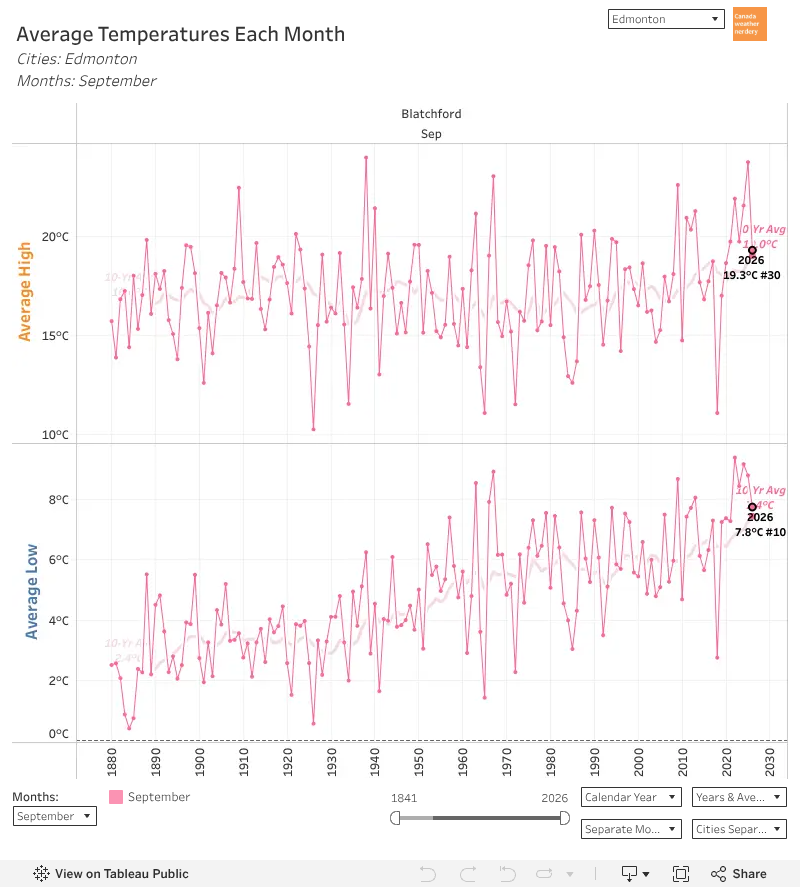
The average High of 19.3°C was the 30th warmest. 

The average Low of 12°C was 10th warmest. (compared to 100 years ago September's average Lows have increased by 5°C)


High Temperatures
September's Highs basically bounced around the average all month, with a few extra warm days around the 21st. The coldest High was 11.1°C on the 26th, and the warmest was 28°C on the 21st. 

Overall 16 Highs were above-average, and 14 were below.

September averages 12 20°C Highs, and 2026 got 12. 

4 of those might get to 25°C, while 2026 got 6 of them.

2022 & 2024 both had several 30°C Highs, but 2026's warmest was 28°C. 

And September averages 2 Highs below 10°C, but 2026 had none.


Warm Days So Far
We might still see some warm days in October. 

But right now 2026 has had 103 Highs reach 20°C, which is typical nowadays, but the historic average was closer to 90. 

And 38 of those got to 25°C, which is just a bit above average.


Low Temperatures
September 2026's Lows were mostly above average: 19 were above, with 11 below. 

The warmest was 14.6°C on the 2nd. The coldest was 1.4°C on the 15th. So it was another frost-free September for Blatchford.

Blatchford hasn't had a September frost since 2019. Although they used to happen every few years.


First-Frost
Blatchford's average first frost is September 30th, and Stony Plain's is September 25th. But so far they're both frost-free.

The airport & Campsie got their first frosts on the 15th & 13th, which is a little later than their averages of the 10th & 6th.


Warm & Cold Months
September 2026 gets medium orange/warms dots. 

The average High of 19.3°C was 2.4°C warmer than the 20th century average. The average Low of 7.8°C was 3.1°C warmer than the 20th century average.


The Horserace
With 3 months left in the year (and the promise of a super El Niño on the way) 2026's temperatures currently sit as Edmonton's 23rd warmest on record, at 1.48°C warmer than the 20th Century average. 

Recently 2025 & 2024 ended the year as 7th & 10th, while 2023 was 1st.


Across Canada
Across Canada September was cool in the east, and above-average everywhere else. Saskatoon's Highs were 2.8°C warmer than their 20th century average, while Moncton's were 0.8°C below theirs.


Precipitation
In September Edmonton averages 32mm of Precipitation. After the ridiculously rainy summer, September was below average. 

In 2026 Blatchford got 14.4mm, the airport got 21mm, and Stony Plain got 21.7mm.


2026 So Far
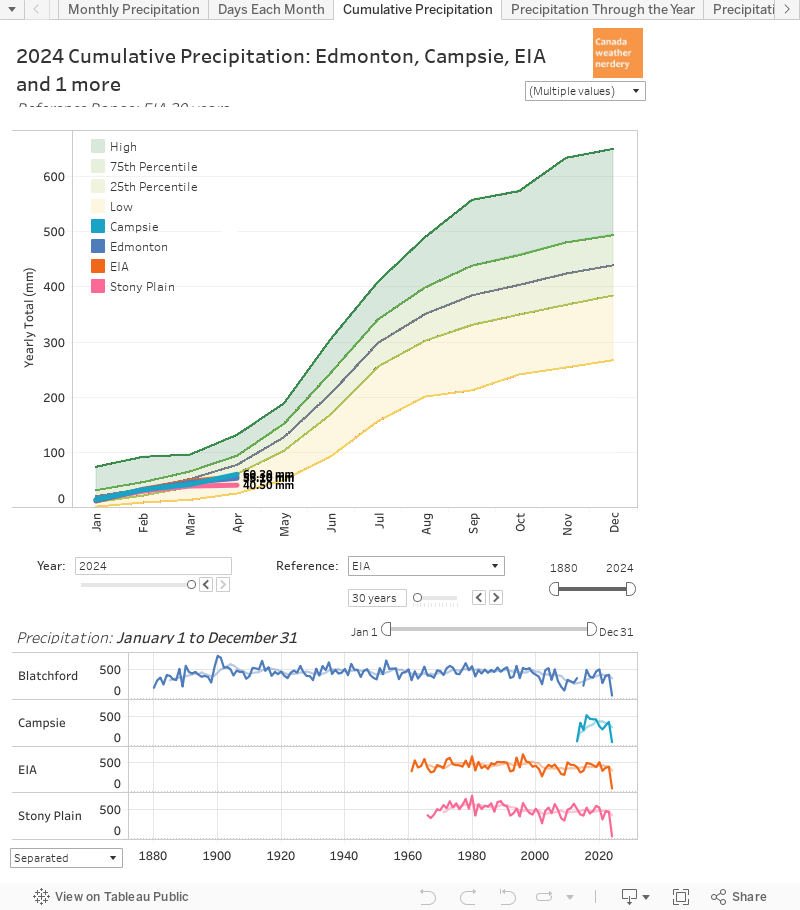
By the end of September we average around 382mm of precipitation for the year, but in 2026 the local stations are still well above average. Blatchford is up at 716.8mm, Stony Plain has 571mm, and the airport has 496mm.

716.8mm is Blatchford's 2nd rainiest year on record. It's just 8mm behind 1900's record of 724.8mm. In October we average 18mm, and before the end of the year we average 54mm.


Precipitation Across Canada
Edmonton's 717mm has it well ahead of the other prairie cities, which are all between 350-400mm. But central & eastern Canada are mostly from 800-1000mm, with Halifax close to 1100mm.

For big September storms Halifax led the way with 72.6mm on the 4th. That first week saw 40mm+ storms in Toronto, Halifax, Charlottetown (x2), St. John's, Regina & Saskatoon. Compared to that the rest of the month was pretty quiet.


October
For October, we average about 1~2 Highs of 20°C, but half of the time there are none. 

October also averages 2 Highs below 0°C, and 14 freezing Lows. 

And...we average 7cm of snow in October. Although 2021, 2022, 2024 & 2025 had none.

2025/04/30

April 2025 Review

Suddenly it's May, so it's time for our big look back at April 2025 weather in Edmonton.

April 2025 ends up as a pretty warm one. 
The average High of 13.3°C was the 30th warmest on record, and average Low of 1.3°C was 15th warmest. 

That made it our warmest April since 2016.

April is one of the months, along with October, where our average Highs haven't changed much over the past century. Both have stayed a little below 11°C going back to 1880. The Lows for both have increased by around 2.5°C, though.


High Temperatures
April 2025 had 22 above-average Highs, and 8 below-average. The 6th & 26th got near the top of our 30-year range, although they weren't close to any all-time records. And none of the below-average Highs were particularly cold.

April averages 2 below-freezing Highs, and 2025 didn't have any. The last April that did get some was 2022, with 5. 

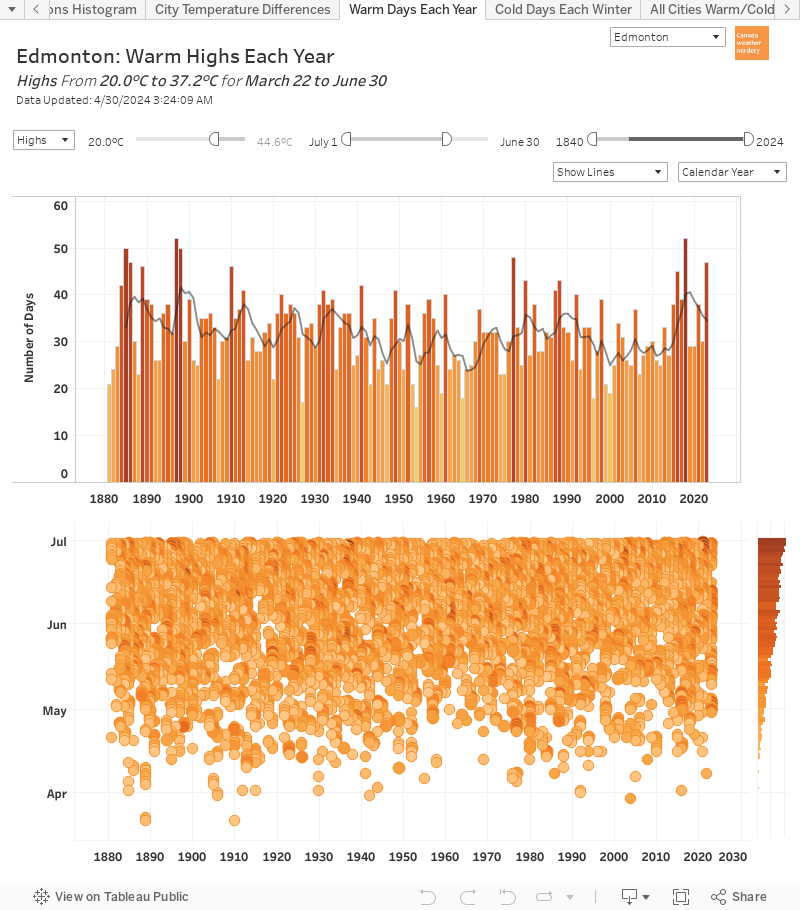
April also averages 3 20°C Highs, and this year we got 2 (although 2024 had none).

20°C Highs often start to show up around mid-April. The first one of 2025 was April 26th. 

Before that our last one was back on October 8th. So we went 198 days below 20°C, which is fairly typical. 

Recently 2022 went just 173 days, while 2017 went 218.


Low Temperatures
April 2025's Lows looked a lot like the Highs, with 20 above-average and 10 below-below average. A few days were up at the top of our 30-year range, and the below-average Lows weren't particularly cold.

April averages around 15 below-freezing Lows, and 2025 had 9. The coldest was -7.4°C on the 4th. 

April average 2 Lows above 5°C, and 2025 had 7.


Final Spring Frost
The average date of the final spring frost at Blatchford is May 4th. 

Right now the last frost was on April 18th, although there's still plenty of time for the weather to turn again. 

But 2024's final frost was April 20th, 2023's was the 22nd, and 2020's was the 19th.


Warm & Cold Months
April 2025 gets a medium sized orange bubble. The average High of 13.3°C was 2.7°C warmer than the 20th century average. The average Low of 1.3°C was also 2.7°C warmer. And it was the warmest April since 2016.


Across Canada
April follows March as another warm month across the whole country. Dawson City was the most above average with a High 3.2°C above its 20th century average, and Edmonton's 2.7°C was second.


Snow
In April we average 14cm of snowfall. In 2025 we got...0cm! 

The airport has only had 1 other snowless April, back in 1998.

When Blatchford still recorded snow it was snowfree in 2005, 1998, 1984, 1949, 1919, 1906 & 1905 (and 6 more before 1900, which seems suspect)

Quite a few other cities did get snow in April. Charlottetown was up at 43cm, Halifax had 43cm, and Calgary got 11cm.

By the end of April Edmonton averages 114cm of total snowfall. After the snowfree April the winter of 2024-2025 is stuck at 105cm. But in May we get more snow about half of the time.

At the end of the winter Charelottetown takes the top spot with 450cm of snow, well ahead of Ottawa, St. John's and Moncton around 250cm. 

Calgary was the biggest outlier here, as its 83.5cm was a bottom-10 year.


Snowdepth
The airport's last day with snow on the ground was April 4th. Stony Plain's was the 6th. Elk Island's was basically the 10th, although it bounced around a bit. Campsie was at 1cm on the 8th, but then also bounced around.

The airport has snow on the ground from November 22nd to April 4th. That's 133 days in-a-row, which is fairly typical. For Stony Plain it was 99 days (it originally got to 0cm in March), and Elk Island was 138 days.


Precipitation
In April we average 27mm of combined precipitation (rain+snow). 

2025 was low, with 4.9mm at Blatchford, and 12.8mm at the airport and Stony Plain. Campise (100km NW) was right on average. 

Blatchford's 4.9mm was still more than April 2019, 2020 or 2021.

By the end of April we average around 75mm of precipitation for the year. 

Right now the stations range from 75mm at the airport to 85mm at Blatchford. 

Things usually pick up from mid-May through mid-August, with about 60% of our total precipitation for the year.

While Edmonton has had 75mm of precipitation so far in 2025, and Calgary is at 51mm, at the other end St. John's is up at 443mm, Halifax has 385mm, and Vancouver has 351mm.


May
For May we average a week or two of days above 20°C, and quite often we will reach 30°C. 

About a third of the time our final frost is in April, but May often has a few of frosty nights. 

And the airport recorded May snow in 2022, 2021, 2020, 2019, 2015...

2023/10/22

First Autumn Frost of 2023

It finally happened: October 22nd is Blatchford's first official frost of fall 2023. 
That comes 6 months after the final frost of spring, back on April 22nd.


October 22 is Blatchford's 2nd latest first-frost-of-autumn on record. It just misses 2022's record of October 23rd. 1975 is 3rd, with October 21st.

2023 had a fairly early final-spring-frost on April 22nd, and a very late first-fall-frost on October 22nd. 

Altogether there were 182 frost-free days in-a-row, which is the 2nd most on record, behind 184 in 1985. 182 days is essentially half of the year.

2023 snuck through on a bit of a technicality though, because we did already drop all of the way down to 0.1°C on October 1st and 5th. 

Last year in 2022 things stayed above 1°C until the first frost, and 1980 & 1975 dipped down to 0.6°C.

While Blatchford's first-fall-frost was very late this year, the rest of the region was closer to average, and got caught by some of the cool nights back in September.

Across the prairies Edmonton almost always records a longer frost-free season than the other big cities. 

But this year Calgary's was 1 week later than their average, and Saskatoon, Regina & Winnipeg were all around 2 weeks late.

October 22nd is an extremely late frost for Edmonton, but in central and eastern Canada it's just average. St. John's had its first frost on October 18th, but the rest of the cities are still waiting.

This is another way of looking at how freezing Lows start to creep in during September & October. 

2022 had 5 by the end of October, and the average is around 17. 2018 had a ridiculously cold September, and had 29 freezing Lows up to Halloween.

2023/01/01

2022 Year-in-Review Part 1: Temperatures

And now, what you've all been waiting for! It's time for Part 1 of our big look back at 2022 with our Year-in-Review.
Sometimes the dashboards in these posts will become corrupted, and so if you are reading this in the future and things no longer make sense the original charts are here:

Warmest & Coldest Years
The big news is that Edmonton's average temperature for 2022 was the 18 warmest on record. That is not as warm as 2021 (#10), but is warmer than 2018-2020. 

April, May, November & December were the below-average months, with December as our 18th coldest on record.

At the end of October the temperatures for 2022 had climbed into the #4 spot, but the very cold November & December pushed it back down. 

At the end of the year the Highs were 30th warmest and the Lows were 20th warmest, which combined makes it the 18th warmest overall.

For the climate stripes scarf chart 2022 is a fairly dark pink. The last time that we had a blue stripe was back in 1996, at -1.7°C colder than the 20th century average.


Temperatures Across Canada
Across the country 2022 was a top-10 year for St. John's & Halifax, and top-20 for Montréal, Edmonton & Calgary. 

Winnipeg was the only city here with a cool year, ranking as its 100th warmest and -0.6°C below the 20th century average.


Warm & Cold Months
2022's temperatures were often split west/east across the country, with a cool January in central Canada, a cool April in the west, a really warm summer in the west, and then a very cold November & December in the west.

The temperatures for July 1st-October 31st were the #1 warmest on record for Edmonton, Calgary, Halifax & St. John's, and #2 for Vancouver & Saskatoon. That was followed by a November-December which was bottom 10~20 coldest in Vancouver through Regina.


High Temperatures
For 2022 we had 211 days with Highs above our 30-year average, including 5 new warmest-records in July-September. There were 154 below-average Highs, including 2 new coldest-records in December. There were lots of above-average days in January, and July-October.

2022 had 118 days with Highs that reached 20°C, which is 2nd only to 122 in 1897 & 1898. 

The number of 25°C & 30°C days was down from the record-breaking 2021...

...but in Edmonton the summer of 2022 didn't really kick-in until July. Just from July 1st onwards 2022 had 46 Highs reach 25°C, which was the most on record. And it had 11 Highs of 30°C, which tied with 2022, 1981 & 1933 for 1st place.

Across the country Edmonton and Calgary were the most unusual for 30°C days in 2022, having their 5th and 8th highest numbers on record.


Low Temperatures
For 2022 there were 212 days with Lows above average, including 11 new warmest-records in July-October. The 153 below-average Lows didn't set any new records, but 16 were the coldest in 30 years, mostly in November & December.

2022 started and (basically) ended with deepfreezes. We had 33 days with Lows which reached -20°C, while we average around 25 days. 

That included 16 Lows which reached -25°C, which ties 2021, and is above our average of around 10 days.

2022 also had 4 Lows reach -30°C, which is down from 6 in 2021.

For some trivia, this is the first time that we've had 4 years in-a-row record at least 4 Lows of -30°C since 1969-1972.

For -20°C Lows across the country 2022 was a little above average for all of these cities.


Yearly Extremes
With a warmest High of 33.8°C, and a coldest Low of -34.1°C the range of temperatures recorded in 2022 was 67.9°C. The record for a calendar year is 80.5°C, set in 1936 and 1886 (our Lows used to get a lot colder).


Frost-Free Days
The final frost of the spring was a little late on May 10th, while the first frost of fall was record-breakingly late on October 23rd. So 2022 ended up with 166 frost-free days, while our average is 142.

Across the country St. John's & Halifax also had first fall frosts which were a few weeks late, while the rest of these cities were pretty close to their averages.


Edmonton versus Calgary
And finally, a quick comparison of Edmonton & Calgary temperatures for 2022.

The two cities tend to track fairly closely to each other, except that sometimes a Chinook really hits Calgary. We saw that on December 24th & 25th with Calgary's Highs 18°C warmer than Edmonton.

That's the end of Part 1 of our 2022 Year-in-Review. Part 2 will look at precipitation, and part 3 will be all about snow.