2025/12/31

December 2025 Review

The December that just wouldn't end is finally over. But how unusual was it? Let's take a look back at Edmonton weather for a pretty cold and very snowy December 2025.

December's temperatures haven't changed too much over the past century.

But 2025 was cold.

The average High of -8.8°C was our 108th warmest (out of 146). The average Low of -18.4°C was 113th.

Lots of recent years were in the same range, like 2022, 2021, 2013, 2012, 2010, 2009, 2008...


High Temperatures
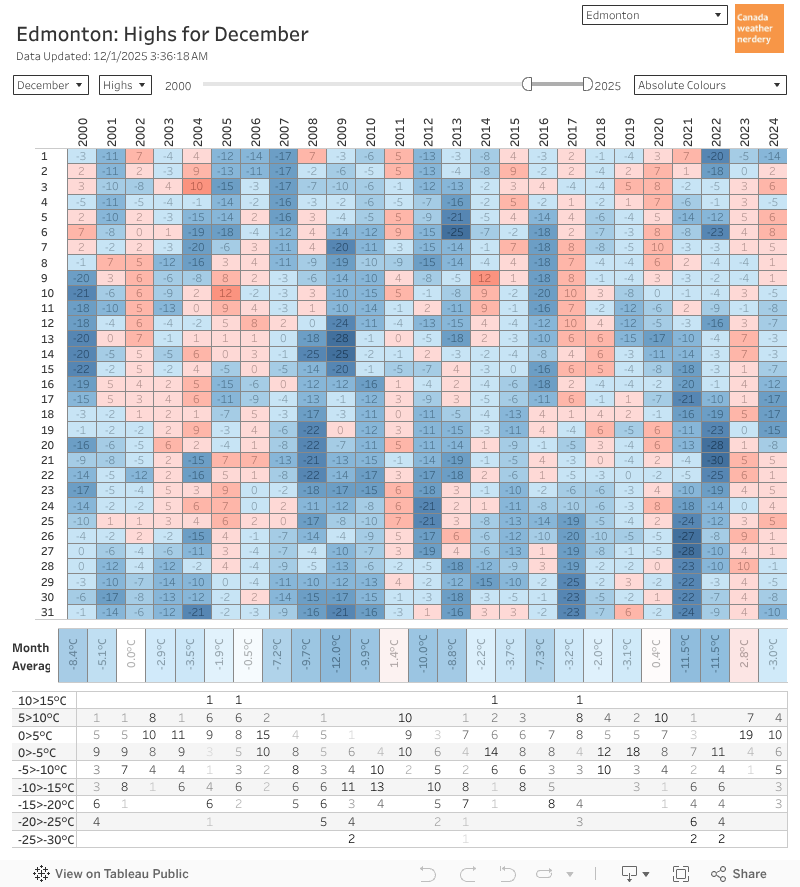
December 2025 ended up with 9 Highs which were above our 30 year average, at the start, the end, an 1 in the middle.

Our average High is around -4°C, but we spent a bunch of the month down around -15°C.

None got super cold, but there were a lot of them.

December averages around 10 Highs above-freezing, and 2025 got to 7. The warmest was 8.5°C on the 15th. 

And it averages 5 Highs below -15°C, and we had 11. We didn't officially get any -20°C Highs, although the 11th & 12th both got to -19.8°C.


Low Temperatures
For the Lows, 8 were above average, with the rest below.

Our average Low at this time of year is around -13°C, and we spent a chunk of the month below -20°C. The coldest was -29.5°C on the 28th.

December averages around 6 -20°C Lows, and 2025 had 13. Recently 2022 had 12, and 2021 had 14. 

December averages 2 -25°C Lows, and 2025 had 6. The coldest was -29.5°C, but 2022 & 2021 both had 3 -30°C Lows, including a -35°C on December 28th, 2021.

In comparison to 2022 & 2021, 2025 didn't have the extreme deepfreezes that the other two got.


Cold Days So Far
On average we get around 25 -20°C Lows in a whole winter.

December's 13 has gotten us more than halfway there by itself. And for a whole winter we average around a dozen -25°C, and December gave us 6.


Cold Days In-A-Row
December 2025's coldsnap was annoying, but not very interesting. 

For -20°C Lows in-a-row we had 7. But a bunch of recent winters threw more than 2 weeks at us.

We had 13 -17°C Lows in-a-row, but we've gotten to 19 or 20 a few times recently.

For cold Highs, we had 7 in-a-row below -15°C. That's a lot, but around 2020 we had a bunch of 11 day streaks.

And we've had 11 Highs in-a-row below -12°C, which is unusual, but 2019 got to 18.


1/3 Done
Our average temperatures for December, January & February are all pretty close. We've just had a cold December. There's nothing to stop us getting another deepfreeze in January or February. But at this point we are about a third of the way through.


Warm & Cold Months
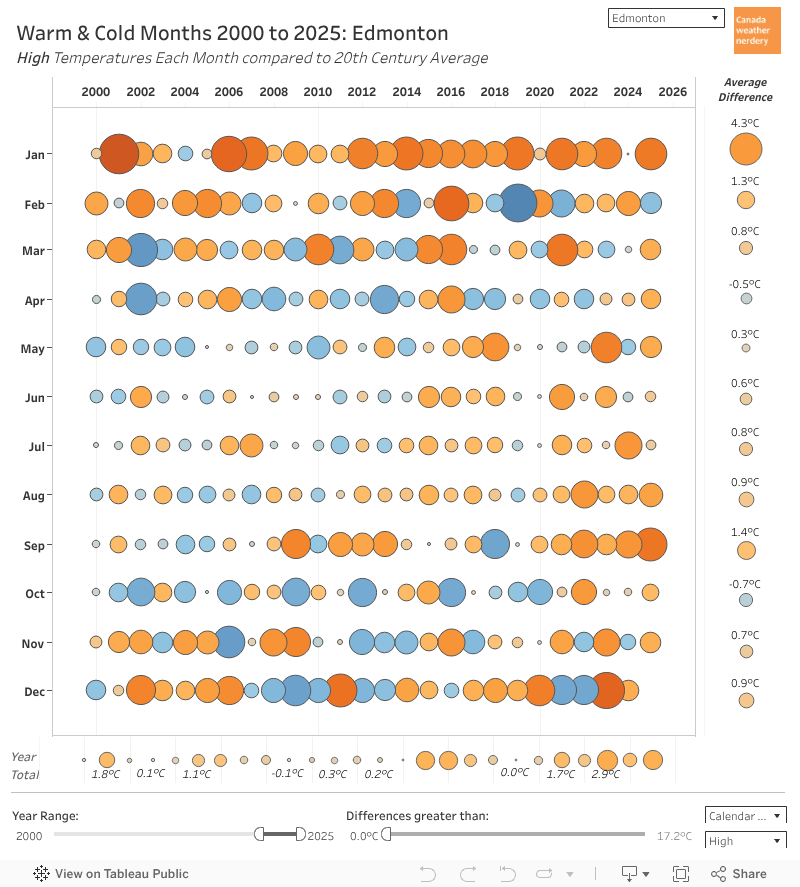
December joins February as the two months of 2025 which were colder than our 20th century average. 

The average High of -8.8°C was -3°C colder. The average Low of -18.4°C was -3.7°C colder.

But lots of Decembers (2022, 2021, 2015, 2012...) get blue bubbles here.


Across Canada
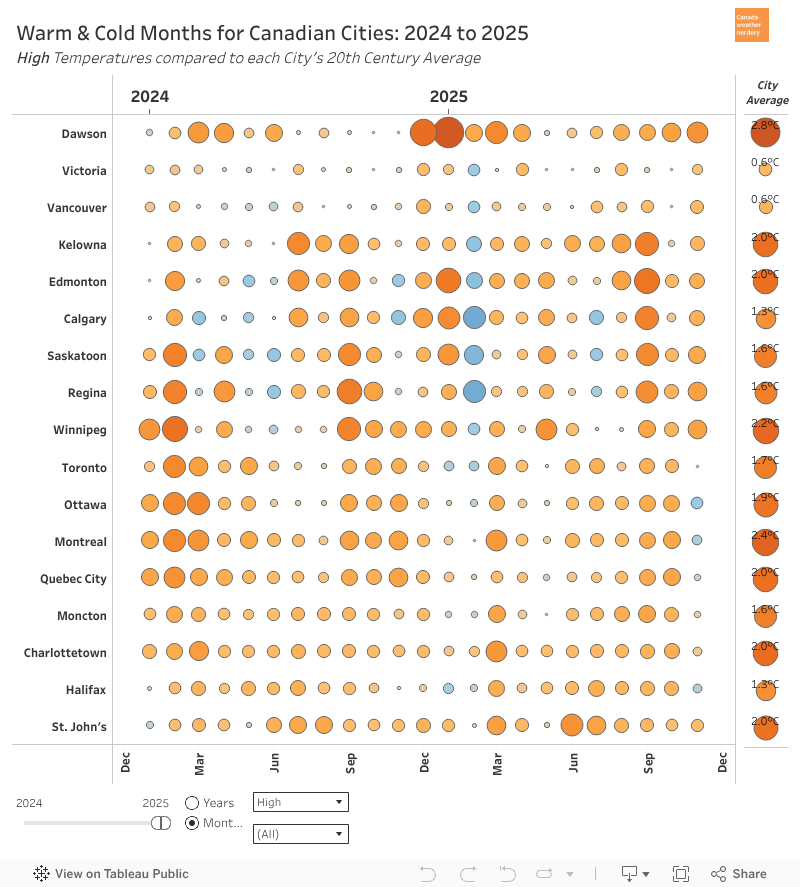
December was cool across the country, although Dawson City (with an average high of -32.2°C and Low of -38.3°C), Edmonton, and Saskatoon got the worst of it.

Somehow Calgary escaped with a relatively mild month, even though the rest of the prairies were well below average.


Snow
In December we average 18cm of snow, and in 2025 we got 59.9cm. 

That is actually a record for the airport, although if you go further back Blatchford's biggest December was 81.5cm in 1893.

December's 59.9cm is the snowiest month that we've had since January 2011, which got 63.7cm.

And before that we have to go back to November 1996, which got 68.5cm at Blatchford & 73.7cm at that airport.
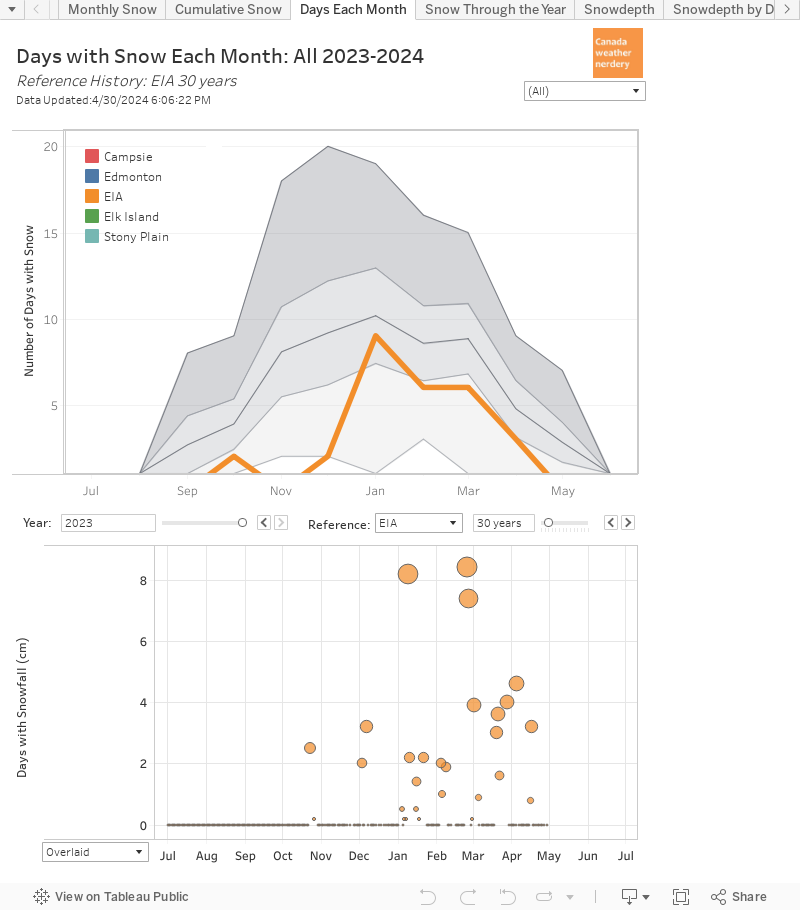
In December we average 9 days with snowfall, and 2025 had 12.

The end of the month got a lot of big snowfalls. The included 3 10cm+ storms, when we might get 3 in an entire winter. The biggest was 18.3cm on the 16th & 17th.


Snow Across Canada
These are the snow totals across the country so far.

Edmonton's 72cm is a fair amount for us. But Ottawa, Montréal & Charlottetown are around 80cm, and St. John's is up at 107cm.


Snowdepth
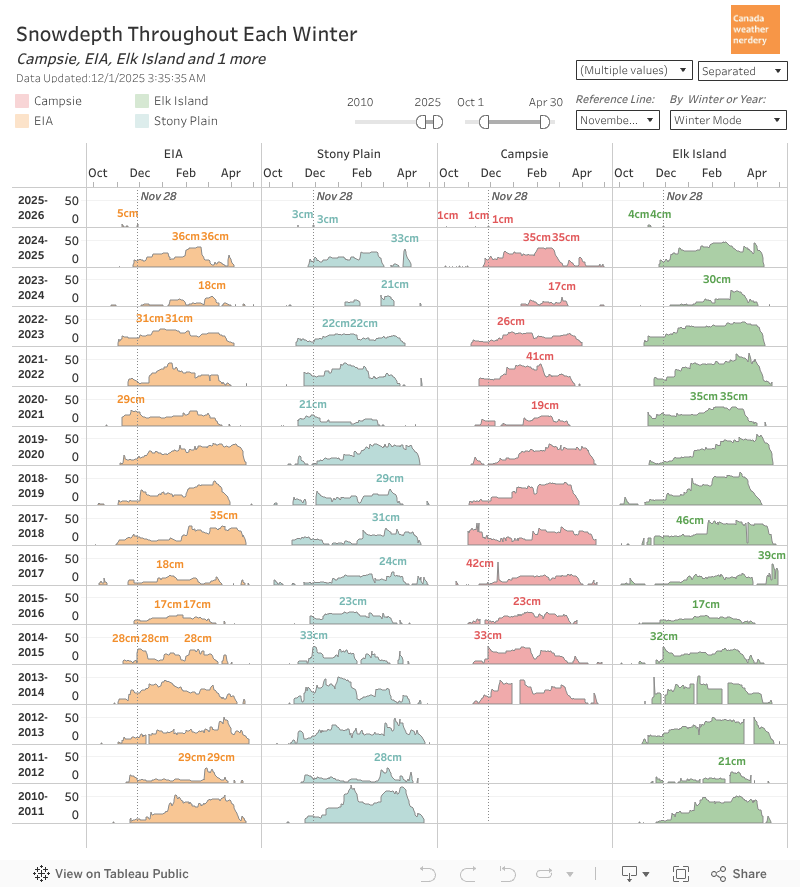
At this point of the winter we average around 15cm of snowdepth.

But with December's record snow it's no surprise that the local stations are all well above that.

The airport is the lowest at 22cm, while Blatchford is at 46cm, after jumping up to 54cm.

These are messy charts, but around the country Edmonton's 46cm is well ahead of the other cities.


Precipitation
In December we average 20mm of precipitation (rain+snow). 

Given all of the snow it's no surprise that 2025 is above average.

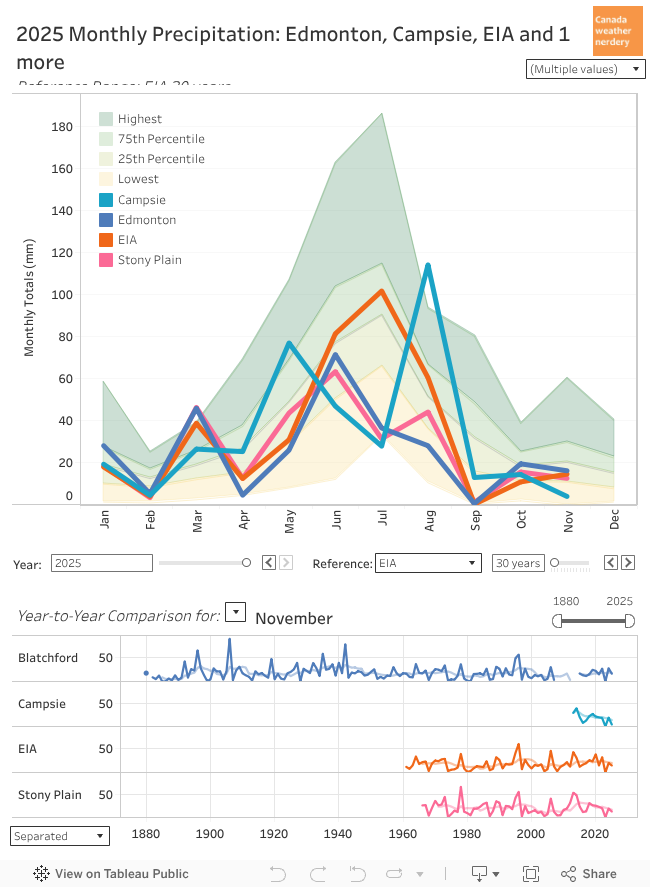
Blatchford, Campsie and the Airport are all around 50mm, while Stony Plain was a bit lower with 38mm.
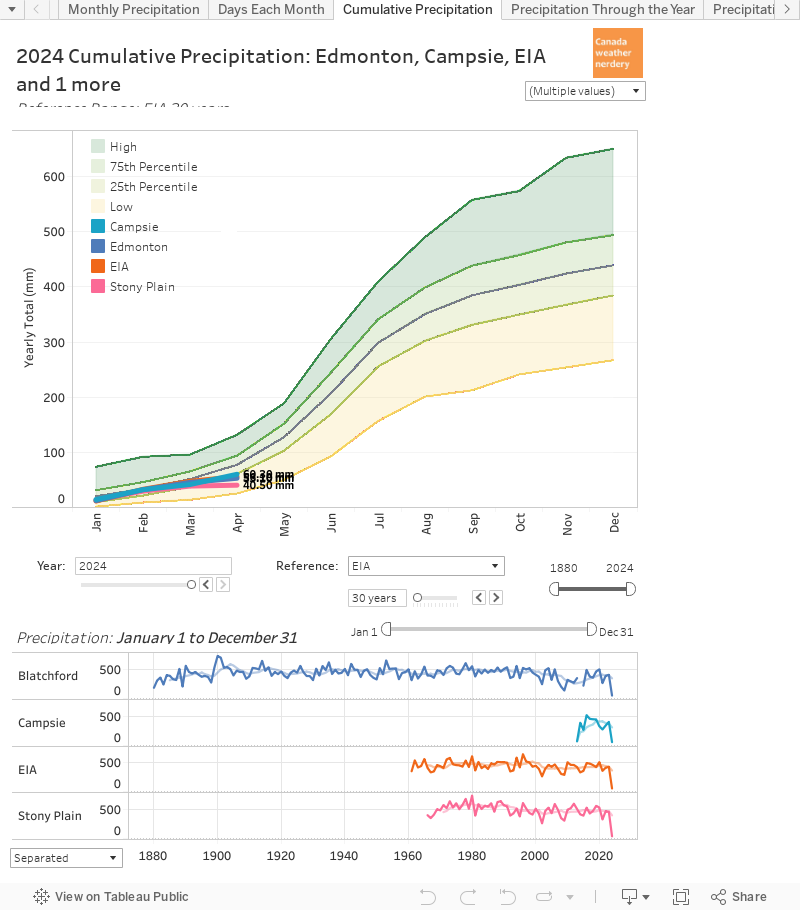
By the end of December we average around 430mm of precipitation for the year. But 2025 had a really low September, July, April & February. 

The airport and Campsie did both end up right on the average. But Stony Plain and Blatchford are 100mm lower, around 335mm.


Precipitation Across Canada
These are the precipitation totals for 2025 across the country. 

St. John's is way out ahead around 1,300mm, while Quebec City and Halifax both crossed 1000mm.

On the other end, the prairies are all below 500mm.

For big December storms it was really Victoria's month, with 227mm, including 47mm on the 16th and 60mm on the 10th. 

Toronto got 41mm on the 28th.

Vancouver's atmospheric river dropped 173mm, including 30.9mm on the 10th.

For Edmonton the biggest was 13mm on the 17th.


January
As for January, on-average we get 12 days with Highs above freezing, with a week of those close to 5°C.

But January is also our biggest month for deepfreezes, with an average of 8 Lows of -20°C.

January's average snowfall is 22cm.

2025/12/01

November 2025 Review

Somehow it's December already, which means that it's time for our big look back at Edmonton weather for November 2025.

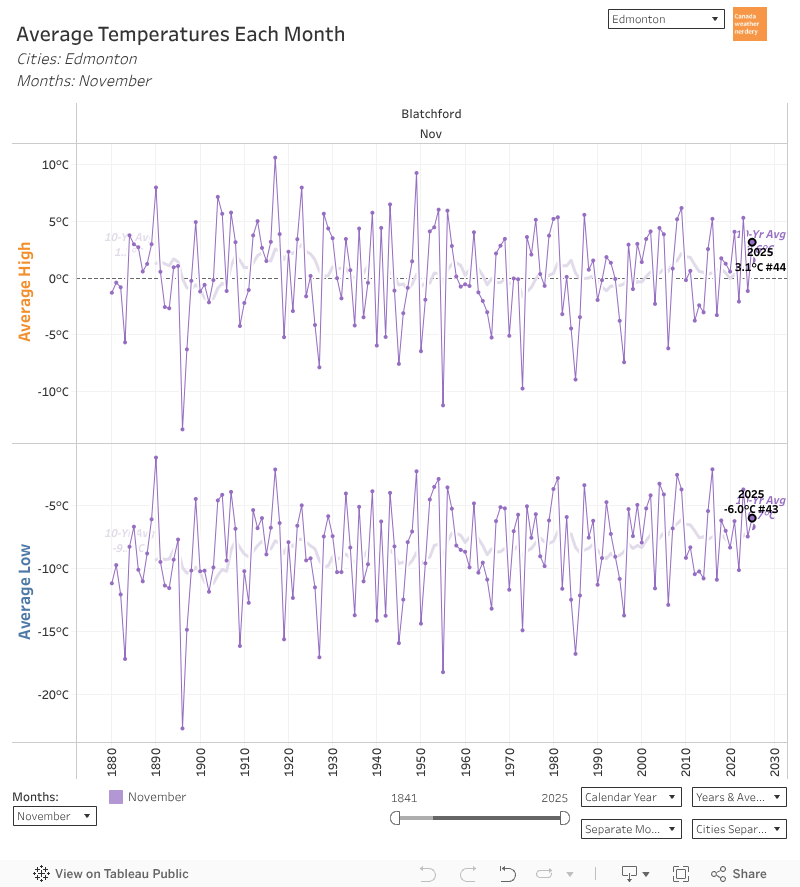
November is one of the months where our average temperatures haven't changed too much over the past century. 

But November 2025 was still warmish. 

The average High of 3.3°C was our 44th warmest, and average Low of -6°C was 43rd. That's just a little below 2023 & 2021.


High Temperatures
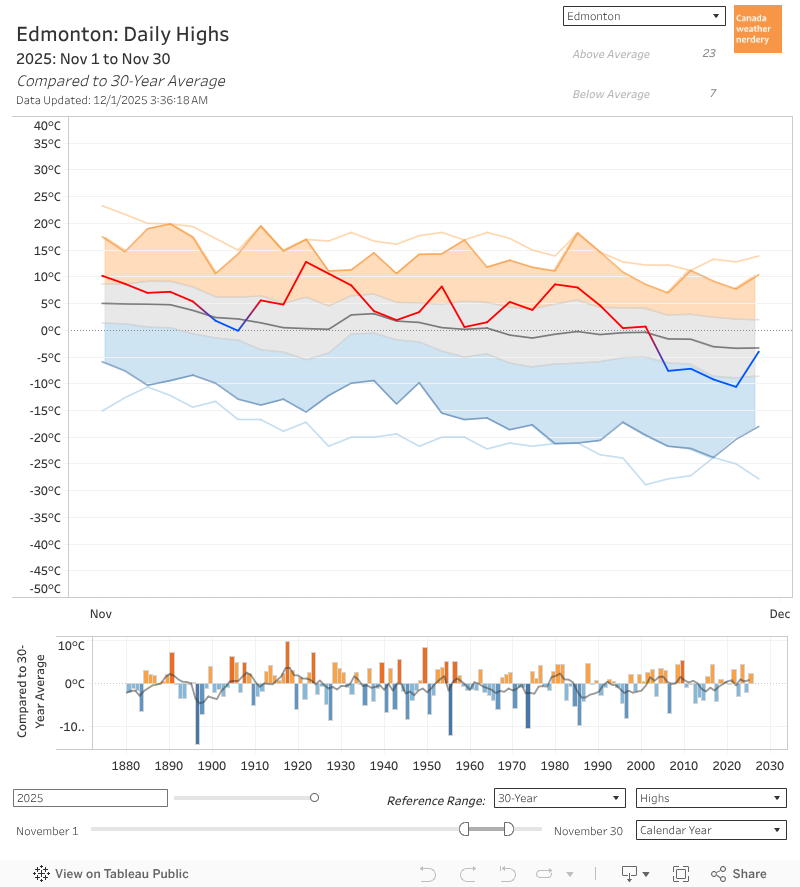
November was pretty mild for most of the month, but it did cool off for the final week. 

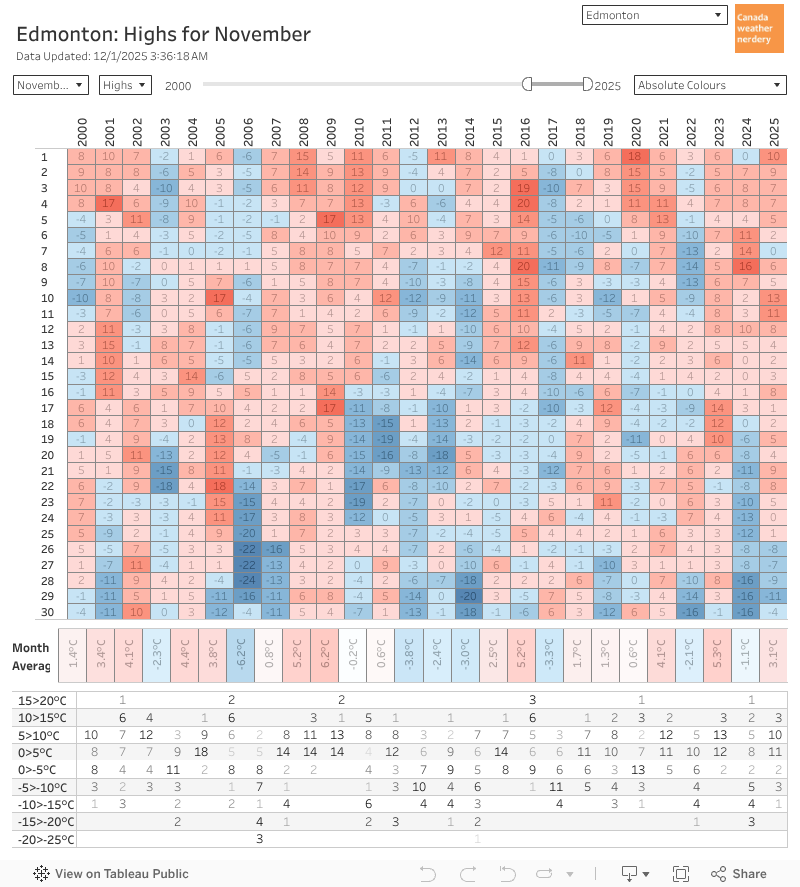
Overall 23 Highs were above average, and 7 were below. Nothing was close to a record, or even to the top or bottom of our ranges.

November averages around 18 Highs above-freezing, and 2025 had 24. 

It also averages 2 Highs below 10°C, and this year we got 1.


Low Temperatures
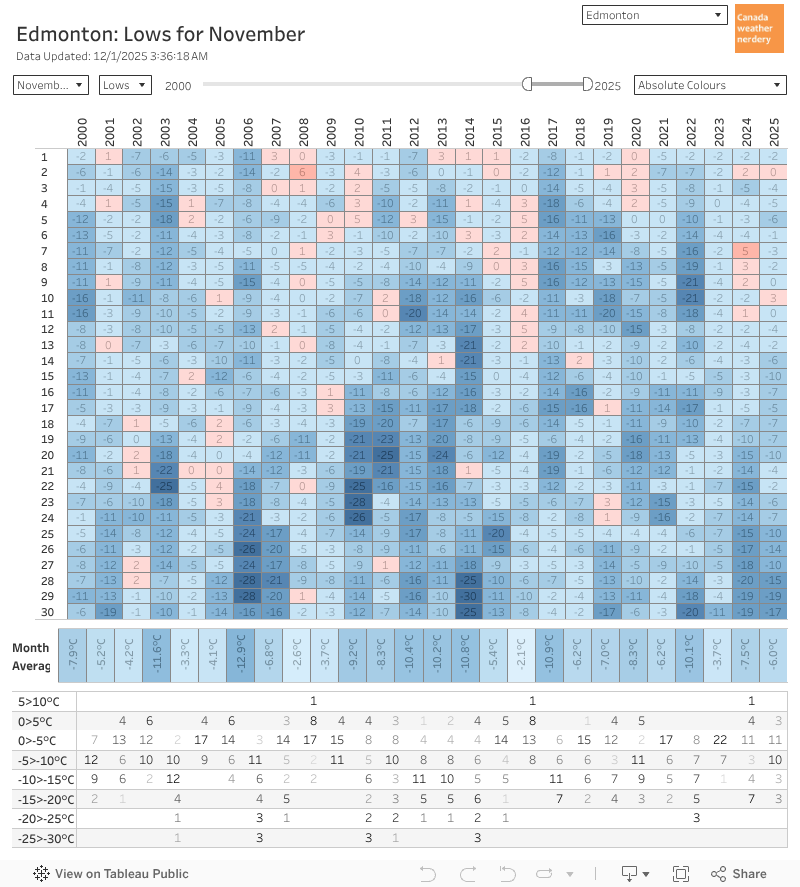
November's Lows were above average for most of the month, before cooling off near the end.

November 10th's Low of 2.9°C was close to the record of 3.3°C from 1895, but other than that they were pretty typical.

The 29th's -19.3°C got us really close to our first -20°C.

So we narrowly missed a -20°C with the 29th's -19.3°C. 

But in November getting all of the way to -20°C is not that common. 

2010-2014 had a bunch of early deepfreezes, including a -29.8°C in 2014. But since 2014, only November 2023 has crossed the -20°C mark.


Warm & Cold Months
November 2025 gets a medium orange bubble here, because it was fairly warm.

The average High of 3.1°C was 2.7°C warmer than the 20th century average. The average Low of -6°C was 2.5°C warmer.

So far February is 2025's only blue month.


Across Canada
Across the country November was cooler than the 20th century average in Ontario & Quebec (and Moncton), and warmer everywhere else.

That ranged from Dawson City with an average High 4.8°C above its 20th century average, to Ottawa at -1.5°C below theirs.


The Horserace
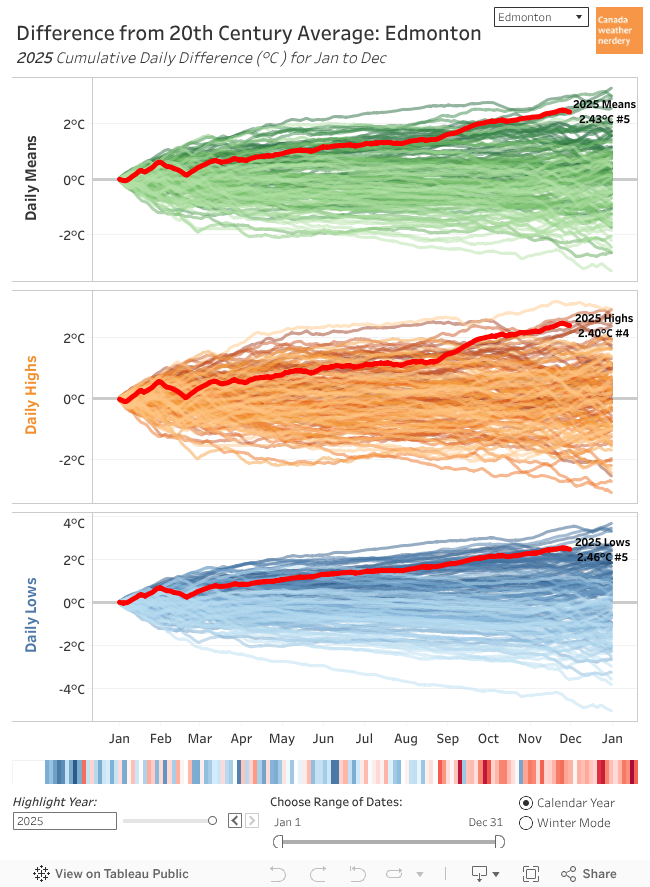
With a month left in 2025 its average temperature is currently Edmonton's 5th warmest overall, at 2.4°C above the 20th century average.

The Highs are actually our 4th warmest, while Lows are 5th, and combined they rank as 5th.

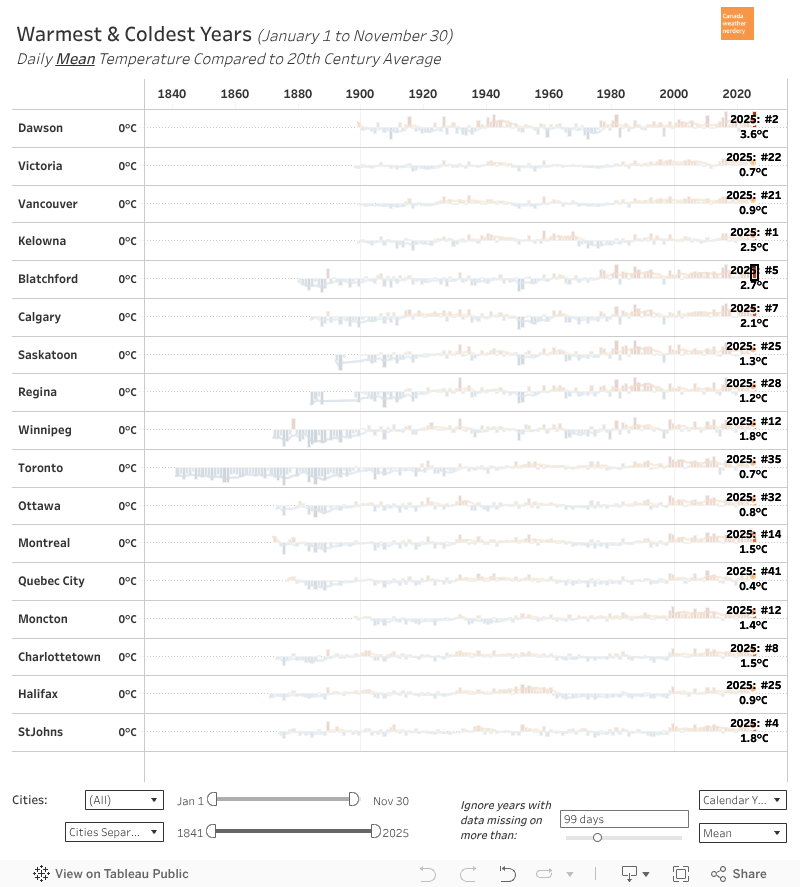
With 1 month left, 2025's average temperature is top-5 in Dawson City, Kelowna, Edmonton & St. John's, and top-10 in Calgary & Charlottetown.


Precipitation
In November we average 20mm of precipitation.

Blatchford got close with 16.5mm, the airport got 14.9mm, and Stony Plain got 12.9mm.

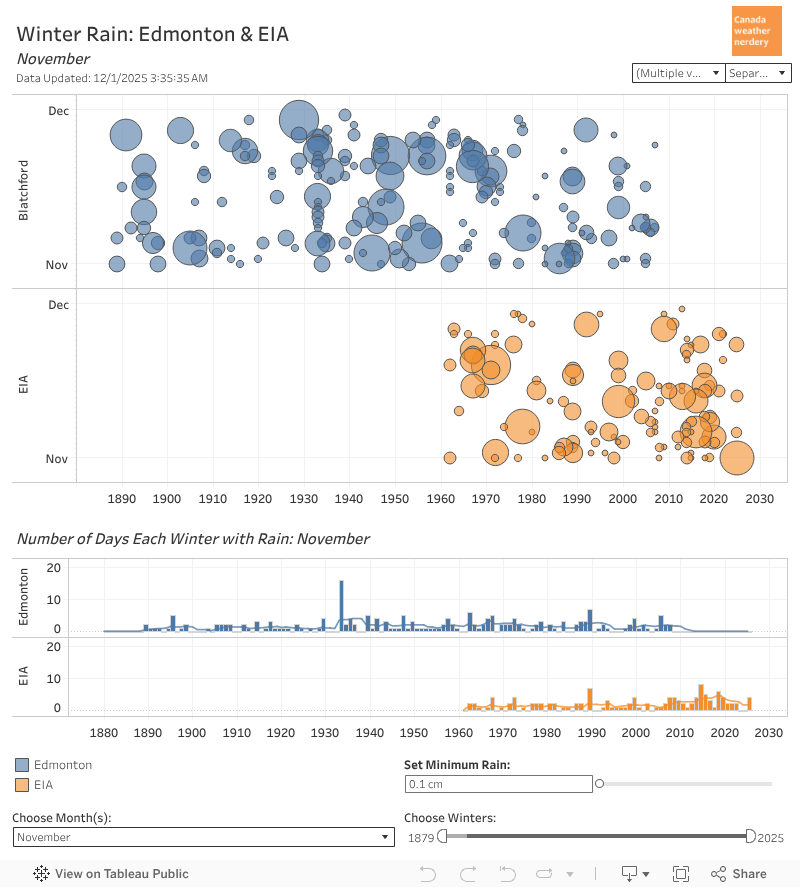
November's precipitation included 4 rainy days: the 1st, 6th, 13th & 23rd. Even though we think of November as a winter month, most Novembers get a few days with rain.

By the end of November we average around 416mm of precipitation for the year. 

2025 has had a really low September, July, April & February, so it's below average.

The airport and Campsie are at 376mm. Stony Plain is down at 296mm, and Blatchford has 286mm.


Precipitation Across Canada
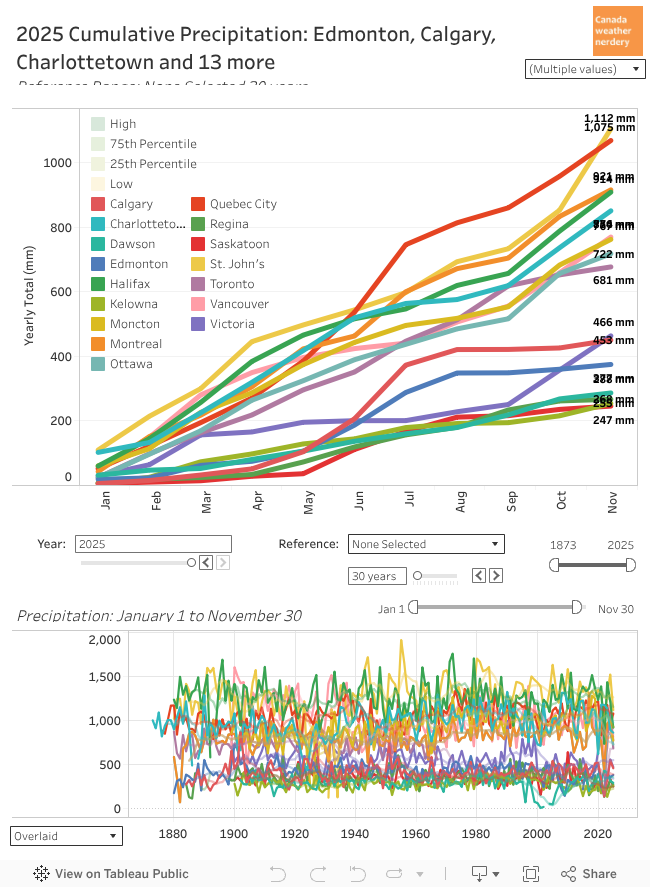
These are the precipitation totals for 2025 across the country. 

St. John's & Quebec City are way out ahead with around 1100mm. The rest of eastern & central Canada range from 700-900mm. The west is below 500mm, except for Vancouver at 774mm.

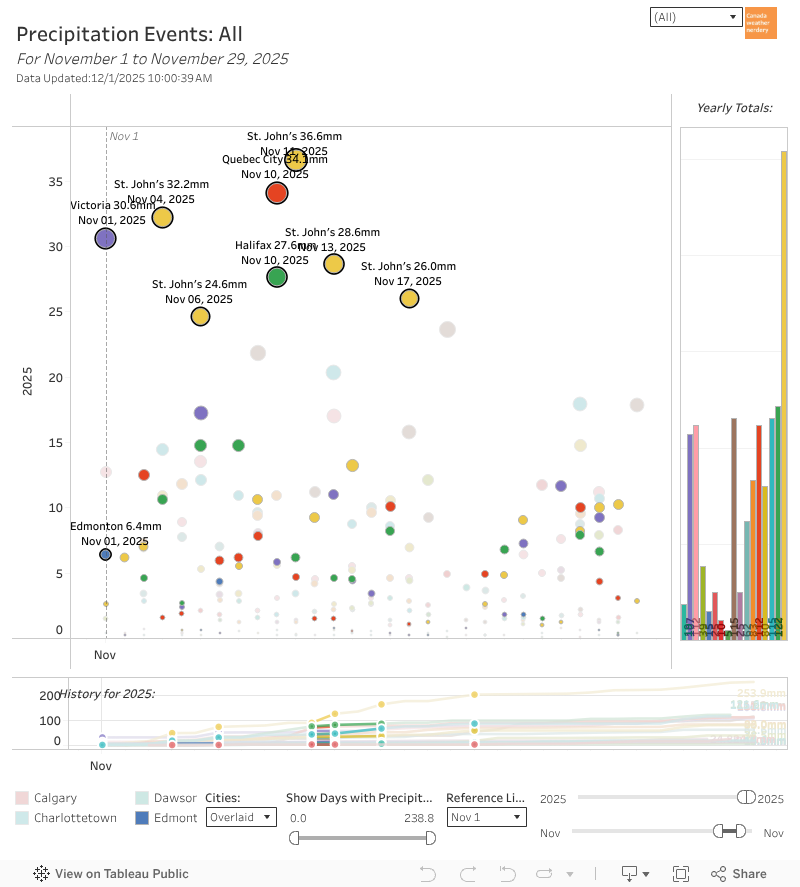
For big November storms: 
  • St. John's had 5 from 25-37mm
  • Victoria had 31mm
  • Halifax had 28mm
For Edmonton the biggest was 6mm on the 1st.


Snow
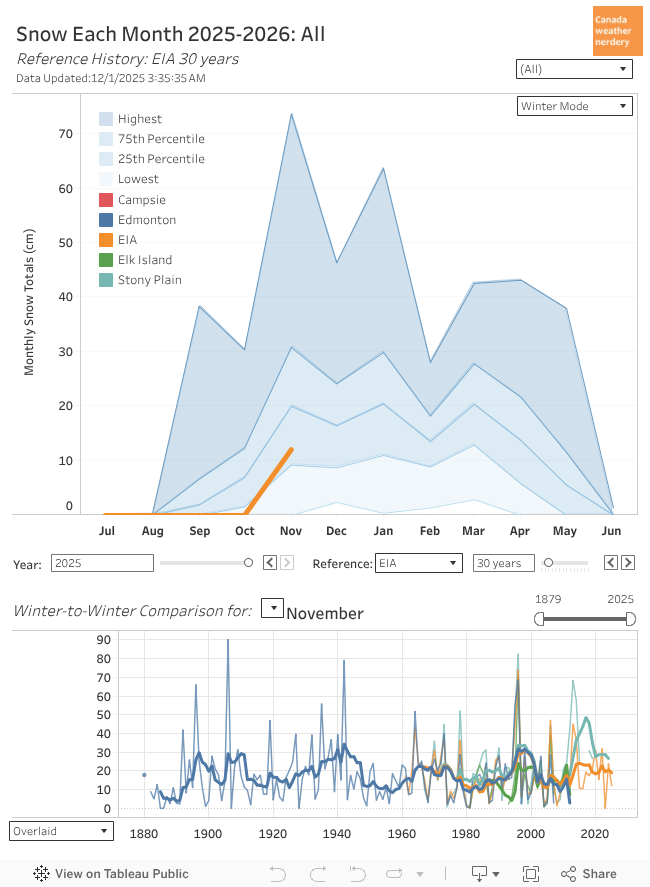
In November we average 20cm of snow, and in 2025 we got 12cm.
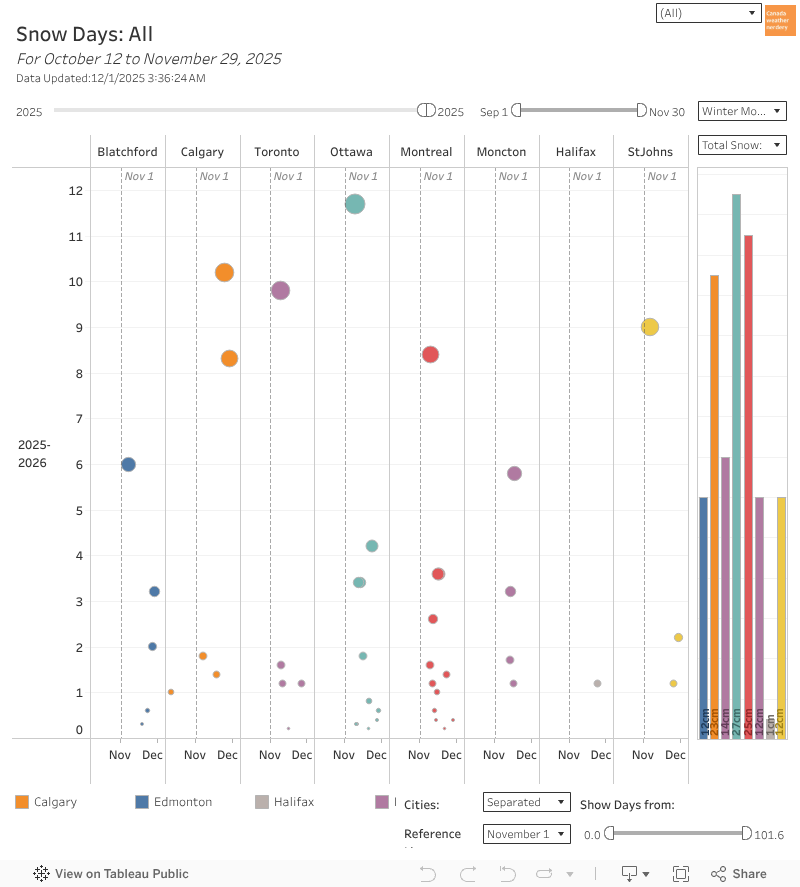
We average 8 snow days, and the airport got 5.

These are the cities with snowfall so far. 

Calgary was the only one to record any before November. 

But by the end of November Calgary, Ottawa & Montréal have all had over 25cm.
(although many cities, like Saskatoon, Regina & Winnipeg do not record snowfall)


First Snow
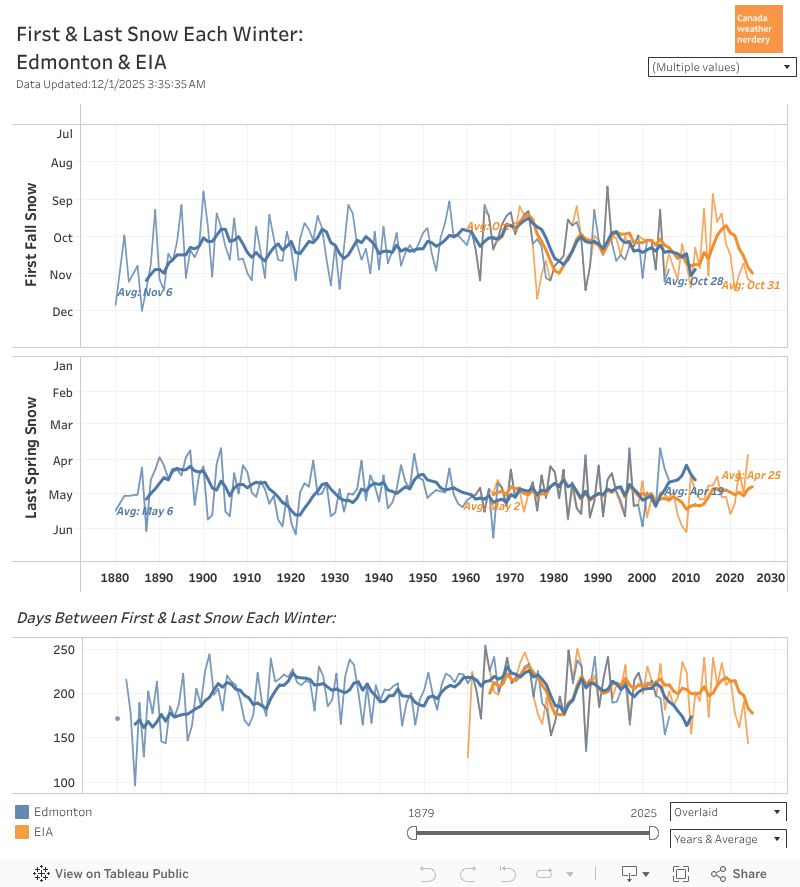
Historically, our first snow has been around the middle of October. That's for the airport and Blatchford, going back to the 1880s.

In 2025 our first snow wasn't until November 7th, and 2021-2025 were all pretty late.

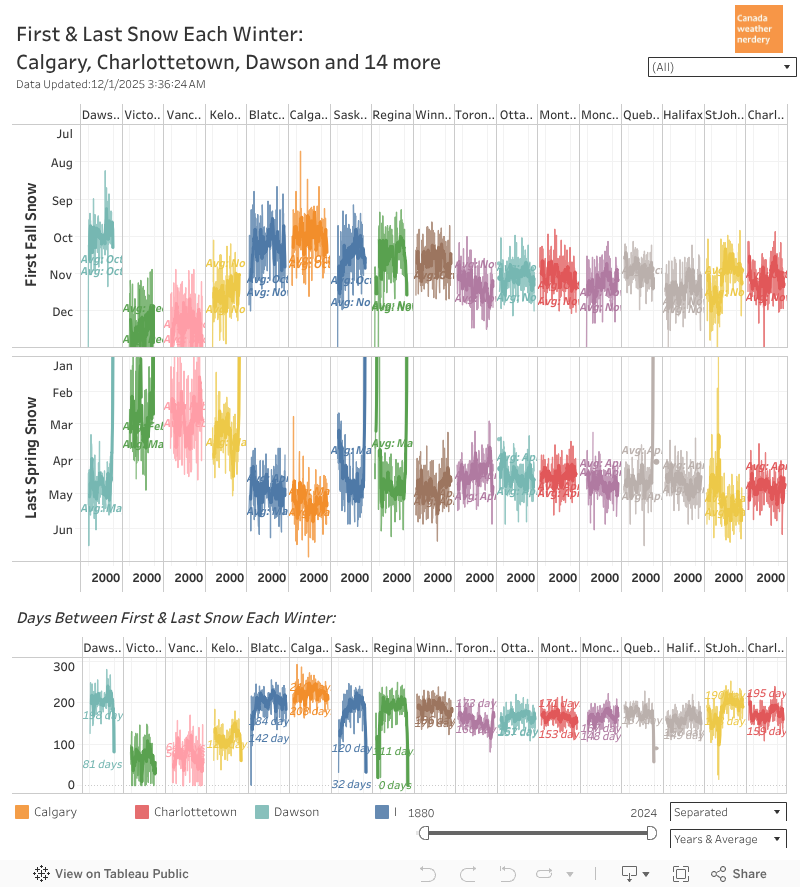
This one is pretty busy, but it gives a sense of the snow season for all these cities. Edmonton, Calgary & Dawson city all get started early.

And unsurprisingly, Vancouver, Victoria & Kelowna get started late.


Snowdepth
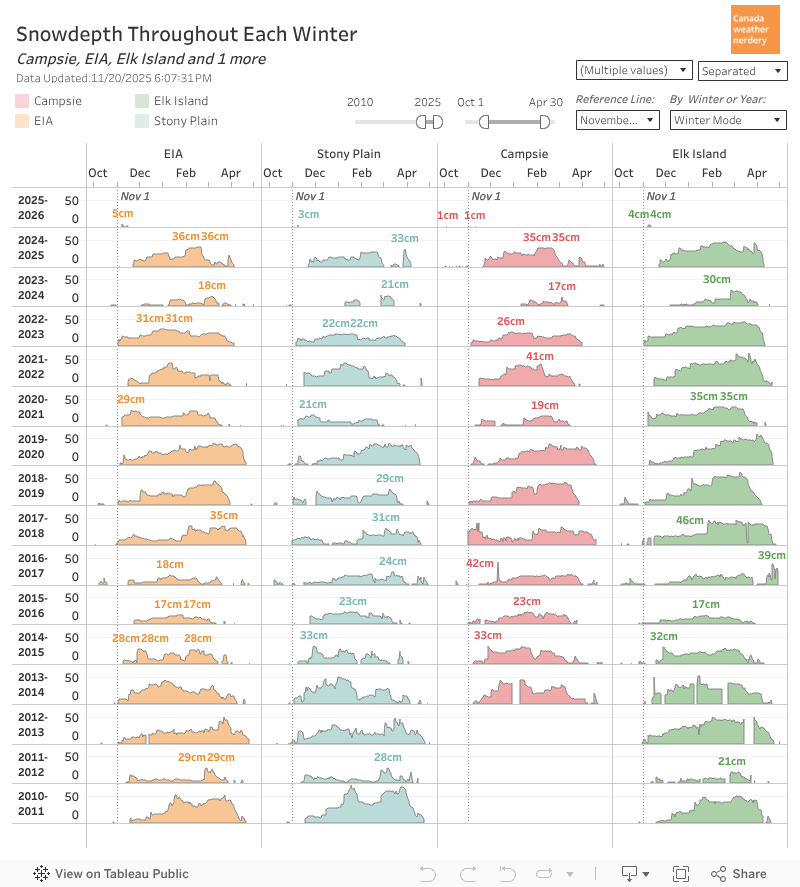
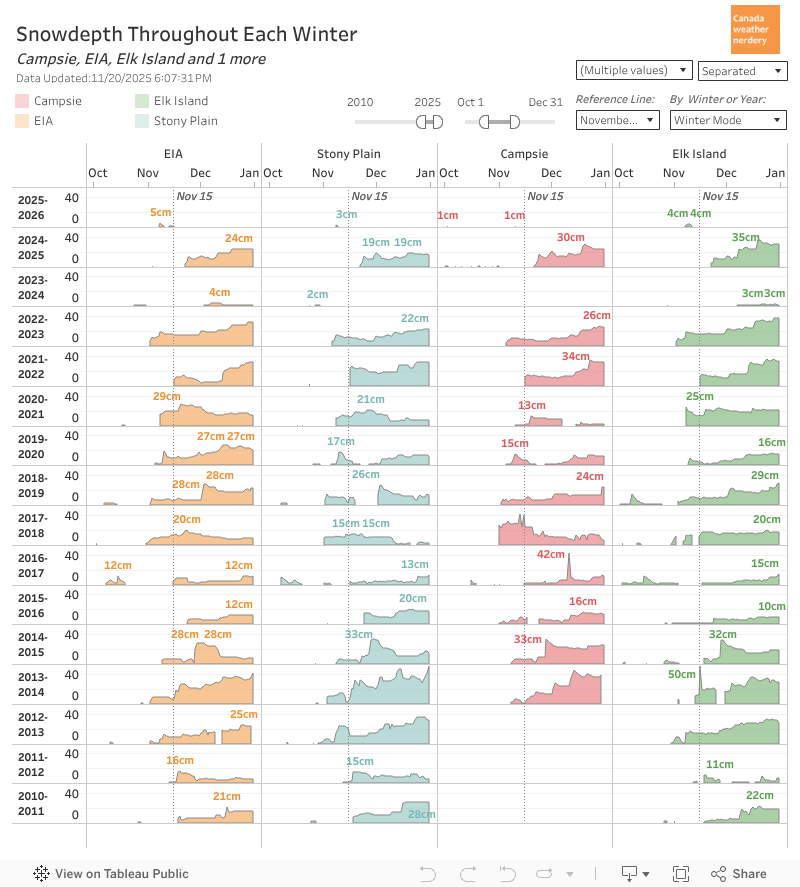
We often start to see lasting snow in the first week of November.

2025 waited until November 28th, and it's still pretty low with 5cm at the airport.

2024 was November 22nd, and 2023 was December 3rd.

But who knows what the winter of 2025-2026 really has in store for us?

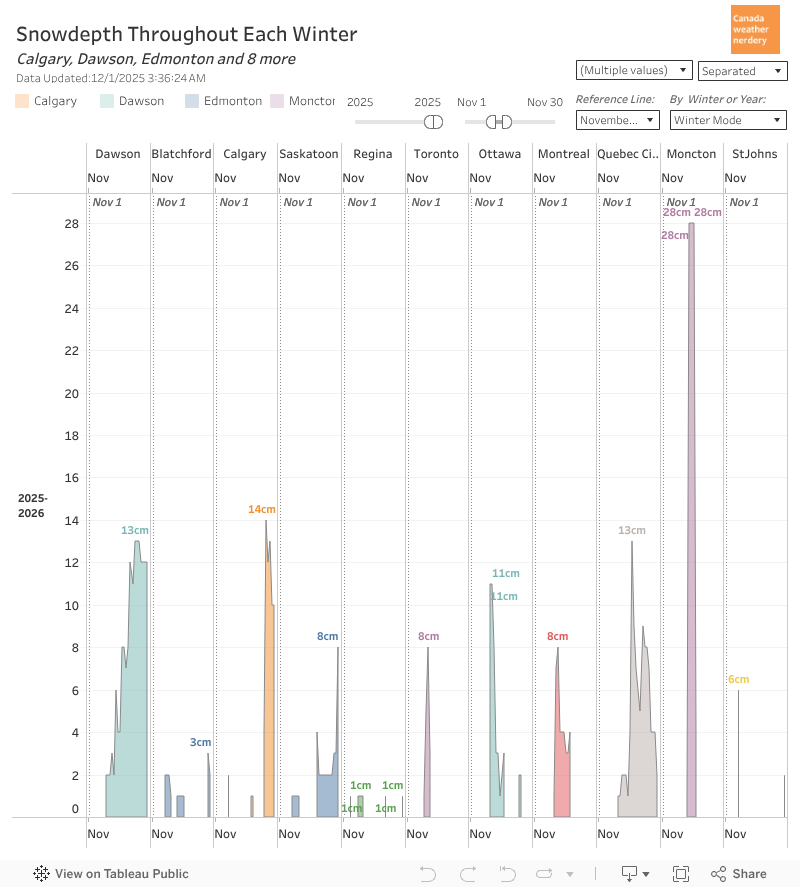
A bunch of cities saw their snowdepths spike in November. 

Dawson City, Calgary, Ottawa & Quebec City all got above 10cm, and Moncton got to 28cm.


December
As for December - it's winter.
We do still average about 10 days with Highs above 0°C.

About half of the time December will hit -25°C, but since 1990 there have been 6 Decembers which didn't hit -20°C (including 2019 & 2023).

And December averages 16cm of snow.

2025/11/20

Edmonton's Winters - the Good, the Bad, and the Data (Part 2)

We're back today with Edmonton's Winters - the Good, the Bad, and the Data (Part 2). Let's talk snow! 

(Our only snowfall measurement now is at the airport, which is quite a bit colder than the city. But we'll use it because it's what we've got.)


Snowfall History
Edmonton averages 125cm of snow each winter. Before the 1980s it was maybe a bit higher at around 135cm.

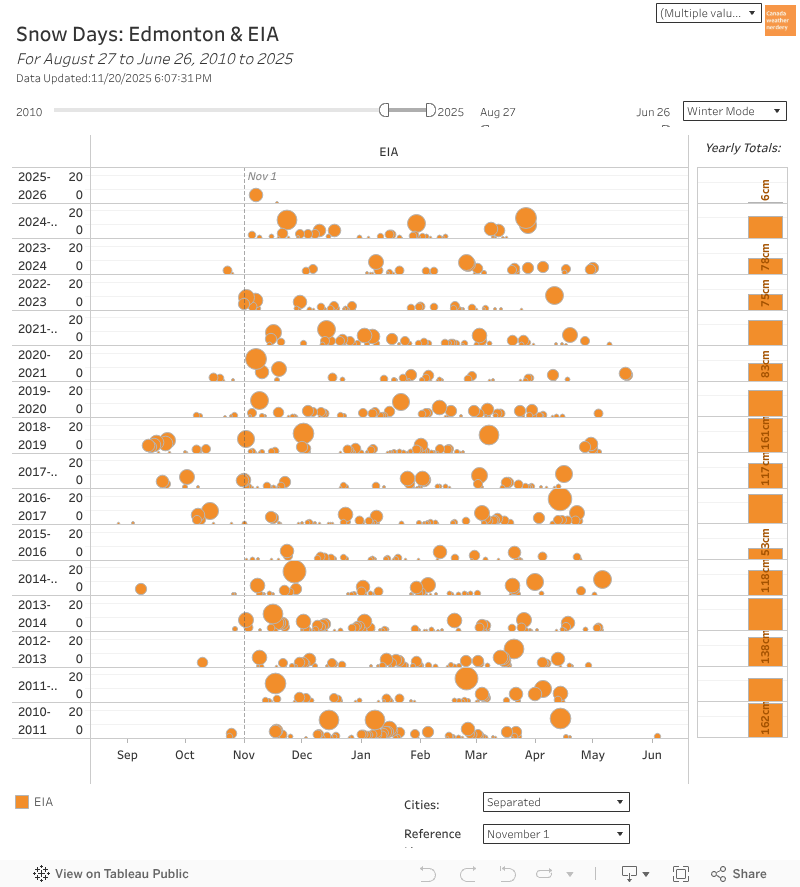
Most winter months average around 20cm, while February & April are lower at 13cm. October & May are pretty hit or miss, and average 6cm.

Snow is also possible in June, August & September, but those are pretty uncommon.

The airport's last June snow was 1.4cm in 2011.
For August it was 0.1cm in 2016.
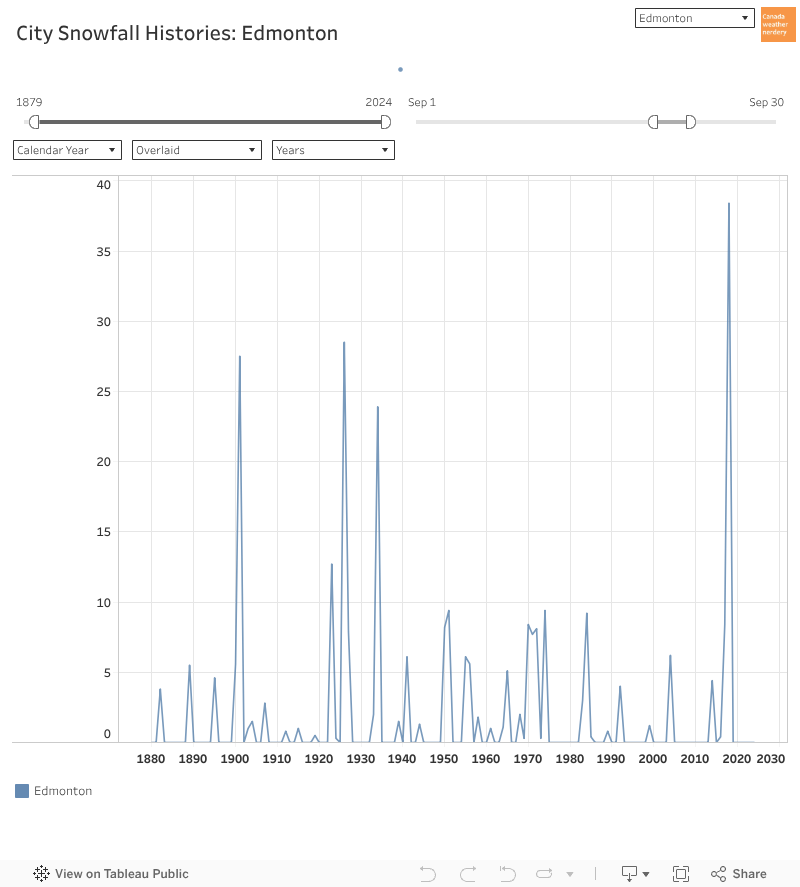
And September is a little snowier, with a record 38.4cm in 2018, and smaller snowfalls in 2014 & 2004.

In terms of snowy days, November-March average 8 or 9 of them, with January peaking at 10. For April it's 5, and October is 4.

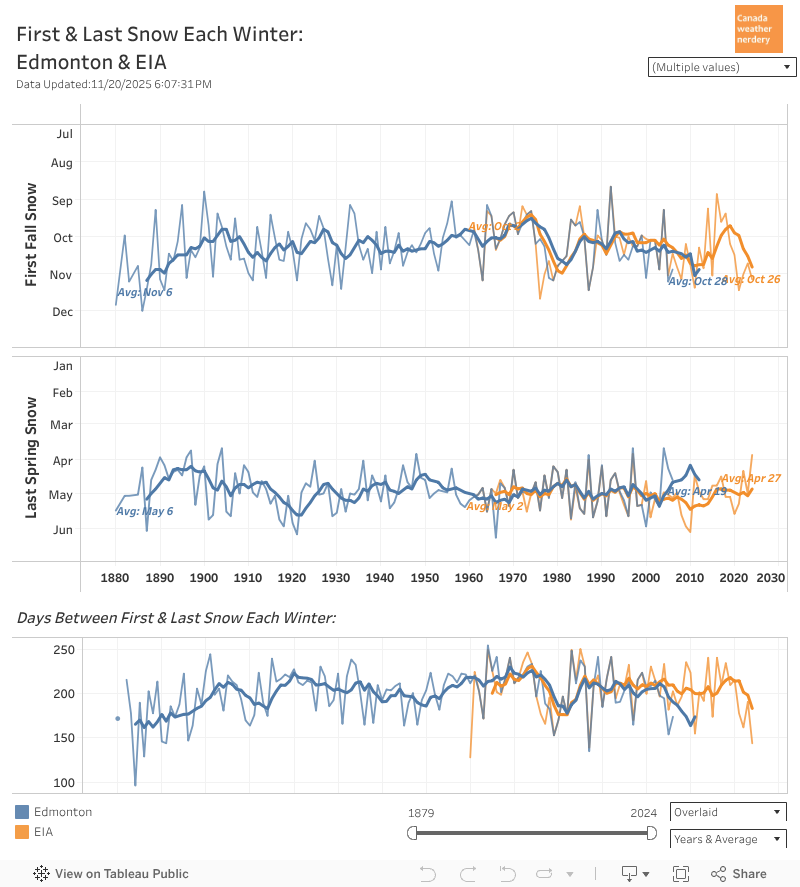
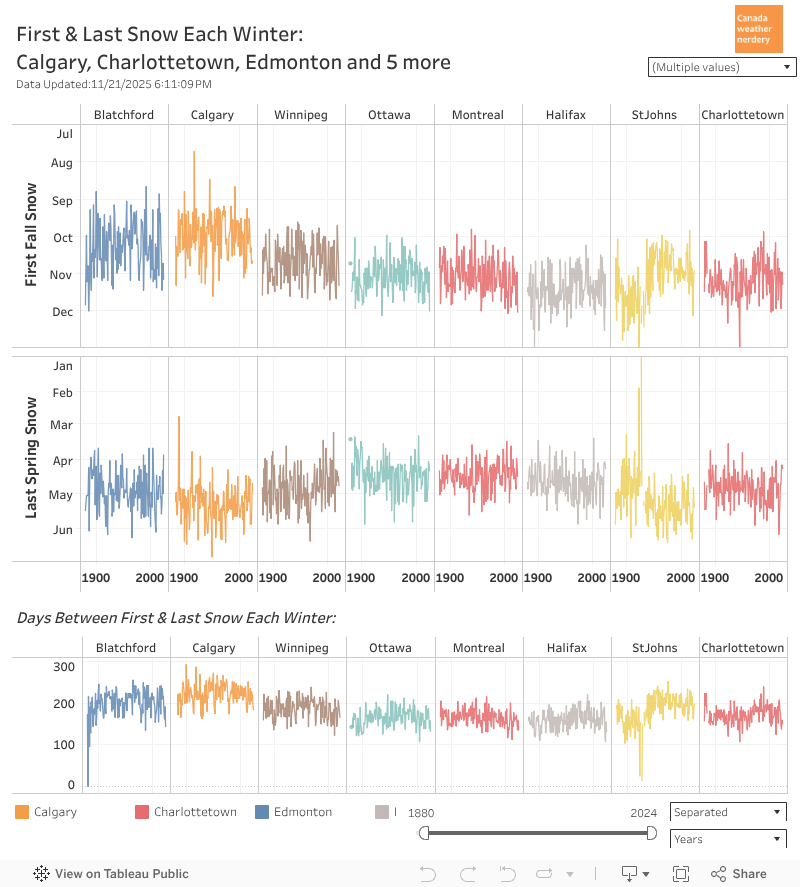
Historically our first fall snow has been around mid-October, although just the past few years are closer to the end of October.

The average final spring snowfall is around the end of April.

And so from the first snowfall of winter to the last we average right around 200 days.

So we get snowfall pretty consistently for November through April. Although some winters will have an early start, or a late end, or both.


Around Canada
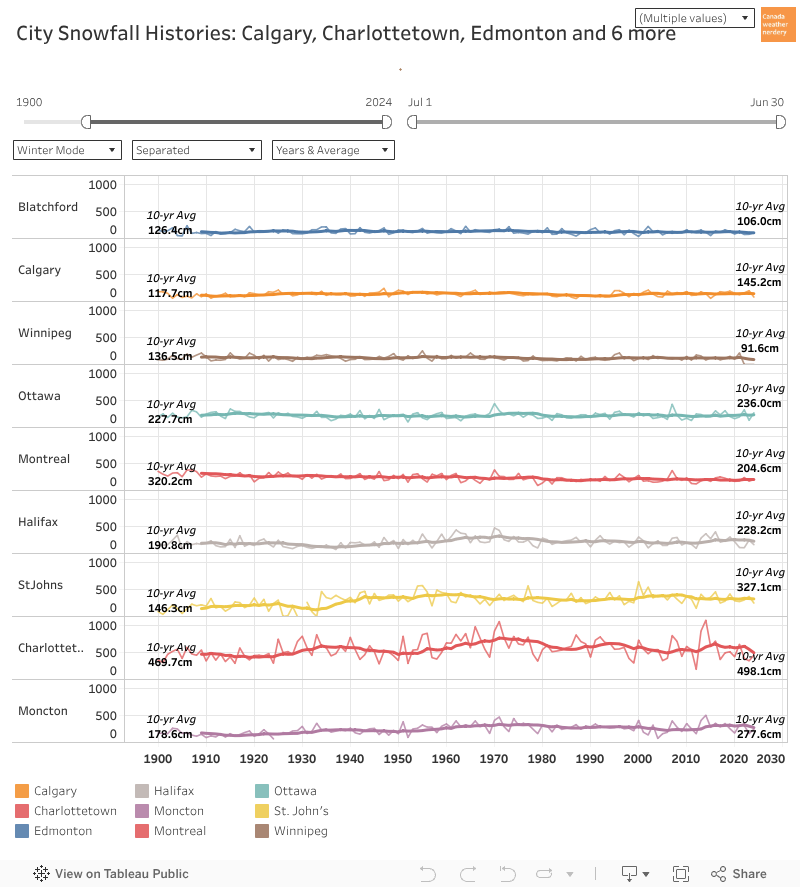
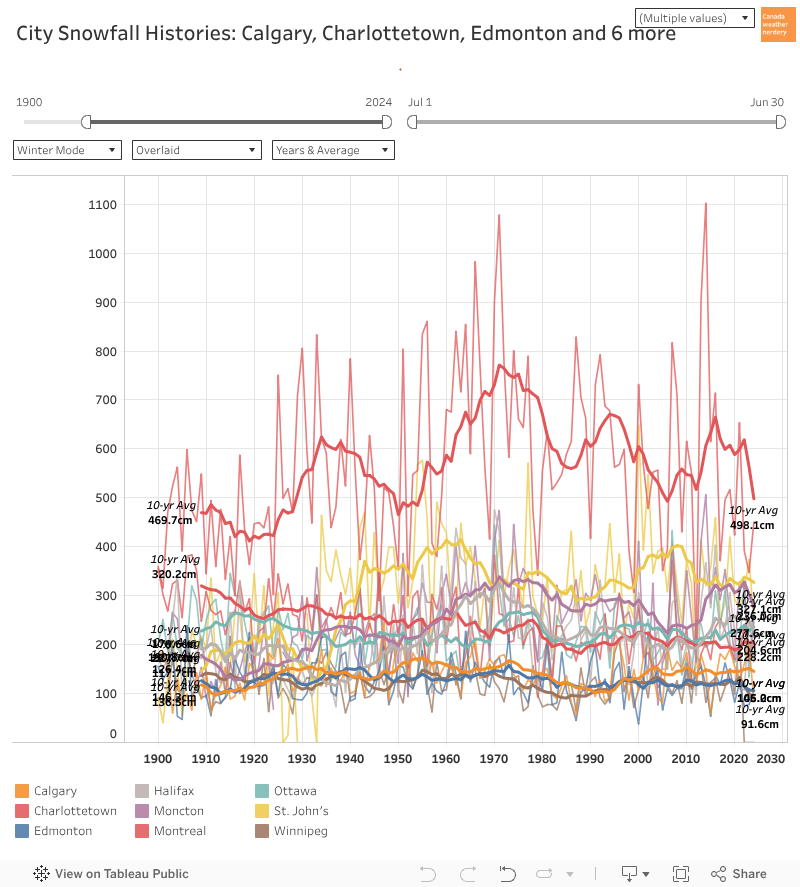
Of Canada's winter cities, Edmonton's 125cm of snow (or ~110cm recently) is actually near the bottom. 
Winnipeg doesn't record anymore, but was also around 120cm. And Calgary is around 145cm.

But the east coast cities are all over 200cm, and Charlottetown is near 500cm.

For most of these cities the snow totals have stayed pretty level over the years.

Montréal is the biggest exception, falling from 320cm down to 210cm. (St. John's saw a big jump in 1940, possibly due to a station move? But it's been flat since then)

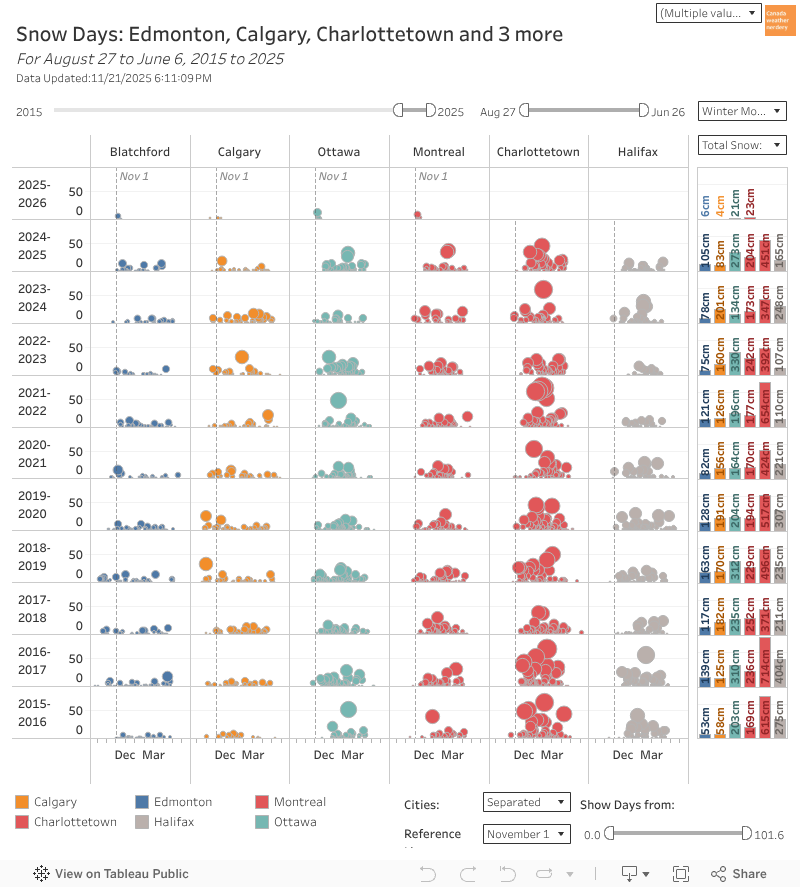
So Edmonton gets less snow than other cities, but we get it over a longer period of time.

We might go 200 days between first and last snowfalls, and Calgary is closer to 220.

But in central Canada and the east coast 150 days is more typical.

Compared to Edmonton, many of the other cities get a lot more snow over a much shorter period of time.


Big Storms
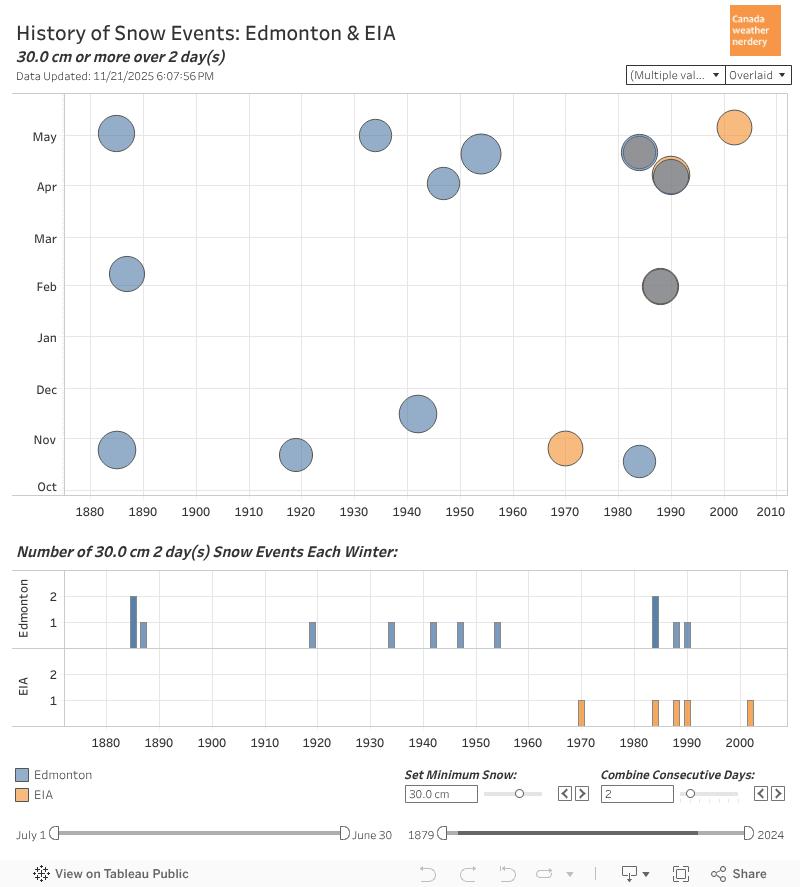
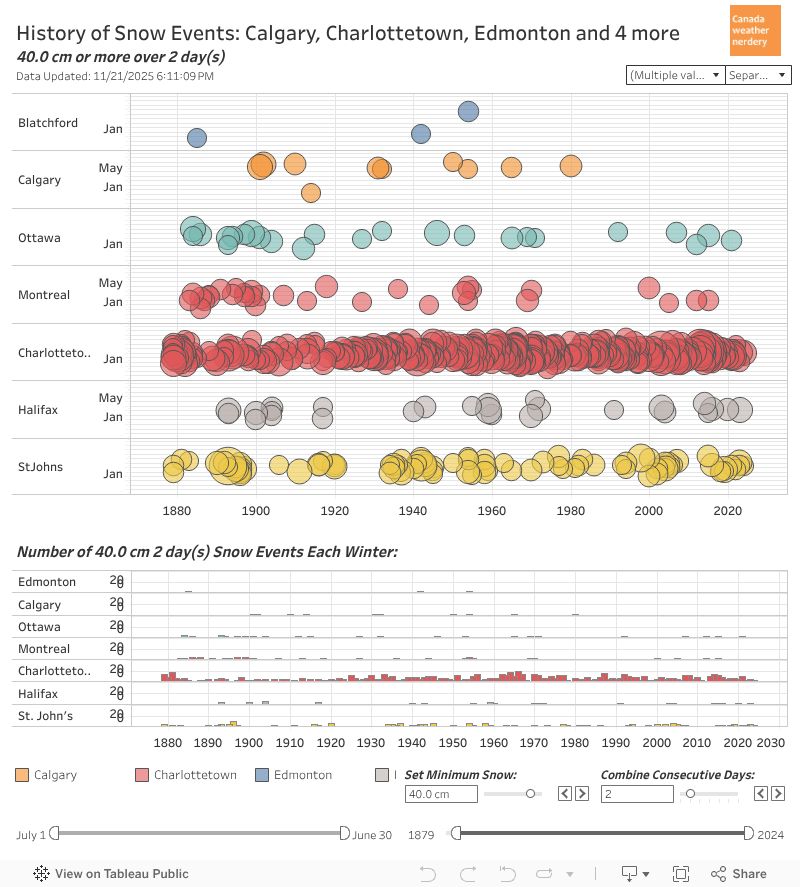
These bubbles are all of the 30cm+ storms (counting 2 consecutive days, to include snow that continues overnight).

There have only been 14 of them since 1880 at the two stations. 4 of those got to 40cm, with the largest on April 19-20 1955 with 46cm.

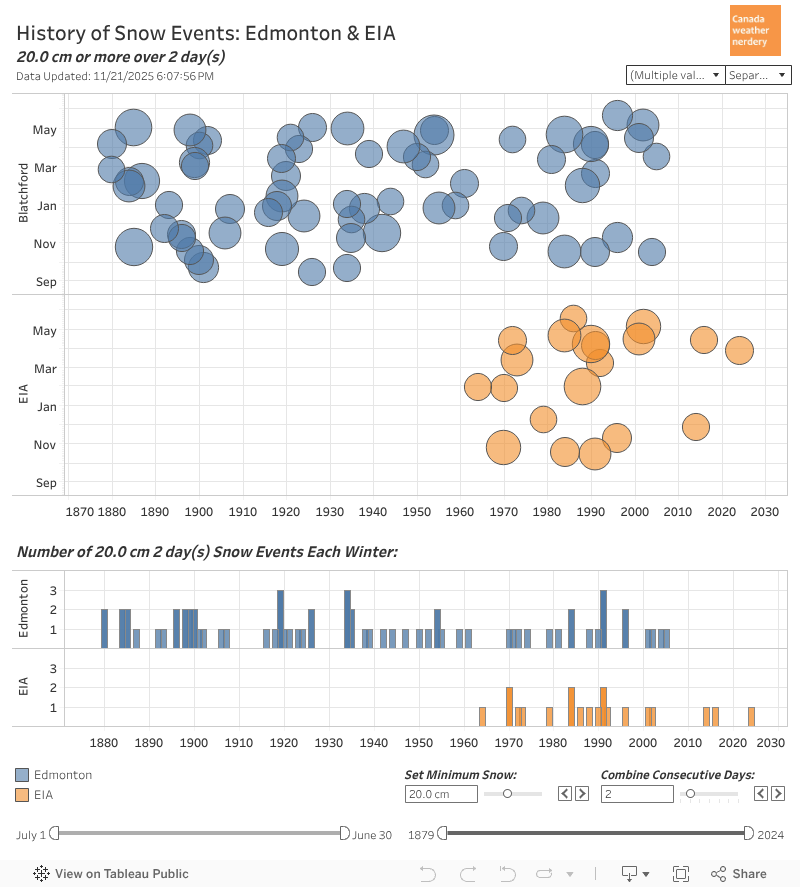
20cm 2-day storms only happen every few years, with the most recent March 27-28, 2025. 

For 10cm storms we'll get 1 or 2 per winter. 

And for 5cm storms it's 4~8.


Big Storms Across Canada
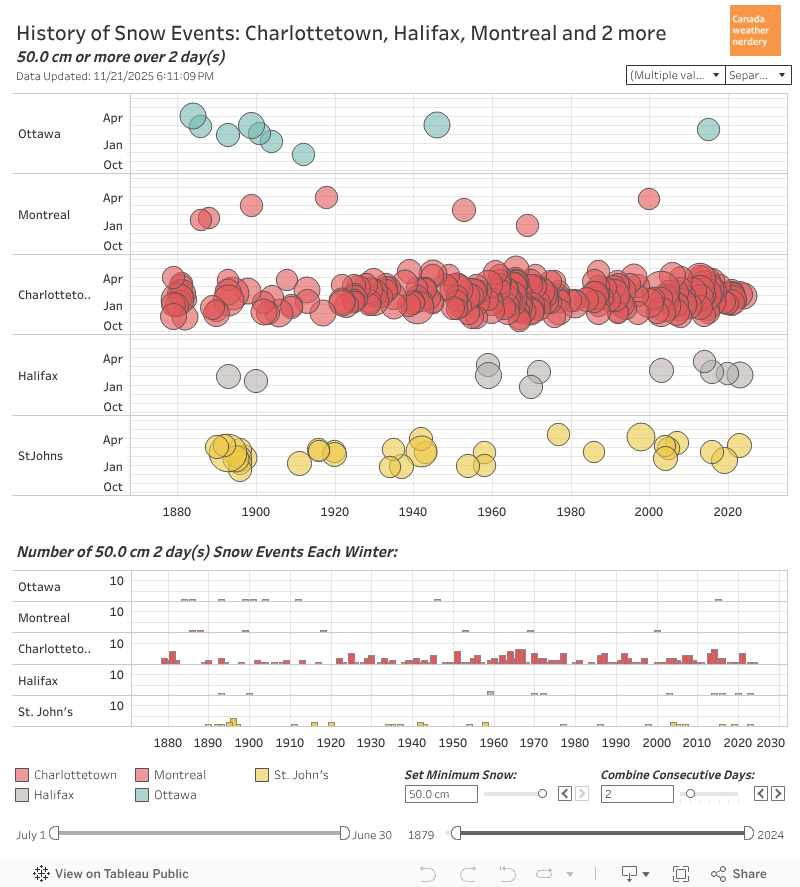
In 140+ years Edmonton has only had a handful of 40cm+ storms. Calgary has had a few more than that. Ottawa & Montréal got a lot before 1900, but now they're pretty rare. But Halifax still gets 1 in most winters, and Charlottetown gets a few every winter.

This is the 50cm+ 2-day storms for these cities. 

Charelottown's biggest on record was 153cm in 2004, and St. John's was close with 152cm. 

Ottawa & Halifax are both around 75cm, and Montréal's was 58cm.


Snowdepth
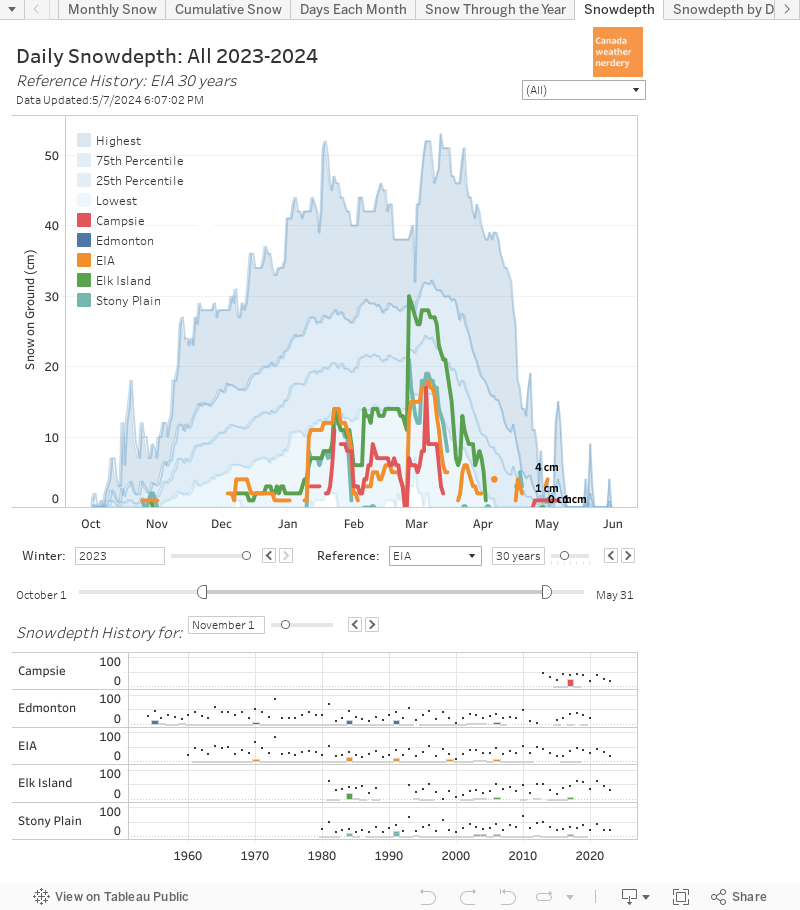
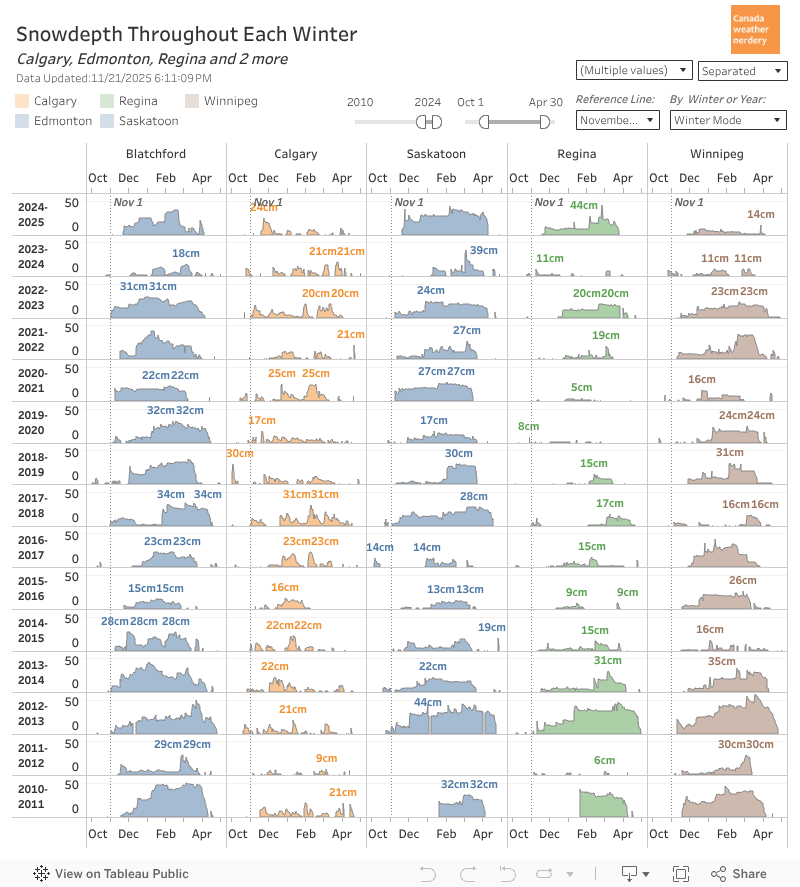
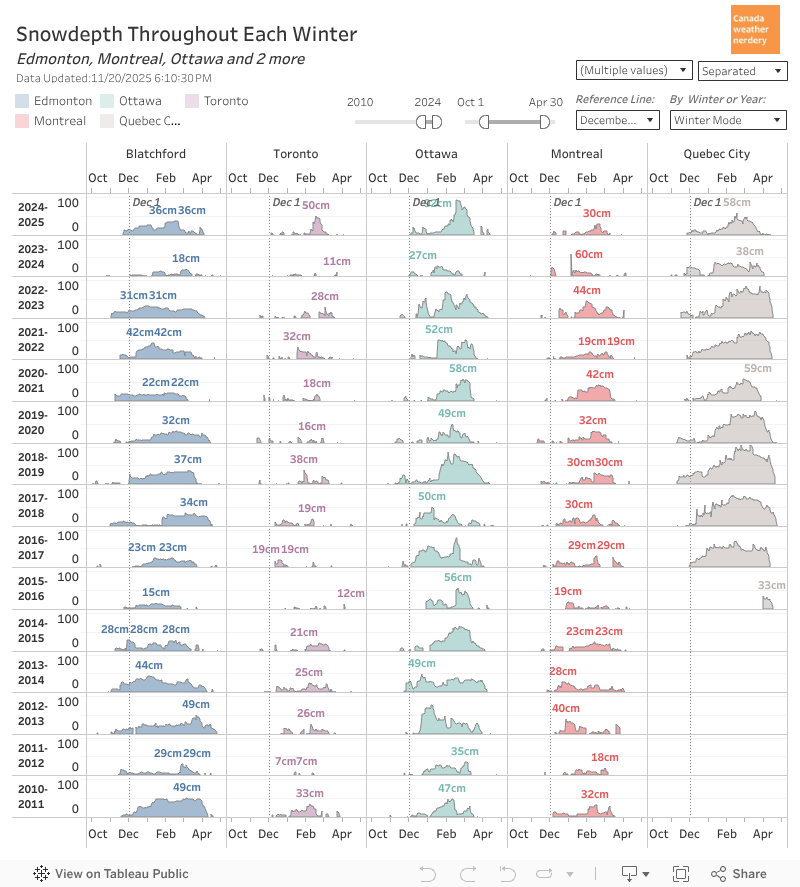
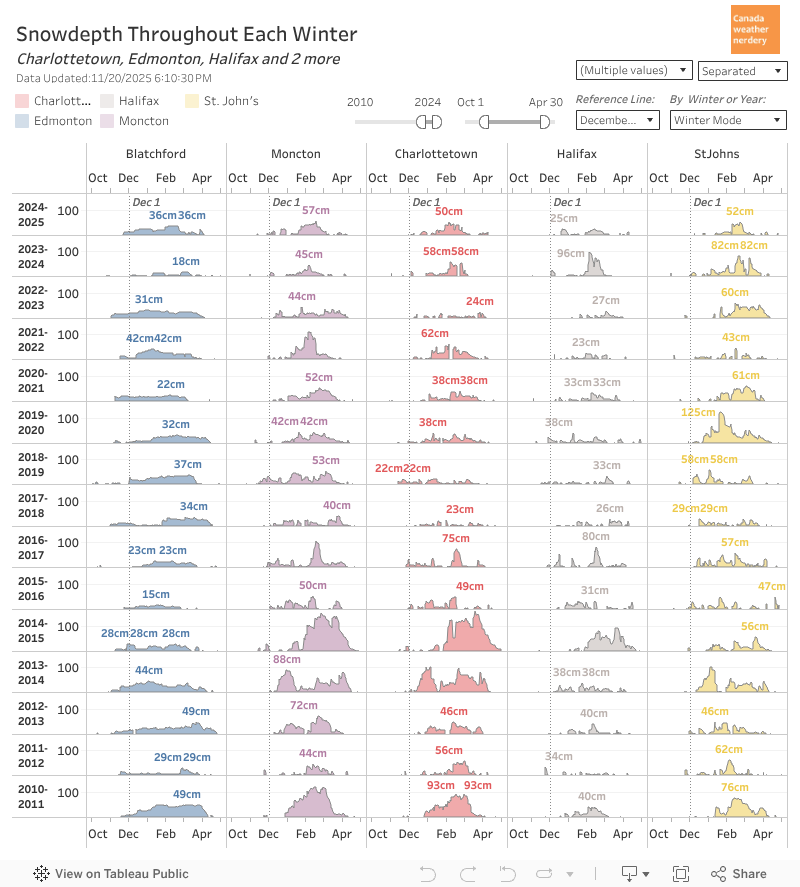
This shows the average and the range of our snowdepth throughout the winter.

It starts to climb around November 1st, and levels off at the end of February around 24cm. 

The big spring melt starts a week into March, and we (or at least the airport) are down to 0cm sometime in April.

Every winter is a little different though. When we do get early snow in Sep/Oct, it usually melts off. But after November 1st any snow that we get usually hangs around until spring.

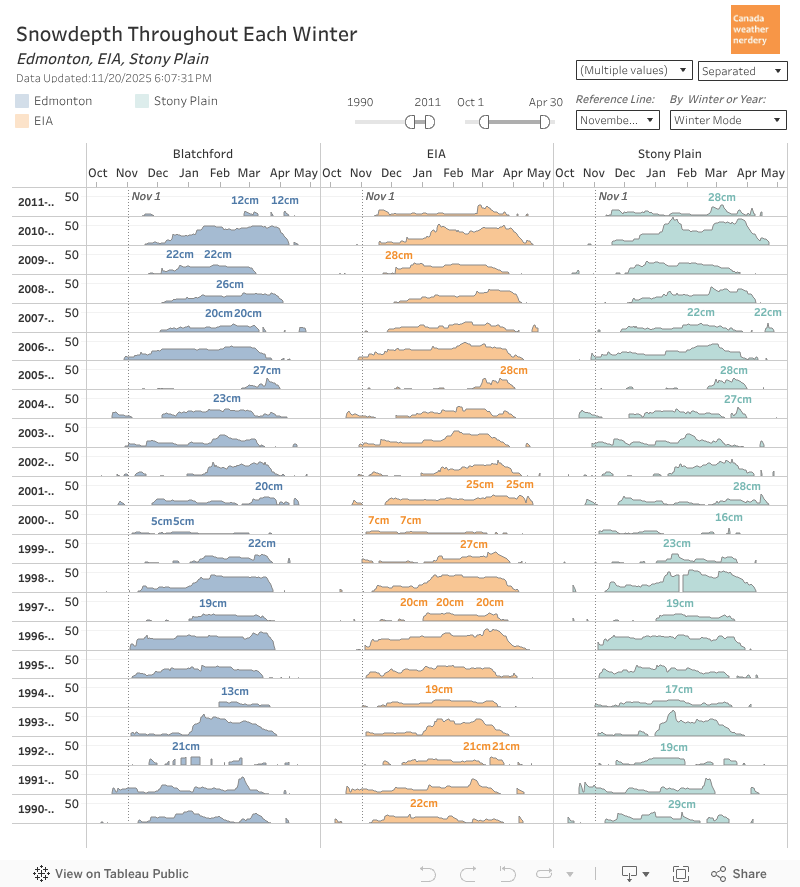
The outlying stations aren't a perfect proxy for the city, but they're not bad. Back when Blatchford did measure snowdepth it's numbers were maybe a little bit lower than the airport's, but it's still pretty close.

So far the winter of 2025-2026 is off to a pretty slow start for lasting snow. 2024 waited until November 22nd, and 2023 was December 3rd. But 2021, 2016, 2015, 2011 & 2010 also all waited until mid-November or later.

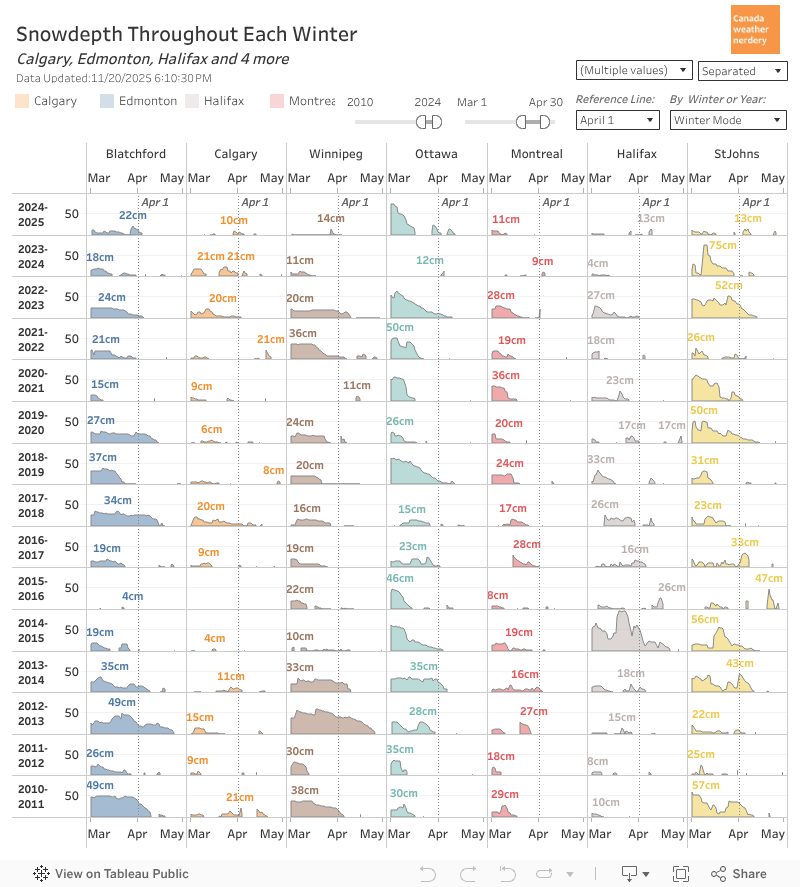
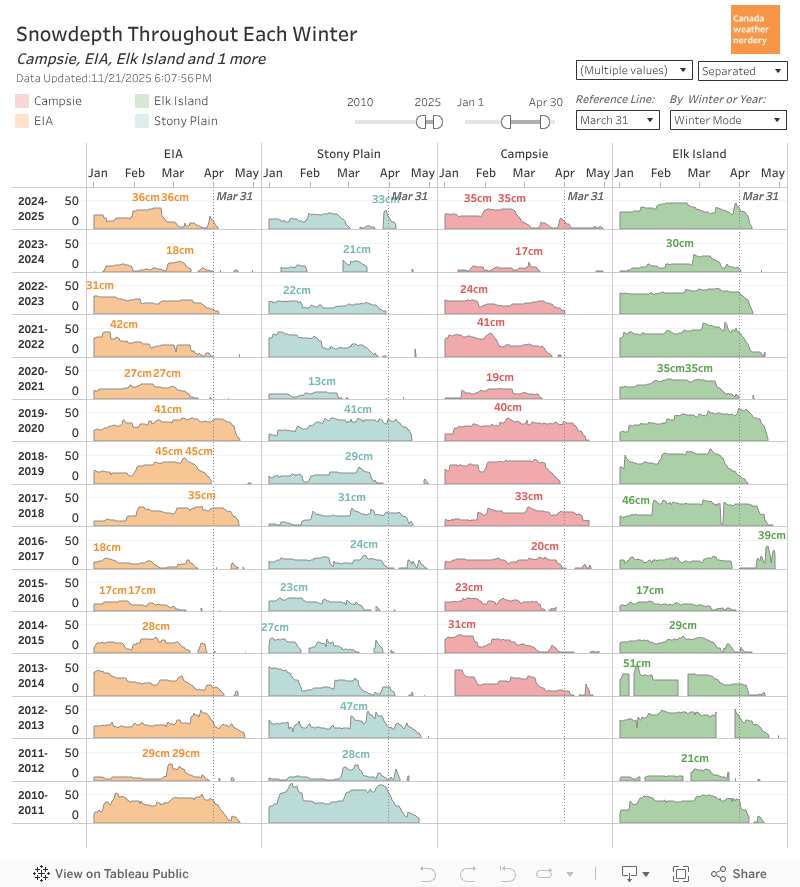
For the big spring melt we're often basically down to 0cm of snowdepth by the end of March, although sometimes a late snowfall will bump it up again temporarily.

Some recent late years were 2021 on April 21st, 2018 on April 20th, 2013 on April 25, and 2011 on April 21st.

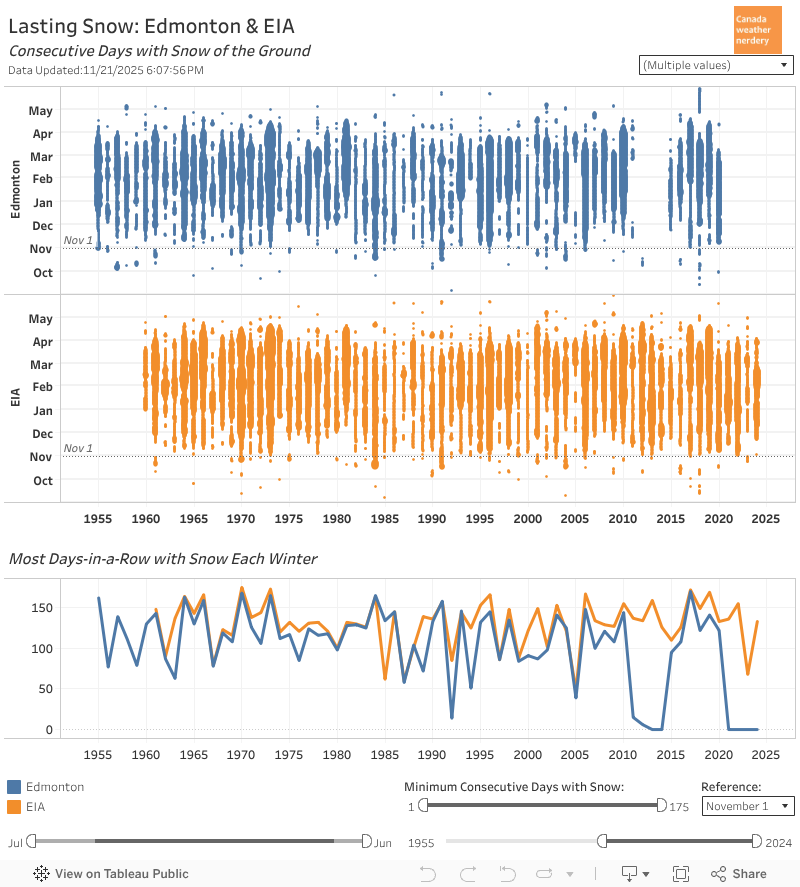
So we will usually have snow on the ground from mid-November to late-March, +/- two weeks on either end. On average that's around 130 days in-a-row. And that hasn't changed much since the 60s, and it wasn't too different between the city and the airport.


The Prairies
For comparison, Calgary is very different from us, with their frequent chinooks keeping the snowdepth low or zero for most of the winter.

Saskatoon, Regina & Winnipeg all tend to keep their snow, like Edmonton. But they also often start a few weeks after us.


Central Canada
Snowdepth in central Canada usually starts closer to the beginning of December. But where Edmonton usually peaks around 35cm, Ottawa & Quebec City will often get to 50cm, and sometimes up to 80cm or 90cm.


The East Coast
The east coast also gets started a month later than us, and gets melts throughout the winter. A lot of these years peak around 50cm. 

But St. John's got to 125cm in 2019-2020, and in 2014-2015 Moncton & Charlottetown both got above 150cm.


The Big Melt
In the fall Edmonton's snow gets started earlier than other cities. But for the big spring melt we're not that different. We can be snowfree by mid to late March, or we can drag into April. And that's true for a lot of places.


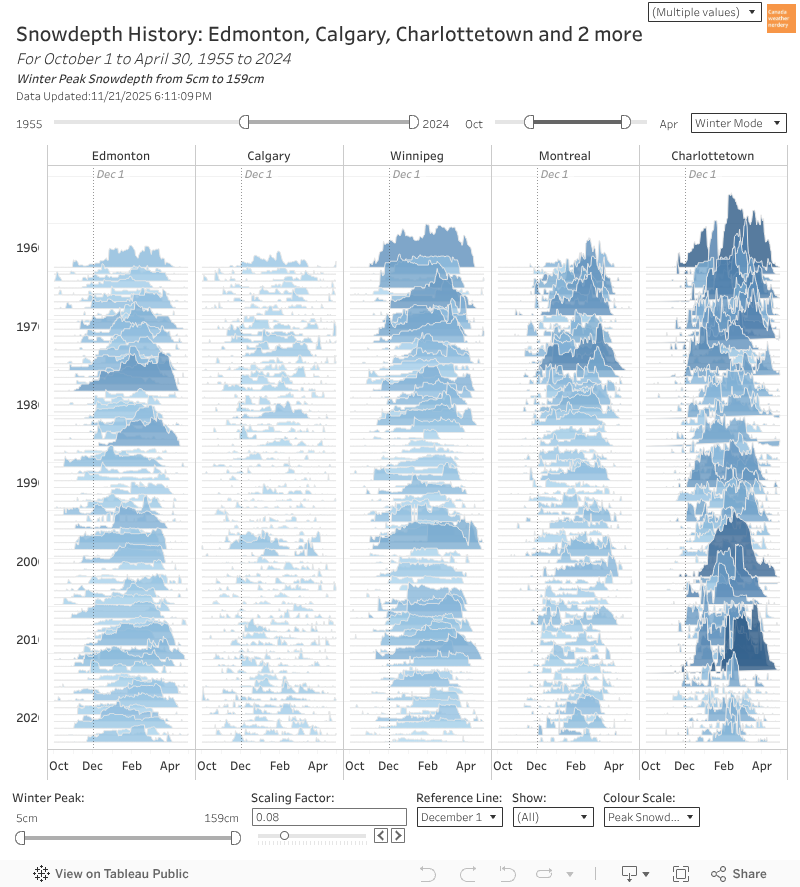
This is just a fun chart showing the full recorded history of snowdepths for a few stations. The darkest years are the ones with the highest peaks, and Charlottetown has a lot of them.


Winter Rain
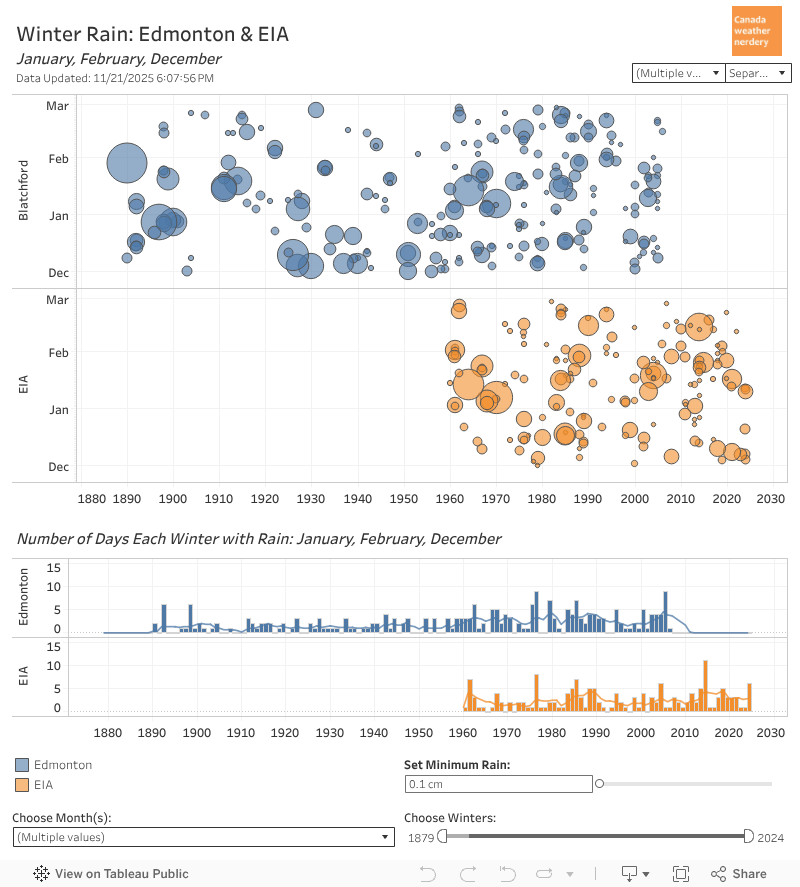
And finally, it always feels surprising when it happens, but winter rain is not actually completely rare in Edmonton. 

In December-February we average around 3 rainy days. 2024-2025 had 6 of them, and 2014-2015 had 11, while a lot of others only had 1 or 2.


And that brings us to the end of Part 2 of our look at Edmonton winters.