Fine, let's talk about snow removal.
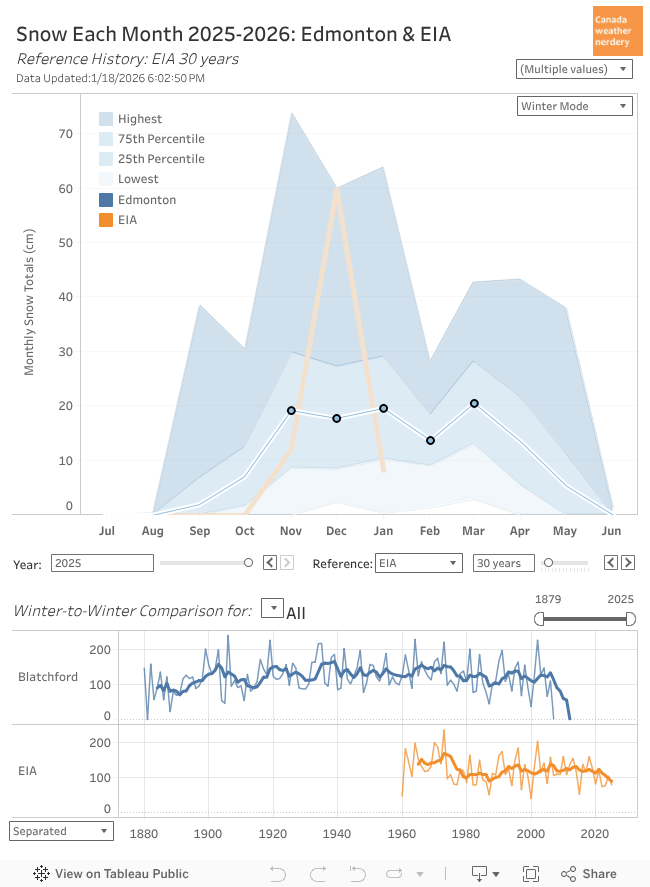

That was the airport's snowiest December on record. Although Blatchford got to 73cm in 1933, and 81.5cm in 1893.
 Ge got a few reasonable snowfalls in November and early December.
But from the 16th through the 26th we got the 44.3cm, which led to most of our problems.
That snow coincided with a long stretch of temperatures 10-15°C below average.
Also, the holidays.
 A 10cm storm is pretty big for us, and they tend to make a mess of things.
In a typical winter we will get 1 or 2 of them. 3 would be a big year.
A 10cm storm is pretty big for us, and they tend to make a mess of things.
In a typical winter we will get 1 or 2 of them. 3 would be a big year.
But December 2025 gave us 3 of those in the span of a week and a half.
 The bubbles here are snowfall totals for each month. (Blatchford used to record snow, but now it's just the airport)
December 2025's 59.9cm was the biggest month since January 2011.
Before that Blatchford had a snowy January 1999, and November 1996 was big for both.
 Here we've just got the 60cm months (well, 59.9cm) going back to 1880.
In that time the two stations have only had 19 of those.
They used to be a bit more common, but in "recent" history it's: 1960, 1974, 1982, 1994, 1996, 1999, 2011, 2025.
 Here we've just got the 40cm months, or 2x average.
In recent memory the only time that we've gotten 2 of those in-a-row was Nov-Dec 2013. Before that you need to go back to 1965.
So when we do get a big month, afterwards things are usually closer to average.
 And now, we get to the point of all of this.
In cities like Ottawa & Montréal the average snowfall in December-February is ~50cm per month.
So they get what we just got, but 3~ish months of it in-a-row, every winter.
 Here are the monthly bubbles for Edmonton, Ottawa & Montréal.
Edmonton has more bubbles, because our snow season is longer. But our bubbles are generally a lot smaller.
 Here we've got the 40cm & 60cm months.
In Ottawa & Montréal basically every winter gets at least 2 40cm months in a row.
And basically every winter gets at least 1 60cm month. Ottawa had 3 in-a-row in 2022-2023.
 For a bit more fun, these are 100cm months.
Since 2000 Montréal has had 2, and Ottawa has had 6.
Going back to the 1880s Edmonton has never had one, while before 1930 Ottawa often had more than 1 per year.
 Earlier we saw that Edmonton might get 1-2 10cm storms across a whole winter.
Ottawa & Montréal get a bunch more. They'll get 8 over a much shorter timeframe.
And 20cm might happen every few years around here, but they will get a few each winter.
 So you can't really compare Edmonton's snow to Montréal & Ottawa.
We average 120cm (a bit less in recent years) mostly spread across Nov-Mar (5 months), with a bit in the shoulder-season.
Ottawa & Montréal average 230cm & 200cm, mostly spread across Dec-Feb (3 months).
 But don't they get more melting than us, so the snow disappears?
Well actually, in December-February we average more 0°C and 5°C Highs than Ottawa & Montréal, and a lot more than Quebec City.
I don't know where their snow goes, but they definitely don't get to rely on chinooks.